Enhanced intragranular precipitation strengthening in Sc-microalloyed ultrafine-grained SiCp/Al-Cu-Mg composites via retrogression and re-ageing heat treatment
Yunpeng Cai, Kan Liu, Yiwei Dong, Andong Hua, Yishi Su, Qiubao Ouyang, Di Zhang
{"title":"Enhanced intragranular precipitation strengthening in Sc-microalloyed ultrafine-grained SiCp/Al-Cu-Mg composites via retrogression and re-ageing heat treatment","authors":"Yunpeng Cai, Kan Liu, Yiwei Dong, Andong Hua, Yishi Su, Qiubao Ouyang, Di Zhang","doi":"10.1016/j.matdes.2025.113789","DOIUrl":null,"url":null,"abstract":"<div><div>Ultrafine-grained Al matrix composites suffer from the insufficient dislocation accumulation capability and intragranular precipitation strengthening due to their length-scale dependent precipitation behaviors. In this work, a combination of Sc-microalloying and a retrogression and re-ageing (RRA) route was applied on the SiC<sub>p</sub>/Al-Cu-Mg composites to achieve well-balanced strength and ductility. Compared to the T6 treatment, RRA heat treatment exhibit a significant strengthening effect in Sc-microalloyed composites with only a slight loss in ductility. The yield strength and ultimate strength of the Sc-RRA samples reach up to 686.4 MPa and 734.5 MPa, respectively. The plastic deformation mechanism was analyzed by thermal activation analysis and TEM observation of deformed microstructure. The plastic deformation of UFG composites, both with and without Sc, is primarily governed by a dislocation-grain boundary interaction mechanism. As confirmed by the observed stacking faults, the Sc-microalloyed composite subjected to T6 treatment suffers from poor dislocation storge capacity and insufficient intragranular precipitation strengthening. In contrast, the RRA treatment promotes the formation of intragranular Al<sub>3</sub>Sc precipitates and GP zones, which improve the dislocation accumulation capability and precipitation strengthening of ultrafine-grained composites by pinning dislocations. This work provides an accessible pathway to exploit aluminum matrix composites with advanced strength-ductility balance.</div></div>","PeriodicalId":383,"journal":{"name":"Materials & Design","volume":"252 ","pages":"Article 113789"},"PeriodicalIF":7.9000,"publicationDate":"2025-03-01","publicationTypes":"Journal Article","fieldsOfStudy":null,"isOpenAccess":false,"openAccessPdf":"","citationCount":"0","resultStr":null,"platform":"Semanticscholar","paperid":null,"PeriodicalName":"Materials & Design","FirstCategoryId":"88","ListUrlMain":"https://www.sciencedirect.com/science/article/pii/S0264127525002096","RegionNum":2,"RegionCategory":"材料科学","ArticlePicture":[],"TitleCN":null,"AbstractTextCN":null,"PMCID":null,"EPubDate":"","PubModel":"","JCR":"Q1","JCRName":"MATERIALS SCIENCE, MULTIDISCIPLINARY","Score":null,"Total":0}
引用次数: 0
Abstract
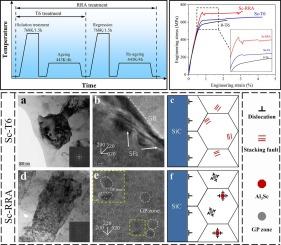
Ultrafine-grained Al matrix composites suffer from the insufficient dislocation accumulation capability and intragranular precipitation strengthening due to their length-scale dependent precipitation behaviors. In this work, a combination of Sc-microalloying and a retrogression and re-ageing (RRA) route was applied on the SiCp/Al-Cu-Mg composites to achieve well-balanced strength and ductility. Compared to the T6 treatment, RRA heat treatment exhibit a significant strengthening effect in Sc-microalloyed composites with only a slight loss in ductility. The yield strength and ultimate strength of the Sc-RRA samples reach up to 686.4 MPa and 734.5 MPa, respectively. The plastic deformation mechanism was analyzed by thermal activation analysis and TEM observation of deformed microstructure. The plastic deformation of UFG composites, both with and without Sc, is primarily governed by a dislocation-grain boundary interaction mechanism. As confirmed by the observed stacking faults, the Sc-microalloyed composite subjected to T6 treatment suffers from poor dislocation storge capacity and insufficient intragranular precipitation strengthening. In contrast, the RRA treatment promotes the formation of intragranular Al3Sc precipitates and GP zones, which improve the dislocation accumulation capability and precipitation strengthening of ultrafine-grained composites by pinning dislocations. This work provides an accessible pathway to exploit aluminum matrix composites with advanced strength-ductility balance.
期刊介绍:
Materials and Design is a multi-disciplinary journal that publishes original research reports, review articles, and express communications. The journal focuses on studying the structure and properties of inorganic and organic materials, advancements in synthesis, processing, characterization, and testing, the design of materials and engineering systems, and their applications in technology. It aims to bring together various aspects of materials science, engineering, physics, and chemistry.
The journal explores themes ranging from materials to design and aims to reveal the connections between natural and artificial materials, as well as experiment and modeling. Manuscripts submitted to Materials and Design should contain elements of discovery and surprise, as they often contribute new insights into the architecture and function of matter.



 京公网安备 11010802042870号
京ICP备2023020795号-1
京公网安备 11010802042870号
京ICP备2023020795号-1

 分享
分享
 求助内容:
求助内容: 应助结果提醒方式:
 扫码关注我们
