Roles of ohmic heating to achieve sustainable development goals in the food industry: From reduced energy consumption and resource optimization to innovative production pathways with reduced carbon footprint
{"title":"Roles of ohmic heating to achieve sustainable development goals in the food industry: From reduced energy consumption and resource optimization to innovative production pathways with reduced carbon footprint","authors":"Mohsen Gavahian , Natthaphon Chaosuan , Era Yusraini , Sudhir Sastry","doi":"10.1016/j.tifs.2025.104947","DOIUrl":null,"url":null,"abstract":"<div><h3>Background</h3><div>The Sustainable Development Goals (SDGs) adopted by the United Nations set targets to address global social, economic, and environmental issues. The food industry is crucial to achieving SDGs due to its impact on hunger, health, economic growth, and environmental sustainability. Conventional food processing falls short of these goals, necessitating alternative technologies, such as ohmic heating, a key technology capable of driving the food industry in a sustainable direction.</div></div><div><h3>Scope and approach</h3><div>This review aims to explain various aspects attained from the application of ohmic heating correlated with the SDGs.</div></div><div><h3>Key findings and conclusion</h3><div>Literature analysis shows that ohmic heating could significantly contribute to SDGs 2 (zero hunger), 3 (good health and well-being), 6 (clean water and sanitation), 7 (affordable and clean energy), 9 (industry, innovation, and infrastructure), 12 (responsible consumption and production), 13 (climate action), among other goals. These could be achieved because of the ohmic process's capability to increase the production yield (e.g., pectin by 8.9%; essential oil by 51.2%) and shelf-life (e.g., pasteurized milk by 1.7 times), produce healthier and more nutritious products (e.g., dried quince with 2 times phenolics), reduce food waste through valorization (e.g., transforming lemon peel to pectin and essential oil), enhance production infrastructure due to improved energy efficiency (e.g., 72.8% in evaporation process). Unique insights into ohmic heating's mechanistic principles, scalability challenges, and integration with other approaches (e.g., renewable energy systems and artificial intelligence) are presented. The review identifies critical research gaps and proposes a future research roadmap to improve its industrial applicability and expand its practical role in achieving SDGs.</div></div>","PeriodicalId":441,"journal":{"name":"Trends in Food Science & Technology","volume":"159 ","pages":"Article 104947"},"PeriodicalIF":15.4000,"publicationDate":"2025-02-27","publicationTypes":"Journal Article","fieldsOfStudy":null,"isOpenAccess":false,"openAccessPdf":"","citationCount":"0","resultStr":null,"platform":"Semanticscholar","paperid":null,"PeriodicalName":"Trends in Food Science & Technology","FirstCategoryId":"97","ListUrlMain":"https://www.sciencedirect.com/science/article/pii/S0924224425000834","RegionNum":1,"RegionCategory":"农林科学","ArticlePicture":[],"TitleCN":null,"AbstractTextCN":null,"PMCID":null,"EPubDate":"","PubModel":"","JCR":"Q1","JCRName":"FOOD SCIENCE & TECHNOLOGY","Score":null,"Total":0}
引用次数: 0
Abstract
Background
The Sustainable Development Goals (SDGs) adopted by the United Nations set targets to address global social, economic, and environmental issues. The food industry is crucial to achieving SDGs due to its impact on hunger, health, economic growth, and environmental sustainability. Conventional food processing falls short of these goals, necessitating alternative technologies, such as ohmic heating, a key technology capable of driving the food industry in a sustainable direction.
Scope and approach
This review aims to explain various aspects attained from the application of ohmic heating correlated with the SDGs.
Key findings and conclusion
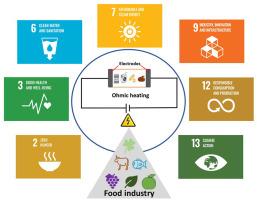
Literature analysis shows that ohmic heating could significantly contribute to SDGs 2 (zero hunger), 3 (good health and well-being), 6 (clean water and sanitation), 7 (affordable and clean energy), 9 (industry, innovation, and infrastructure), 12 (responsible consumption and production), 13 (climate action), among other goals. These could be achieved because of the ohmic process's capability to increase the production yield (e.g., pectin by 8.9%; essential oil by 51.2%) and shelf-life (e.g., pasteurized milk by 1.7 times), produce healthier and more nutritious products (e.g., dried quince with 2 times phenolics), reduce food waste through valorization (e.g., transforming lemon peel to pectin and essential oil), enhance production infrastructure due to improved energy efficiency (e.g., 72.8% in evaporation process). Unique insights into ohmic heating's mechanistic principles, scalability challenges, and integration with other approaches (e.g., renewable energy systems and artificial intelligence) are presented. The review identifies critical research gaps and proposes a future research roadmap to improve its industrial applicability and expand its practical role in achieving SDGs.
期刊介绍:
Trends in Food Science & Technology is a prestigious international journal that specializes in peer-reviewed articles covering the latest advancements in technology, food science, and human nutrition. It serves as a bridge between specialized primary journals and general trade magazines, providing readable and scientifically rigorous reviews and commentaries on current research developments and their potential applications in the food industry.
Unlike traditional journals, Trends in Food Science & Technology does not publish original research papers. Instead, it focuses on critical and comprehensive reviews to offer valuable insights for professionals in the field. By bringing together cutting-edge research and industry applications, this journal plays a vital role in disseminating knowledge and facilitating advancements in the food science and technology sector.



 京公网安备 11010802042870号
京ICP备2023020795号-1
京公网安备 11010802042870号
京ICP备2023020795号-1

 分享
分享
 求助内容:
求助内容: 应助结果提醒方式:
 扫码关注我们
