{"title":"Gradient all-nanostructured aerogel fibers for enhanced thermal insulation and mechanical properties","authors":"Xiaotong Fu, Lianmeng Si, Zhaoxin Zhang, Tingting Yang, Qichun Feng, Jianwei Song, Shuze Zhu, Dongdong Ye","doi":"10.1038/s41467-025-57646-4","DOIUrl":null,"url":null,"abstract":"<p>Lightweight, nanoporous aerogel fibers are crucial for personal thermal management and specialized heat protection. However, wet-spinning methods, exemplified by aramid aerogels, inevitably form a dense outer layer, significantly reducing the volume fraction of efficient thermal barrier nanovoids and limiting the development of ultimate thermal resistance in fibers. Herein, we develop a microfluidic spinning method to prepare gradient all-nanostructure aramid aerogel fibers (GAFs). Benefiting from the simultaneous shear alignment and diffusion dilution of a good solvent within the channels, the precursor gel fibers assemble into a structure with a sparse exterior and dense interior, which reverses during supercritical drying to form sheath and core layers with average pore diameters of 150 nm and 600 nm, respectively. Experiments and simulations reveal that the gradient nanostructure creates high interfacial thermal resistance at heat transfer interfaces, resulting in a radial thermal conductivity as low as 0.0228 W m<sup>–1</sup> K<sup>–1</sup>, far below that of air and wet-spun aerogel fibers. Moreover, GAF’s unique nano-entangled network efficiently dissipates stress, achieving exceptionally high tensile strength (29.5 MPa) and fracture strain (39.2%). This work establishes a correlation between multiscale nanostructures and superlative performance, thereby expanding the scope of aerogel applications in intricate environments.</p>","PeriodicalId":19066,"journal":{"name":"Nature Communications","volume":"158 1","pages":""},"PeriodicalIF":15.7000,"publicationDate":"2025-03-10","publicationTypes":"Journal Article","fieldsOfStudy":null,"isOpenAccess":false,"openAccessPdf":"","citationCount":"0","resultStr":null,"platform":"Semanticscholar","paperid":null,"PeriodicalName":"Nature Communications","FirstCategoryId":"103","ListUrlMain":"https://doi.org/10.1038/s41467-025-57646-4","RegionNum":1,"RegionCategory":"综合性期刊","ArticlePicture":[],"TitleCN":null,"AbstractTextCN":null,"PMCID":null,"EPubDate":"","PubModel":"","JCR":"Q1","JCRName":"MULTIDISCIPLINARY SCIENCES","Score":null,"Total":0}
引用次数: 0
Abstract
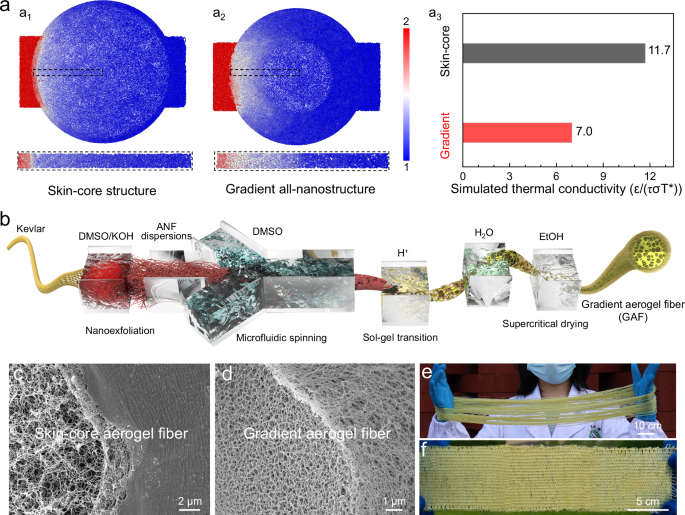
Lightweight, nanoporous aerogel fibers are crucial for personal thermal management and specialized heat protection. However, wet-spinning methods, exemplified by aramid aerogels, inevitably form a dense outer layer, significantly reducing the volume fraction of efficient thermal barrier nanovoids and limiting the development of ultimate thermal resistance in fibers. Herein, we develop a microfluidic spinning method to prepare gradient all-nanostructure aramid aerogel fibers (GAFs). Benefiting from the simultaneous shear alignment and diffusion dilution of a good solvent within the channels, the precursor gel fibers assemble into a structure with a sparse exterior and dense interior, which reverses during supercritical drying to form sheath and core layers with average pore diameters of 150 nm and 600 nm, respectively. Experiments and simulations reveal that the gradient nanostructure creates high interfacial thermal resistance at heat transfer interfaces, resulting in a radial thermal conductivity as low as 0.0228 W m–1 K–1, far below that of air and wet-spun aerogel fibers. Moreover, GAF’s unique nano-entangled network efficiently dissipates stress, achieving exceptionally high tensile strength (29.5 MPa) and fracture strain (39.2%). This work establishes a correlation between multiscale nanostructures and superlative performance, thereby expanding the scope of aerogel applications in intricate environments.
期刊介绍:
Nature Communications, an open-access journal, publishes high-quality research spanning all areas of the natural sciences. Papers featured in the journal showcase significant advances relevant to specialists in each respective field. With a 2-year impact factor of 16.6 (2022) and a median time of 8 days from submission to the first editorial decision, Nature Communications is committed to rapid dissemination of research findings. As a multidisciplinary journal, it welcomes contributions from biological, health, physical, chemical, Earth, social, mathematical, applied, and engineering sciences, aiming to highlight important breakthroughs within each domain.



 京公网安备 11010802042870号
京ICP备2023020795号-1
京公网安备 11010802042870号
京ICP备2023020795号-1

 分享
分享
 求助内容:
求助内容: 应助结果提醒方式:
 扫码关注我们
