A Theoretical Investigation on Pt(II) Complexes Consisting of 4-phenyl-1,2,3-triazole With Variant Linker Groups: Electronic Structures, Spectral Characters and Luminescence Mechanism
{"title":"A Theoretical Investigation on Pt(II) Complexes Consisting of 4-phenyl-1,2,3-triazole With Variant Linker Groups: Electronic Structures, Spectral Characters and Luminescence Mechanism","authors":"Dongting Huang, Pingjun Zhang, Jiannan Qin, Jingjie Tang, Fei Meng","doi":"10.1002/adts.202401146","DOIUrl":null,"url":null,"abstract":"<p>Square planar Pt(II) complexes are promising candidates for use as luminophores in organic light-emitting diodes (OLEDs). Recently, Wang et al. reported their findings on Pt(II) complexes that incorporate 4-phenyl-1,2,3-triazole with various linker groups (O, CH<sub>2</sub>, C═O). These compounds exhibit different spectral characteristics and distinct quantum yields (Φp). In this work, a theoretical investigation of related Pt(II) complexes is presented utilizing density functional theory (DFT) and time-dependent DFT (TD-DFT) methods. This research encompasses the study of geometric structure, electronic structure, spectral analysis, and luminescence mechanisms. Various wavefunction analysis techniques are employed, including frontier orbital analysis, charge decomposition analysis, excited state analysis, and reorganization energy calculations, etc. This study elucidates the effects of linker groups and systematically addresses the relationships between the structure and optical properties of platinum (Pt) complexes. This research provides deeper insights into the structure of Pt(II) complexes and paves the way for the design of novel phosphorescent emitters.</p>","PeriodicalId":7219,"journal":{"name":"Advanced Theory and Simulations","volume":"8 6","pages":""},"PeriodicalIF":2.9000,"publicationDate":"2025-03-10","publicationTypes":"Journal Article","fieldsOfStudy":null,"isOpenAccess":false,"openAccessPdf":"","citationCount":"0","resultStr":null,"platform":"Semanticscholar","paperid":null,"PeriodicalName":"Advanced Theory and Simulations","FirstCategoryId":"5","ListUrlMain":"https://advanced.onlinelibrary.wiley.com/doi/10.1002/adts.202401146","RegionNum":4,"RegionCategory":"工程技术","ArticlePicture":[],"TitleCN":null,"AbstractTextCN":null,"PMCID":null,"EPubDate":"","PubModel":"","JCR":"Q1","JCRName":"MULTIDISCIPLINARY SCIENCES","Score":null,"Total":0}
引用次数: 0
Abstract
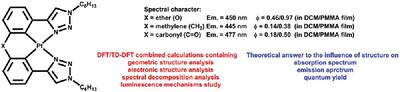
Square planar Pt(II) complexes are promising candidates for use as luminophores in organic light-emitting diodes (OLEDs). Recently, Wang et al. reported their findings on Pt(II) complexes that incorporate 4-phenyl-1,2,3-triazole with various linker groups (O, CH2, C═O). These compounds exhibit different spectral characteristics and distinct quantum yields (Φp). In this work, a theoretical investigation of related Pt(II) complexes is presented utilizing density functional theory (DFT) and time-dependent DFT (TD-DFT) methods. This research encompasses the study of geometric structure, electronic structure, spectral analysis, and luminescence mechanisms. Various wavefunction analysis techniques are employed, including frontier orbital analysis, charge decomposition analysis, excited state analysis, and reorganization energy calculations, etc. This study elucidates the effects of linker groups and systematically addresses the relationships between the structure and optical properties of platinum (Pt) complexes. This research provides deeper insights into the structure of Pt(II) complexes and paves the way for the design of novel phosphorescent emitters.
期刊介绍:
Advanced Theory and Simulations is an interdisciplinary, international, English-language journal that publishes high-quality scientific results focusing on the development and application of theoretical methods, modeling and simulation approaches in all natural science and medicine areas, including:
materials, chemistry, condensed matter physics
engineering, energy
life science, biology, medicine
atmospheric/environmental science, climate science
planetary science, astronomy, cosmology
method development, numerical methods, statistics



 京公网安备 11010802042870号
京ICP备2023020795号-1
京公网安备 11010802042870号
京ICP备2023020795号-1

 分享
分享
 求助内容:
求助内容: 应助结果提醒方式:
 扫码关注我们
