{"title":"Guidelines for MINFLUX Excitation Pattern Design","authors":"Nahuel Tarkowski, Fernando D. Stefani","doi":"10.1021/acsphotonics.5c00131","DOIUrl":null,"url":null,"abstract":"MINFLUX nanoscopy pushes the boundaries of optical resolution by localizing single fluorophores with minimal excitation, providing valuable new insight about the structures and functions of biological systems at the nanoscale. MINFLUX is based on registering the number of photons emitted by the target fluorophore when it is excited with a minimum of light sequentially displaced over a series of nearby positions, the so-called excitation pattern. Remarkably, while there are plenty of possible variations for the design of the excitation pattern, only a handful of them have been applied and evaluated. Here, we investigate the critical role of excitation pattern design in achieving high localization precision over the complete field of view and beyond. We demonstrate that the simultaneous cancellation of the spatial derivatives of the photon detection probabilities for each exposure to the excitation minimum leads to divergences in the localization error, and show various ways of solving this issue, like optimizing the number and position of measurement points or utilizing anisotropic excitation minima. These findings provide crucial guidelines for optimizing 3D MINFLUX experiments, enabling researchers to achieve the highest possible localization accuracy with minimal complexity and measurement time.","PeriodicalId":23,"journal":{"name":"ACS Photonics","volume":"33 1","pages":""},"PeriodicalIF":6.7000,"publicationDate":"2025-03-09","publicationTypes":"Journal Article","fieldsOfStudy":null,"isOpenAccess":false,"openAccessPdf":"","citationCount":"0","resultStr":null,"platform":"Semanticscholar","paperid":null,"PeriodicalName":"ACS Photonics","FirstCategoryId":"101","ListUrlMain":"https://doi.org/10.1021/acsphotonics.5c00131","RegionNum":1,"RegionCategory":"物理与天体物理","ArticlePicture":[],"TitleCN":null,"AbstractTextCN":null,"PMCID":null,"EPubDate":"","PubModel":"","JCR":"Q1","JCRName":"MATERIALS SCIENCE, MULTIDISCIPLINARY","Score":null,"Total":0}
引用次数: 0
Abstract
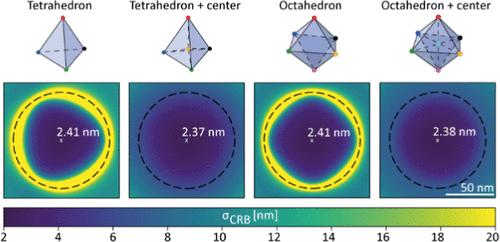
MINFLUX nanoscopy pushes the boundaries of optical resolution by localizing single fluorophores with minimal excitation, providing valuable new insight about the structures and functions of biological systems at the nanoscale. MINFLUX is based on registering the number of photons emitted by the target fluorophore when it is excited with a minimum of light sequentially displaced over a series of nearby positions, the so-called excitation pattern. Remarkably, while there are plenty of possible variations for the design of the excitation pattern, only a handful of them have been applied and evaluated. Here, we investigate the critical role of excitation pattern design in achieving high localization precision over the complete field of view and beyond. We demonstrate that the simultaneous cancellation of the spatial derivatives of the photon detection probabilities for each exposure to the excitation minimum leads to divergences in the localization error, and show various ways of solving this issue, like optimizing the number and position of measurement points or utilizing anisotropic excitation minima. These findings provide crucial guidelines for optimizing 3D MINFLUX experiments, enabling researchers to achieve the highest possible localization accuracy with minimal complexity and measurement time.
期刊介绍:
Published as soon as accepted and summarized in monthly issues, ACS Photonics will publish Research Articles, Letters, Perspectives, and Reviews, to encompass the full scope of published research in this field.



 京公网安备 11010802042870号
京ICP备2023020795号-1
京公网安备 11010802042870号
京ICP备2023020795号-1

 分享
分享
 求助内容:
求助内容: 应助结果提醒方式:
 扫码关注我们
