Shuwen Zhang, Gang Wang, Yangtian Jing, Shiguo Wei, Bin Wang, Qi Zhang, Youcai Xie, Chunlin Yin, Yufeng Zhou, Jie Zhang, Jinwei Chen, Ruilin Wang
{"title":"A Novel Sulfonated Polyimide Composite Membrane Containing Covalent Organic Frameworks for Iron–Chromium Redox Flow Battery Application","authors":"Shuwen Zhang, Gang Wang, Yangtian Jing, Shiguo Wei, Bin Wang, Qi Zhang, Youcai Xie, Chunlin Yin, Yufeng Zhou, Jie Zhang, Jinwei Chen, Ruilin Wang","doi":"10.1021/acs.iecr.4c04715","DOIUrl":null,"url":null,"abstract":"Iron–chromium redox flow batteries (ICRFB), as the pioneering technology in flow battery energy storage, have regained research attention with advancements in the field. Despite their significant cost advantage, the capacity degradation due to ion crossover through ion exchange membranes remains a major barrier to commercialization. In addition, there are relatively few types of nonfluorinated ion exchange membrane materials currently reported in ICRFB. Herein, covalent organic frameworks, sulfonated Schiff base network type (SSNW), were introduced into sulfonated polyimide (SPI) to prepare a novel SPI/SSNW composite membrane for ICRFB. The hydrogen bonding network formed by the −SO<sub>3</sub>H group in SPI and SSNW, with the fluorine atoms in SPI and the nitrogen atoms in SSNW, as well as the size exclusion effect of the SSNW, effectively hinder the permeation of Cr<sup>3+</sup> and Fe<sup>3+</sup>, which was further analyzed by electrostatic potential calculation. Single-cell performance tests revealed that ICRFB equipped with SPI/SSNW-1% membrane achieved 93.96% Coulombic efficiency and 76.40% energy efficiency at 80 mA cm<sup>–2</sup>. Compared with the Nafion212 membrane, the SPI/SSNW-1% membrane exhibited 17.74% higher capacity retention over 50 cycles. These results demonstrate that optimized sulfonated polyimide composite membranes are promising candidates for ICRFB applications.","PeriodicalId":39,"journal":{"name":"Industrial & Engineering Chemistry Research","volume":"17 1","pages":""},"PeriodicalIF":3.9000,"publicationDate":"2025-03-09","publicationTypes":"Journal Article","fieldsOfStudy":null,"isOpenAccess":false,"openAccessPdf":"","citationCount":"0","resultStr":null,"platform":"Semanticscholar","paperid":null,"PeriodicalName":"Industrial & Engineering Chemistry Research","FirstCategoryId":"5","ListUrlMain":"https://doi.org/10.1021/acs.iecr.4c04715","RegionNum":3,"RegionCategory":"工程技术","ArticlePicture":[],"TitleCN":null,"AbstractTextCN":null,"PMCID":null,"EPubDate":"","PubModel":"","JCR":"Q2","JCRName":"ENGINEERING, CHEMICAL","Score":null,"Total":0}
引用次数: 0
Abstract
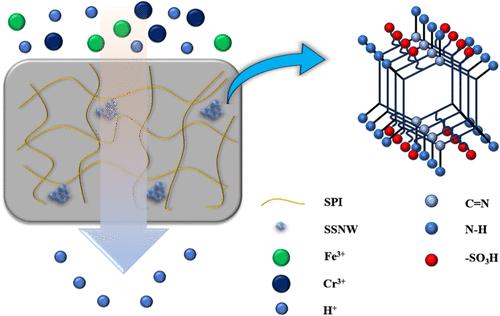
Iron–chromium redox flow batteries (ICRFB), as the pioneering technology in flow battery energy storage, have regained research attention with advancements in the field. Despite their significant cost advantage, the capacity degradation due to ion crossover through ion exchange membranes remains a major barrier to commercialization. In addition, there are relatively few types of nonfluorinated ion exchange membrane materials currently reported in ICRFB. Herein, covalent organic frameworks, sulfonated Schiff base network type (SSNW), were introduced into sulfonated polyimide (SPI) to prepare a novel SPI/SSNW composite membrane for ICRFB. The hydrogen bonding network formed by the −SO3H group in SPI and SSNW, with the fluorine atoms in SPI and the nitrogen atoms in SSNW, as well as the size exclusion effect of the SSNW, effectively hinder the permeation of Cr3+ and Fe3+, which was further analyzed by electrostatic potential calculation. Single-cell performance tests revealed that ICRFB equipped with SPI/SSNW-1% membrane achieved 93.96% Coulombic efficiency and 76.40% energy efficiency at 80 mA cm–2. Compared with the Nafion212 membrane, the SPI/SSNW-1% membrane exhibited 17.74% higher capacity retention over 50 cycles. These results demonstrate that optimized sulfonated polyimide composite membranes are promising candidates for ICRFB applications.
铁铬氧化还原液流电池(ICRFB)作为液流电池储能的前沿技术,随着该领域的研究进展,重新引起了人们的关注。尽管它们具有显著的成本优势,但由于离子通过离子交换膜交叉而导致的容量下降仍然是商业化的主要障碍。此外,ICRFB目前报道的非氟离子交换膜材料种类相对较少。本文将磺化席夫碱网络型(SSNW)共价有机骨架引入磺化聚酰亚胺(SPI)中,制备了一种新型的SPI/SSNW复合膜。SPI和SSNW中的−SO3H基团与SPI中的氟原子和SSNW中的氮原子形成的氢键网络,以及SSNW的尺寸排斥效应,有效地阻碍了Cr3+和Fe3+的渗透,通过静电势计算进一步分析了这一点。单电池性能测试表明,在80 mA cm-2下,配置SPI/SSNW-1%膜的ICRFB库仑效率为93.96%,能量效率为76.40%。与Nafion212膜相比,SPI/SSNW-1%的膜在50次循环中的容量保留率提高了17.74%。这些结果表明,优化的磺化聚酰亚胺复合膜是ICRFB应用的有希望的候选者。
期刊介绍:
ndustrial & Engineering Chemistry, with variations in title and format, has been published since 1909 by the American Chemical Society. Industrial & Engineering Chemistry Research is a weekly publication that reports industrial and academic research in the broad fields of applied chemistry and chemical engineering with special focus on fundamentals, processes, and products.



 京公网安备 11010802042870号
京ICP备2023020795号-1
京公网安备 11010802042870号
京ICP备2023020795号-1

 分享
分享
 求助内容:
求助内容: 应助结果提醒方式:
 扫码关注我们
