Jaehui Kim, Jaewang Park, Gwisu Kim, Weidong Xu, Samuel D Stranks, Hanul Min, Sang Il Seok
{"title":"Quasi-2D Scaffolding for Enhanced Stability and Efficiency in 1.67 eV Cs-Rich Pure-Iodide Perovskite Solar Cells","authors":"Jaehui Kim, Jaewang Park, Gwisu Kim, Weidong Xu, Samuel D Stranks, Hanul Min, Sang Il Seok","doi":"10.1002/smll.202500197","DOIUrl":null,"url":null,"abstract":"<p>Cesium lead triiodide (CsPbI<sub>3</sub>) perovskitesare promising candidates for top cells in tandem solar cells owing to their superior thermal and photostability. However, their practical application is hindered by poor phase stability, as CsPbI<sub>3</sub> readily converts from the perovskite phase to the non-perovskite phase. To improve both phase stability and efficiency without significantly altering the bandgap, some fraction of formamidinium (FA<sup>+</sup>) is introduced into CsPbI<sub>3</sub>. This study demonstrates that a quasi-2D perovskite intermediate effectively modulates the crystallization process and improves the film quality of Cs-rich, pure-iodide wide-bandgap perovskites, leading to a significant enhancement in open-circuit voltage (V<sub>OC</sub>). Propylphenylammonium chloride (PPACl) facilitates the formation of a quasi-2D PPA<sub>2</sub>(Cs<sub>x</sub>FA<sub>1-x</sub>)<sub>n−1</sub>Pb<sub>n</sub>I<sub>3n+1</sub> phase, which acts as a scaffold to promote the oriented crystallization of 3D perovskites. This quasi-2D intermediate can mitigate structural distortion in the perovskite lattice by alleviating lattice mismatch, typically associated with the dimethylammonium lead triiodide (DMAPbI<sub>3</sub>) to final α-phase transition. Thus, the approach enhances crystallinity and morphology, reducing defect density and V<sub>OC</sub> loss in the 3D perovskite. Consequently, the optimized Cs<sub>0.7</sub>FA<sub>0.3</sub>PbI<sub>3</sub> perovskite solar cells (PSCs) achieve a power conversion efficiency of 21.42%, marking one of the highest efficiencies reported for Cs-rich wide-bandgap PSCs under standard AM 1.5 G illumination.</p>","PeriodicalId":228,"journal":{"name":"Small","volume":"21 16","pages":""},"PeriodicalIF":12.1000,"publicationDate":"2025-03-10","publicationTypes":"Journal Article","fieldsOfStudy":null,"isOpenAccess":false,"openAccessPdf":"https://onlinelibrary.wiley.com/doi/epdf/10.1002/smll.202500197","citationCount":"0","resultStr":null,"platform":"Semanticscholar","paperid":null,"PeriodicalName":"Small","FirstCategoryId":"88","ListUrlMain":"https://onlinelibrary.wiley.com/doi/10.1002/smll.202500197","RegionNum":2,"RegionCategory":"材料科学","ArticlePicture":[],"TitleCN":null,"AbstractTextCN":null,"PMCID":null,"EPubDate":"","PubModel":"","JCR":"Q1","JCRName":"CHEMISTRY, MULTIDISCIPLINARY","Score":null,"Total":0}
引用次数: 0
Abstract
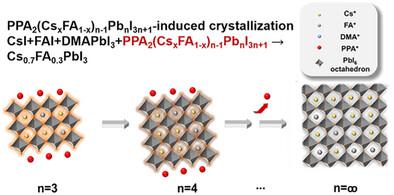
Cesium lead triiodide (CsPbI3) perovskitesare promising candidates for top cells in tandem solar cells owing to their superior thermal and photostability. However, their practical application is hindered by poor phase stability, as CsPbI3 readily converts from the perovskite phase to the non-perovskite phase. To improve both phase stability and efficiency without significantly altering the bandgap, some fraction of formamidinium (FA+) is introduced into CsPbI3. This study demonstrates that a quasi-2D perovskite intermediate effectively modulates the crystallization process and improves the film quality of Cs-rich, pure-iodide wide-bandgap perovskites, leading to a significant enhancement in open-circuit voltage (VOC). Propylphenylammonium chloride (PPACl) facilitates the formation of a quasi-2D PPA2(CsxFA1-x)n−1PbnI3n+1 phase, which acts as a scaffold to promote the oriented crystallization of 3D perovskites. This quasi-2D intermediate can mitigate structural distortion in the perovskite lattice by alleviating lattice mismatch, typically associated with the dimethylammonium lead triiodide (DMAPbI3) to final α-phase transition. Thus, the approach enhances crystallinity and morphology, reducing defect density and VOC loss in the 3D perovskite. Consequently, the optimized Cs0.7FA0.3PbI3 perovskite solar cells (PSCs) achieve a power conversion efficiency of 21.42%, marking one of the highest efficiencies reported for Cs-rich wide-bandgap PSCs under standard AM 1.5 G illumination.
期刊介绍:
Small serves as an exceptional platform for both experimental and theoretical studies in fundamental and applied interdisciplinary research at the nano- and microscale. The journal offers a compelling mix of peer-reviewed Research Articles, Reviews, Perspectives, and Comments.
With a remarkable 2022 Journal Impact Factor of 13.3 (Journal Citation Reports from Clarivate Analytics, 2023), Small remains among the top multidisciplinary journals, covering a wide range of topics at the interface of materials science, chemistry, physics, engineering, medicine, and biology.
Small's readership includes biochemists, biologists, biomedical scientists, chemists, engineers, information technologists, materials scientists, physicists, and theoreticians alike.




 京公网安备 11010802042870号
京ICP备2023020795号-1
京公网安备 11010802042870号
京ICP备2023020795号-1

 分享
分享
 求助内容:
求助内容: 应助结果提醒方式:
 扫码关注我们
