Qin Ye, Daohui Chen, Ziying Zhao, Hongjie Yan, Meijie Chen
{"title":"Adhesive Hydrogel Paint for Passive Heat Dissipation via Radiative Coupled Evaporation Cooling","authors":"Qin Ye, Daohui Chen, Ziying Zhao, Hongjie Yan, Meijie Chen","doi":"10.1002/smll.202412221","DOIUrl":null,"url":null,"abstract":"<p>Passive cooling technologies have shown great interest recently due to their free electricity, especially for radiative cooling (RC), and evaporation cooling (EC). While single-mode passive cooling is often limited by environmental conditions, such as sunlight, clouds, and humidity, resulting in a limited cooling performance. To address these issues, an adhesive hydrogel paint is designed for passive heat dissipation in the daytime or high workload via radiative coupled evaporation cooling (REC), which also can realize water self-replenishment at night or low workload by RC-assisted adsorption for moisture capture. Solar reflectance <span></span><math>\n <semantics>\n <msub>\n <mover>\n <mi>R</mi>\n <mo>¯</mo>\n </mover>\n <mi>solar</mi>\n </msub>\n <annotation>${{\\bar{R}}_{{\\mathrm{solar}}}}$</annotation>\n </semantics></math> = 0.91 and thermal emittance <span></span><math>\n <semantics>\n <msub>\n <mover>\n <mi>ε</mi>\n <mo>¯</mo>\n </mover>\n <mi>LWIR</mi>\n </msub>\n <annotation>${{\\bar{\\varepsilon }}_{{\\mathrm{LWIR}}}}$</annotation>\n </semantics></math> = 0.94 are obtained for RC. Excellent passive heat dissipation performance can be achieved by painting it on the 3D W-shaped substrate. Compared with the flat RC paint, the REC paint on a W-shape substrate achieves a temperature drop of 5.4 °C at the heating density of 100 W m<sup>−2</sup>, which is further increased to 11.4 °C at 400 W m<sup>−2</sup> due to multi-passive cooling strategies. This structural and material design provides a potential adhesive hydrogel paint for outdoor passive heat dissipation.</p>","PeriodicalId":228,"journal":{"name":"Small","volume":"21 17","pages":""},"PeriodicalIF":12.1000,"publicationDate":"2025-03-10","publicationTypes":"Journal Article","fieldsOfStudy":null,"isOpenAccess":false,"openAccessPdf":"","citationCount":"0","resultStr":null,"platform":"Semanticscholar","paperid":null,"PeriodicalName":"Small","FirstCategoryId":"88","ListUrlMain":"https://onlinelibrary.wiley.com/doi/10.1002/smll.202412221","RegionNum":2,"RegionCategory":"材料科学","ArticlePicture":[],"TitleCN":null,"AbstractTextCN":null,"PMCID":null,"EPubDate":"","PubModel":"","JCR":"Q1","JCRName":"CHEMISTRY, MULTIDISCIPLINARY","Score":null,"Total":0}
引用次数: 0
Abstract
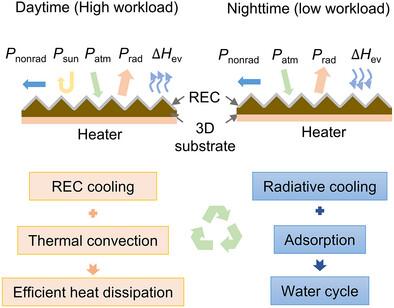
Passive cooling technologies have shown great interest recently due to their free electricity, especially for radiative cooling (RC), and evaporation cooling (EC). While single-mode passive cooling is often limited by environmental conditions, such as sunlight, clouds, and humidity, resulting in a limited cooling performance. To address these issues, an adhesive hydrogel paint is designed for passive heat dissipation in the daytime or high workload via radiative coupled evaporation cooling (REC), which also can realize water self-replenishment at night or low workload by RC-assisted adsorption for moisture capture. Solar reflectance = 0.91 and thermal emittance = 0.94 are obtained for RC. Excellent passive heat dissipation performance can be achieved by painting it on the 3D W-shaped substrate. Compared with the flat RC paint, the REC paint on a W-shape substrate achieves a temperature drop of 5.4 °C at the heating density of 100 W m−2, which is further increased to 11.4 °C at 400 W m−2 due to multi-passive cooling strategies. This structural and material design provides a potential adhesive hydrogel paint for outdoor passive heat dissipation.
期刊介绍:
Small serves as an exceptional platform for both experimental and theoretical studies in fundamental and applied interdisciplinary research at the nano- and microscale. The journal offers a compelling mix of peer-reviewed Research Articles, Reviews, Perspectives, and Comments.
With a remarkable 2022 Journal Impact Factor of 13.3 (Journal Citation Reports from Clarivate Analytics, 2023), Small remains among the top multidisciplinary journals, covering a wide range of topics at the interface of materials science, chemistry, physics, engineering, medicine, and biology.
Small's readership includes biochemists, biologists, biomedical scientists, chemists, engineers, information technologists, materials scientists, physicists, and theoreticians alike.




 京公网安备 11010802042870号
京ICP备2023020795号-1
京公网安备 11010802042870号
京ICP备2023020795号-1

 分享
分享
 求助内容:
求助内容: 应助结果提醒方式:
 扫码关注我们
