{"title":"Weight Differences-Based Multi-level Signal Profiling for Homogeneous and Ultrasensitive Intelligent Bioassays","authors":"Weiqi Zhao, Minjie Han, Xiaolin Huang, Ting Xiao, Dingyang Xie, Yongkun Zhao, Mingqian Tan, Beiwei Zhu, Yiping Chen, Ben Zhong Tang","doi":"10.1021/acsnano.5c01436","DOIUrl":null,"url":null,"abstract":"Current high-sensitivity immunoassay protocols often involve complex signal generation designs or rely on sophisticated signal-loading and readout devices, making it challenging to strike a balance between sensitivity and ease of use. In this study, we propose a homogeneous-based intelligent analysis strategy called Mata, which uses weight analysis to quantify basic immune signals through signal subunits. We perform nanomagnetic labeling of target capture events on micrometer-scale polystyrene subunits, enabling magnetically regulated kinetic signal expression. Signal subunits are classified through the multi-level signal classifier in synergy with the developed signal weight analysis and deep learning recognition models. Subsequently, the basic immune signals are quantified to achieve ultra-high sensitivity. Mata achieves a detection of 0.61 pg/mL in 20 min for interleukin-6 detection, demonstrating sensitivity comparable to conventional digital immunoassays and over 22-fold that of chemiluminescence immunoassay and reducing detection time by more than 70%. The entire process relies on a homogeneous reaction and can be performed using standard bright-field optical imaging. This intelligent analysis strategy balances high sensitivity and convenient operation and has few hardware requirements, presenting a promising high-sensitivity analysis solution with wide accessibility.","PeriodicalId":21,"journal":{"name":"ACS Nano","volume":"86 1","pages":""},"PeriodicalIF":16.0000,"publicationDate":"2025-03-10","publicationTypes":"Journal Article","fieldsOfStudy":null,"isOpenAccess":false,"openAccessPdf":"","citationCount":"0","resultStr":null,"platform":"Semanticscholar","paperid":null,"PeriodicalName":"ACS Nano","FirstCategoryId":"88","ListUrlMain":"https://doi.org/10.1021/acsnano.5c01436","RegionNum":1,"RegionCategory":"材料科学","ArticlePicture":[],"TitleCN":null,"AbstractTextCN":null,"PMCID":null,"EPubDate":"","PubModel":"","JCR":"Q1","JCRName":"CHEMISTRY, MULTIDISCIPLINARY","Score":null,"Total":0}
引用次数: 0
Abstract
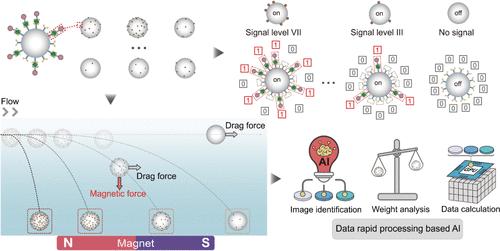
Current high-sensitivity immunoassay protocols often involve complex signal generation designs or rely on sophisticated signal-loading and readout devices, making it challenging to strike a balance between sensitivity and ease of use. In this study, we propose a homogeneous-based intelligent analysis strategy called Mata, which uses weight analysis to quantify basic immune signals through signal subunits. We perform nanomagnetic labeling of target capture events on micrometer-scale polystyrene subunits, enabling magnetically regulated kinetic signal expression. Signal subunits are classified through the multi-level signal classifier in synergy with the developed signal weight analysis and deep learning recognition models. Subsequently, the basic immune signals are quantified to achieve ultra-high sensitivity. Mata achieves a detection of 0.61 pg/mL in 20 min for interleukin-6 detection, demonstrating sensitivity comparable to conventional digital immunoassays and over 22-fold that of chemiluminescence immunoassay and reducing detection time by more than 70%. The entire process relies on a homogeneous reaction and can be performed using standard bright-field optical imaging. This intelligent analysis strategy balances high sensitivity and convenient operation and has few hardware requirements, presenting a promising high-sensitivity analysis solution with wide accessibility.
期刊介绍:
ACS Nano, published monthly, serves as an international forum for comprehensive articles on nanoscience and nanotechnology research at the intersections of chemistry, biology, materials science, physics, and engineering. The journal fosters communication among scientists in these communities, facilitating collaboration, new research opportunities, and advancements through discoveries. ACS Nano covers synthesis, assembly, characterization, theory, and simulation of nanostructures, nanobiotechnology, nanofabrication, methods and tools for nanoscience and nanotechnology, and self- and directed-assembly. Alongside original research articles, it offers thorough reviews, perspectives on cutting-edge research, and discussions envisioning the future of nanoscience and nanotechnology.



 京公网安备 11010802042870号
京ICP备2023020795号-1
京公网安备 11010802042870号
京ICP备2023020795号-1

 分享
分享
 求助内容:
求助内容: 应助结果提醒方式:
 扫码关注我们
