Unai Muniain, Javier Aizpurua, Rainer Hillenbrand, Luis Martín-Moreno, Ruben Esteban
{"title":"Description of ultrastrong light–matter interaction through coupled harmonic oscillator models and their connection with cavity-QED Hamiltonians","authors":"Unai Muniain, Javier Aizpurua, Rainer Hillenbrand, Luis Martín-Moreno, Ruben Esteban","doi":"10.1515/nanoph-2024-0528","DOIUrl":null,"url":null,"abstract":"Classical coupled harmonic oscillator models are capable of describing the optical and infrared response of nanophotonic systems where a cavity photon couples to dipolar matter excitations. The distinct forms of coupling adopted in these classical models lead to different results in the ultrastrong coupling regime. To clarify the specific classical model required to address particular configurations, we establish a connection between each oscillator model and the equivalent cavity Quantum Electrodynamics description. We show that the proper choice of coupled harmonic oscillator model depends on the presence or absence of the diamagnetic term in the quantum models, linked to whether transverse or longitudinal electromagnetic fields mediate the coupling. This analysis also shows how to exploit the classical oscillator models to extract measurable information of the optical response, as demonstrated in three canonical photonic systems, and to describe the opening of the Reststrahlen band in the bulk dispersion of phononic materials.","PeriodicalId":19027,"journal":{"name":"Nanophotonics","volume":"86 1","pages":""},"PeriodicalIF":6.6000,"publicationDate":"2025-03-10","publicationTypes":"Journal Article","fieldsOfStudy":null,"isOpenAccess":false,"openAccessPdf":"","citationCount":"0","resultStr":null,"platform":"Semanticscholar","paperid":null,"PeriodicalName":"Nanophotonics","FirstCategoryId":"101","ListUrlMain":"https://doi.org/10.1515/nanoph-2024-0528","RegionNum":2,"RegionCategory":"物理与天体物理","ArticlePicture":[],"TitleCN":null,"AbstractTextCN":null,"PMCID":null,"EPubDate":"","PubModel":"","JCR":"Q1","JCRName":"MATERIALS SCIENCE, MULTIDISCIPLINARY","Score":null,"Total":0}
引用次数: 0
Abstract
Classical coupled harmonic oscillator models are capable of describing the optical and infrared response of nanophotonic systems where a cavity photon couples to dipolar matter excitations. The distinct forms of coupling adopted in these classical models lead to different results in the ultrastrong coupling regime. To clarify the specific classical model required to address particular configurations, we establish a connection between each oscillator model and the equivalent cavity Quantum Electrodynamics description. We show that the proper choice of coupled harmonic oscillator model depends on the presence or absence of the diamagnetic term in the quantum models, linked to whether transverse or longitudinal electromagnetic fields mediate the coupling. This analysis also shows how to exploit the classical oscillator models to extract measurable information of the optical response, as demonstrated in three canonical photonic systems, and to describe the opening of the Reststrahlen band in the bulk dispersion of phononic materials.
期刊介绍:
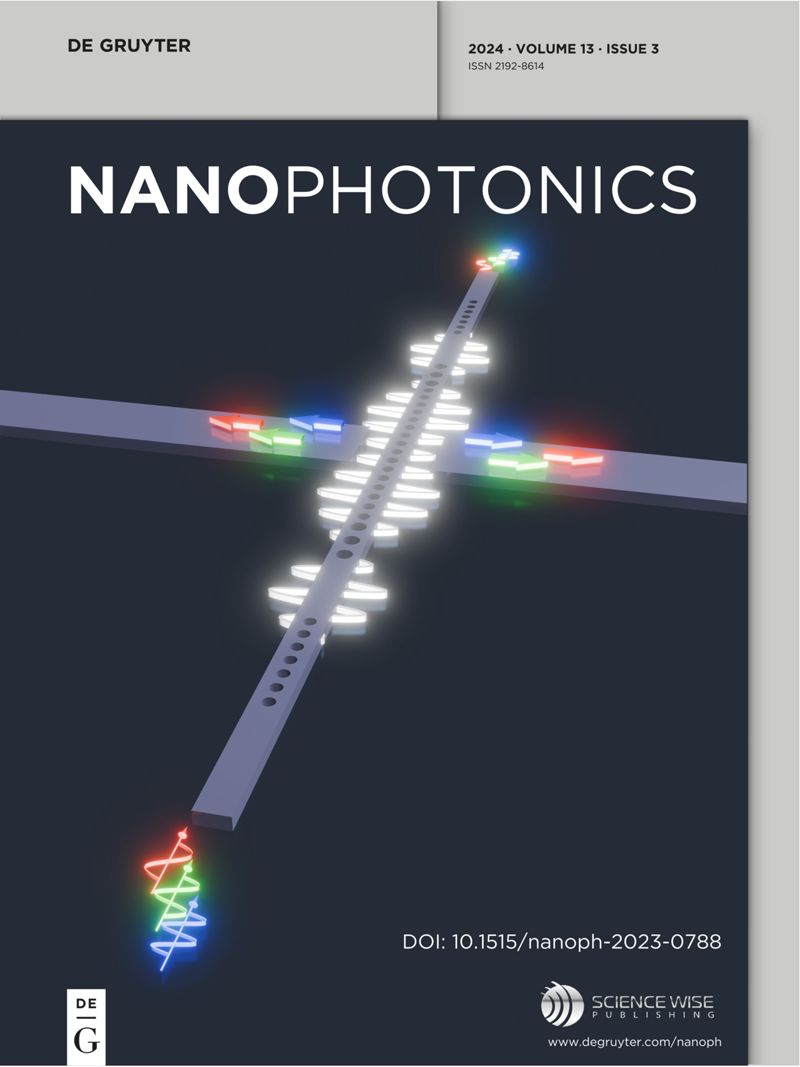
Nanophotonics, published in collaboration with Sciencewise, is a prestigious journal that showcases recent international research results, notable advancements in the field, and innovative applications. It is regarded as one of the leading publications in the realm of nanophotonics and encompasses a range of article types including research articles, selectively invited reviews, letters, and perspectives.
The journal specifically delves into the study of photon interaction with nano-structures, such as carbon nano-tubes, nano metal particles, nano crystals, semiconductor nano dots, photonic crystals, tissue, and DNA. It offers comprehensive coverage of the most up-to-date discoveries, making it an essential resource for physicists, engineers, and material scientists.



 京公网安备 11010802042870号
京ICP备2023020795号-1
京公网安备 11010802042870号
京ICP备2023020795号-1

 分享
分享
 求助内容:
求助内容: 应助结果提醒方式:
 扫码关注我们
