Norbertus J.R. Kraakman, Luis Villarreal-Heras, Javier González-Martín, Sara Cantera, Raúl Muñoz, Raquel Lebrero
{"title":"Enhancing dilute methane treatment through liquid phase alteration in a capillary bioreactor","authors":"Norbertus J.R. Kraakman, Luis Villarreal-Heras, Javier González-Martín, Sara Cantera, Raúl Muñoz, Raquel Lebrero","doi":"10.1016/j.cej.2025.161383","DOIUrl":null,"url":null,"abstract":"This study aimed to maximize the treatment of dilute methane emissions (<5% v/v) using a capillary bioreactor (CBR) to overcome the mass transfer limitations commonly encountered in biological technologies. Three universally used non-ionic surfactants (BRIJ 58, TWEEN 60 and SDBS) were tested for their ability to enhance methane bioavailability when combined with a non-aqueous liquid (silicone oil). The study evaluated each surfactant’s effectiveness in increasing methane bioavailability, enhancing the cell hydrophobicity of a mixed culture of methane oxidizing bacteria, and improving the oil-in-water emulsion capacity at a concentration low enough to eliminate the risk of microbial inhibition. BRIJ 58 was selected and showed in combination with silicone oil potential to enhance gas–liquid mass transfer by >50 % in a capillary channel under segmented (Taylor) flow regime. The optimised liquid phase in the CBR supported stable removal of the methane (∼4500 ppm<sub>v</sub> = 0.45 % v/v) with elimination capacities over 200 g m<sup>-3</sup>h<sup>−1</sup> at an empty capillary channel gas contact time of 23 s, which is one order of magnitude lower than the empty bed gas contact time of conventional biological gas treatment methods treating dilute methane. The improved emulsification of the oil-in-water emulsion combined with enhanced cell hydrophobicity appeared to be the main mechanism. Internal gas recirculation was applied to decouple the optimal gas–liquid turbulence conditions inside the capillary channel from the actual gas retention time. The study demonstrated that the addition of 20 % silicon oil and 160 mg L<sup>-1</sup> BRIJ 58 significantly improved the overall methane abatement performance.","PeriodicalId":270,"journal":{"name":"Chemical Engineering Journal","volume":"21 1","pages":""},"PeriodicalIF":13.2000,"publicationDate":"2025-03-10","publicationTypes":"Journal Article","fieldsOfStudy":null,"isOpenAccess":false,"openAccessPdf":"","citationCount":"0","resultStr":null,"platform":"Semanticscholar","paperid":null,"PeriodicalName":"Chemical Engineering Journal","FirstCategoryId":"5","ListUrlMain":"https://doi.org/10.1016/j.cej.2025.161383","RegionNum":1,"RegionCategory":"工程技术","ArticlePicture":[],"TitleCN":null,"AbstractTextCN":null,"PMCID":null,"EPubDate":"","PubModel":"","JCR":"Q1","JCRName":"ENGINEERING, CHEMICAL","Score":null,"Total":0}
引用次数: 0
Abstract
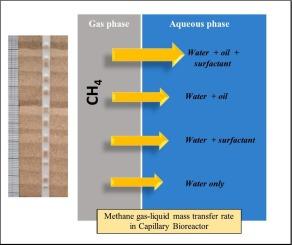
This study aimed to maximize the treatment of dilute methane emissions (<5% v/v) using a capillary bioreactor (CBR) to overcome the mass transfer limitations commonly encountered in biological technologies. Three universally used non-ionic surfactants (BRIJ 58, TWEEN 60 and SDBS) were tested for their ability to enhance methane bioavailability when combined with a non-aqueous liquid (silicone oil). The study evaluated each surfactant’s effectiveness in increasing methane bioavailability, enhancing the cell hydrophobicity of a mixed culture of methane oxidizing bacteria, and improving the oil-in-water emulsion capacity at a concentration low enough to eliminate the risk of microbial inhibition. BRIJ 58 was selected and showed in combination with silicone oil potential to enhance gas–liquid mass transfer by >50 % in a capillary channel under segmented (Taylor) flow regime. The optimised liquid phase in the CBR supported stable removal of the methane (∼4500 ppmv = 0.45 % v/v) with elimination capacities over 200 g m-3h−1 at an empty capillary channel gas contact time of 23 s, which is one order of magnitude lower than the empty bed gas contact time of conventional biological gas treatment methods treating dilute methane. The improved emulsification of the oil-in-water emulsion combined with enhanced cell hydrophobicity appeared to be the main mechanism. Internal gas recirculation was applied to decouple the optimal gas–liquid turbulence conditions inside the capillary channel from the actual gas retention time. The study demonstrated that the addition of 20 % silicon oil and 160 mg L-1 BRIJ 58 significantly improved the overall methane abatement performance.
期刊介绍:
The Chemical Engineering Journal is an international research journal that invites contributions of original and novel fundamental research. It aims to provide an international platform for presenting original fundamental research, interpretative reviews, and discussions on new developments in chemical engineering. The journal welcomes papers that describe novel theory and its practical application, as well as those that demonstrate the transfer of techniques from other disciplines. It also welcomes reports on carefully conducted experimental work that is soundly interpreted. The main focus of the journal is on original and rigorous research results that have broad significance. The Catalysis section within the Chemical Engineering Journal focuses specifically on Experimental and Theoretical studies in the fields of heterogeneous catalysis, molecular catalysis, and biocatalysis. These studies have industrial impact on various sectors such as chemicals, energy, materials, foods, healthcare, and environmental protection.



 京公网安备 11010802042870号
京ICP备2023020795号-1
京公网安备 11010802042870号
京ICP备2023020795号-1

 分享
分享
 求助内容:
求助内容: 应助结果提醒方式:
 扫码关注我们
