Qi Yang , Xupeng Huang , Hongbo Zhang , Jing Sun , Jielin Tang , Zhao Chen , Lijie Liu , Man Liu , Zeyun Sun , Zhenhao Tang , Dandan Wei , Dong Wang , Yiliang Wang , Mengrong Yan , Li Zhao , Airu Zhu , Yihang Zhong , Haitao Yang , Yao Zhao , Jun Dai , Wei Peng
{"title":"Expanding the utilization of binding pockets proves to be effective for noncovalent small molecule inhibitors against SARS-CoV-2 Mpro","authors":"Qi Yang , Xupeng Huang , Hongbo Zhang , Jing Sun , Jielin Tang , Zhao Chen , Lijie Liu , Man Liu , Zeyun Sun , Zhenhao Tang , Dandan Wei , Dong Wang , Yiliang Wang , Mengrong Yan , Li Zhao , Airu Zhu , Yihang Zhong , Haitao Yang , Yao Zhao , Jun Dai , Wei Peng","doi":"10.1016/j.ejmech.2025.117497","DOIUrl":null,"url":null,"abstract":"<div><div>The coronavirus disease 2019 (COVID-19) pandemic, caused by severe acute respiratory syndrome coronavirus 2 (SARS-CoV-2), has resulted in millions of deaths and continues to pose serious threats to global public health. The main protease (M<sup>pro</sup>) of SARS-CoV-2 is crucial for viral replication and its conservation, making it an attractive drug target. Here, we employed a structure-based drug design strategy to develop and optimize novel inhibitors targeting SARS-CoV-2 M<sup>pro</sup>. By fully exploring occupation of the S1, S2, and S3/S4 binding pockets, we identified eight promising inhibitors with half-maximal inhibitory concentration (IC<sub>50</sub>) values below 20 nM. The cocrystal structure of M<sup>pro</sup> with compound <strong>10</strong> highlighted the crucial roles of the interactions within the S3/S4 pockets in inhibitor potency enhancement. These findings demonstrated that expanding the utilization of these binding pockets was an effective strategy for developing noncovalent small molecule inhibitors that target SARS-CoV-2 M<sup>pro</sup>. Compound <strong>4</strong> demonstrated outstanding <em>in vitro</em> antiviral activity against wild-type SARS-CoV-2 with an EC<sub>50</sub> of 9.4 nM. Moreover, oral treatment with compounds <strong>1</strong> and <strong>9</strong> exhibited excellent antiviral potency and substantially ameliorated virus-induced tissue damage in the lungs of Omicron BA.5-infected K18-human ACE2 (K18-hACE2) transgenic mice, indicating that these novel noncovalent inhibitors could be potential oral agents for the treatment of COVID-19.</div></div>","PeriodicalId":314,"journal":{"name":"European Journal of Medicinal Chemistry","volume":"289 ","pages":"Article 117497"},"PeriodicalIF":6.7000,"publicationDate":"2025-05-05","publicationTypes":"Journal Article","fieldsOfStudy":null,"isOpenAccess":false,"openAccessPdf":"","citationCount":"0","resultStr":null,"platform":"Semanticscholar","paperid":null,"PeriodicalName":"European Journal of Medicinal Chemistry","FirstCategoryId":"3","ListUrlMain":"https://www.sciencedirect.com/science/article/pii/S0223523425002624","RegionNum":2,"RegionCategory":"医学","ArticlePicture":[],"TitleCN":null,"AbstractTextCN":null,"PMCID":null,"EPubDate":"2025/3/10 0:00:00","PubModel":"Epub","JCR":"Q1","JCRName":"CHEMISTRY, MEDICINAL","Score":null,"Total":0}
引用次数: 0
Abstract
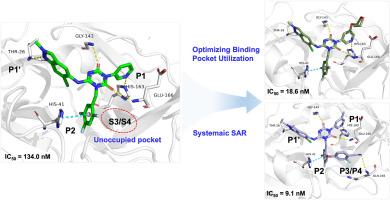
The coronavirus disease 2019 (COVID-19) pandemic, caused by severe acute respiratory syndrome coronavirus 2 (SARS-CoV-2), has resulted in millions of deaths and continues to pose serious threats to global public health. The main protease (Mpro) of SARS-CoV-2 is crucial for viral replication and its conservation, making it an attractive drug target. Here, we employed a structure-based drug design strategy to develop and optimize novel inhibitors targeting SARS-CoV-2 Mpro. By fully exploring occupation of the S1, S2, and S3/S4 binding pockets, we identified eight promising inhibitors with half-maximal inhibitory concentration (IC50) values below 20 nM. The cocrystal structure of Mpro with compound 10 highlighted the crucial roles of the interactions within the S3/S4 pockets in inhibitor potency enhancement. These findings demonstrated that expanding the utilization of these binding pockets was an effective strategy for developing noncovalent small molecule inhibitors that target SARS-CoV-2 Mpro. Compound 4 demonstrated outstanding in vitro antiviral activity against wild-type SARS-CoV-2 with an EC50 of 9.4 nM. Moreover, oral treatment with compounds 1 and 9 exhibited excellent antiviral potency and substantially ameliorated virus-induced tissue damage in the lungs of Omicron BA.5-infected K18-human ACE2 (K18-hACE2) transgenic mice, indicating that these novel noncovalent inhibitors could be potential oral agents for the treatment of COVID-19.
期刊介绍:
The European Journal of Medicinal Chemistry is a global journal that publishes studies on all aspects of medicinal chemistry. It provides a medium for publication of original papers and also welcomes critical review papers.
A typical paper would report on the organic synthesis, characterization and pharmacological evaluation of compounds. Other topics of interest are drug design, QSAR, molecular modeling, drug-receptor interactions, molecular aspects of drug metabolism, prodrug synthesis and drug targeting. The journal expects manuscripts to present the rational for a study, provide insight into the design of compounds or understanding of mechanism, or clarify the targets.





 京公网安备 11010802042870号
京ICP备2023020795号-1
京公网安备 11010802042870号
京ICP备2023020795号-1

 分享
分享
 求助内容:
求助内容: 应助结果提醒方式:
 扫码关注我们
