Surendra Singh, Harsh Bhatt, D. Sarkar and M. Gupta
{"title":"Experimental realization of a helical magnetic structure at Ni/Gd interfaces at room temperature","authors":"Surendra Singh, Harsh Bhatt, D. Sarkar and M. Gupta","doi":"10.1039/D5CP00437C","DOIUrl":null,"url":null,"abstract":"<p >Rare earth (RE) metals in proximity to transition metals (TMs) normally exhibit a strong antiferromagnetic exchange interaction and thus show an increase in the Curie temperature and twisted magnetic structures. Here, we performed depth profiling of the structure and magnetic properties of a Ni/Gd multilayer at room temperature using polarized neutron reflectivity (PNR) measurements, suggesting intermixing and long-range ordered magnetism at interfaces. We observed different spin-dependent PNR profiles for the multilayer upon reflecting neutrons from front and back surfaces. The analysis of the observed PNR profiles can be explained by the twisted magnetic phase at interfaces due to strong antiferromagnetic exchange interaction between Ni (TM) and Gd (RE). Diffuse PNR measurements indicate that the structural and magnetic roughnesses at the interfaces are not correlated. The depth-dependent experimental techniques were supported by a simple one-dimensional (1D) spin-based model calculation for the existence of a magnetic helical (twisted) phase at the interfaces in this system at room temperature. The twisted phase may contribute significantly to modifying the temperature-dependent magnetic properties. This work demonstrates the realization of a twisted phase at room temperature in the RE/TM system, paving a pathway to manipulate the magnetic properties of all-optical electronics for future magnetic memory applications.</p>","PeriodicalId":99,"journal":{"name":"Physical Chemistry Chemical Physics","volume":" 14","pages":" 6912-6923"},"PeriodicalIF":2.9000,"publicationDate":"2025-03-10","publicationTypes":"Journal Article","fieldsOfStudy":null,"isOpenAccess":false,"openAccessPdf":"","citationCount":"0","resultStr":null,"platform":"Semanticscholar","paperid":null,"PeriodicalName":"Physical Chemistry Chemical Physics","FirstCategoryId":"92","ListUrlMain":"https://pubs.rsc.org/en/content/articlelanding/2025/cp/d5cp00437c","RegionNum":3,"RegionCategory":"化学","ArticlePicture":[],"TitleCN":null,"AbstractTextCN":null,"PMCID":null,"EPubDate":"","PubModel":"","JCR":"Q3","JCRName":"CHEMISTRY, PHYSICAL","Score":null,"Total":0}
引用次数: 0
Abstract
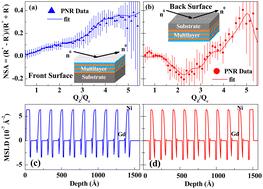
Rare earth (RE) metals in proximity to transition metals (TMs) normally exhibit a strong antiferromagnetic exchange interaction and thus show an increase in the Curie temperature and twisted magnetic structures. Here, we performed depth profiling of the structure and magnetic properties of a Ni/Gd multilayer at room temperature using polarized neutron reflectivity (PNR) measurements, suggesting intermixing and long-range ordered magnetism at interfaces. We observed different spin-dependent PNR profiles for the multilayer upon reflecting neutrons from front and back surfaces. The analysis of the observed PNR profiles can be explained by the twisted magnetic phase at interfaces due to strong antiferromagnetic exchange interaction between Ni (TM) and Gd (RE). Diffuse PNR measurements indicate that the structural and magnetic roughnesses at the interfaces are not correlated. The depth-dependent experimental techniques were supported by a simple one-dimensional (1D) spin-based model calculation for the existence of a magnetic helical (twisted) phase at the interfaces in this system at room temperature. The twisted phase may contribute significantly to modifying the temperature-dependent magnetic properties. This work demonstrates the realization of a twisted phase at room temperature in the RE/TM system, paving a pathway to manipulate the magnetic properties of all-optical electronics for future magnetic memory applications.
期刊介绍:
Physical Chemistry Chemical Physics (PCCP) is an international journal co-owned by 19 physical chemistry and physics societies from around the world. This journal publishes original, cutting-edge research in physical chemistry, chemical physics and biophysical chemistry. To be suitable for publication in PCCP, articles must include significant innovation and/or insight into physical chemistry; this is the most important criterion that reviewers and Editors will judge against when evaluating submissions.
The journal has a broad scope and welcomes contributions spanning experiment, theory, computation and data science. Topical coverage includes spectroscopy, dynamics, kinetics, statistical mechanics, thermodynamics, electrochemistry, catalysis, surface science, quantum mechanics, quantum computing and machine learning. Interdisciplinary research areas such as polymers and soft matter, materials, nanoscience, energy, surfaces/interfaces, and biophysical chemistry are welcomed if they demonstrate significant innovation and/or insight into physical chemistry. Joined experimental/theoretical studies are particularly appreciated when complementary and based on up-to-date approaches.




 京公网安备 11010802042870号
京ICP备2023020795号-1
京公网安备 11010802042870号
京ICP备2023020795号-1

 分享
分享
 求助内容:
求助内容: 应助结果提醒方式:
 扫码关注我们
