Zhe Sun, Xiaojing Yu, Qingfang Zhen, Tingting Yu, Xinming Wang, Guixin Yang, Yongbin Song and Haijun Pang
{"title":"Synthesis of two new polyoxometalate-based organic complexes from 2D to 3D structures for improving supercapacitor performance†","authors":"Zhe Sun, Xiaojing Yu, Qingfang Zhen, Tingting Yu, Xinming Wang, Guixin Yang, Yongbin Song and Haijun Pang","doi":"10.1039/D5DT00284B","DOIUrl":null,"url":null,"abstract":"<p >As an emerging energy-storage technology, research on supercapacitors is vital for advancing new energy applications, which rely on the development of electrode materials with superior properties. In this study, two novel polyoxometalate-based metal–organic complexes (POMOCs), Ag<small><sub>4</sub></small>(imbta)<small><sub>4</sub></small>(PMo<small><sup>V</sup></small>Mo<small><sup>VI</sup></small><small><sub>11</sub></small>O<small><sub>40</sub></small>) (PMo<small><sub>12</sub></small>-Ag-imbta, <strong>1</strong>) (imbta = 1-imidazole-1-methylene-1<em>H</em>-benzotriazole) and Ag<small><sub>4</sub></small>(pybta)<small><sub>4</sub></small>(PMo<small><sup>V</sup></small>Mo<small><sup>VI</sup></small><small><sub>11</sub></small>O<small><sub>40</sub></small>)(PMo<small><sub>12</sub></small>-Ag-pybta, <strong>2</strong>) (pybta = 1-pyridine-3-methylene-1<em>H</em>-benzotriazole), were synthesized <em>via</em> a hydrothermal method utilizing Ag<small><sup>+</sup></small>, imbta/pybta and [PMo<small><sub>12</sub></small>O<small><sub>40</sub></small>]<small><sup>3−</sup></small>, respectively. In <strong>1</strong>, Ag<small><sup>+</sup></small>, imbta, and [PMo<small><sub>12</sub></small>O<small><sub>40</sub></small>]<small><sup>3−</sup></small> form 2D layers <em>via</em> coordination bonds. At the same time, Ag<small><sup>+</sup></small> forms a 1D chain with [PMo<small><sub>12</sub></small>O<small><sub>40</sub></small>]<small><sup>3−</sup></small>. In <strong>2</strong>, Ag<small><sup>+</sup></small> and pybta form four separate Ag-pybta spiral chains. In addition, the coordination interaction between Ag<small><sup>+</sup></small> and [PMo<small><sub>12</sub></small>O<small><sub>40</sub></small>]<small><sup>3−</sup></small> not only induces the construction of the Ag-PMo<small><sub>12</sub></small> 2D network that promotes electron transport in <strong>2</strong> but also facilitates the development of the 3D structure characterized by the four-helix winding. Meanwhile, there are many holes in <strong>2</strong>, which are conducive to ion transport. In a three-electrode system, <strong>2</strong>-GCE demonstrated superior capacitive performance (668 F g<small><sup>−1</sup></small> at 1 A g<small><sup>−1</sup></small>) compared to <strong>1</strong>-GCE (420 F g<small><sup>−1</sup></small> at 1 A g<small><sup>−1</sup></small>), along with excellent cycling stability (91.4% retention after 1000 cycles). Notably, the specific capacitance of <strong>2</strong>-GCE at 5 A g<small><sup>−1</sup></small> was four times higher than that of PMo<small><sub>12</sub></small>. This study advances the development of novel crystalline electrode materials for energy storage applications.</p>","PeriodicalId":71,"journal":{"name":"Dalton Transactions","volume":" 15","pages":" 6093-6102"},"PeriodicalIF":3.3000,"publicationDate":"2025-03-10","publicationTypes":"Journal Article","fieldsOfStudy":null,"isOpenAccess":false,"openAccessPdf":"","citationCount":"0","resultStr":null,"platform":"Semanticscholar","paperid":null,"PeriodicalName":"Dalton Transactions","FirstCategoryId":"92","ListUrlMain":"https://pubs.rsc.org/en/content/articlelanding/2025/dt/d5dt00284b","RegionNum":3,"RegionCategory":"化学","ArticlePicture":[],"TitleCN":null,"AbstractTextCN":null,"PMCID":null,"EPubDate":"","PubModel":"","JCR":"Q2","JCRName":"CHEMISTRY, INORGANIC & NUCLEAR","Score":null,"Total":0}
引用次数: 0
Abstract
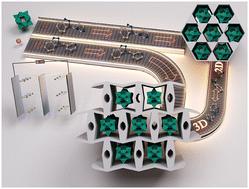
As an emerging energy-storage technology, research on supercapacitors is vital for advancing new energy applications, which rely on the development of electrode materials with superior properties. In this study, two novel polyoxometalate-based metal–organic complexes (POMOCs), Ag4(imbta)4(PMoVMoVI11O40) (PMo12-Ag-imbta, 1) (imbta = 1-imidazole-1-methylene-1H-benzotriazole) and Ag4(pybta)4(PMoVMoVI11O40)(PMo12-Ag-pybta, 2) (pybta = 1-pyridine-3-methylene-1H-benzotriazole), were synthesized via a hydrothermal method utilizing Ag+, imbta/pybta and [PMo12O40]3−, respectively. In 1, Ag+, imbta, and [PMo12O40]3− form 2D layers via coordination bonds. At the same time, Ag+ forms a 1D chain with [PMo12O40]3−. In 2, Ag+ and pybta form four separate Ag-pybta spiral chains. In addition, the coordination interaction between Ag+ and [PMo12O40]3− not only induces the construction of the Ag-PMo12 2D network that promotes electron transport in 2 but also facilitates the development of the 3D structure characterized by the four-helix winding. Meanwhile, there are many holes in 2, which are conducive to ion transport. In a three-electrode system, 2-GCE demonstrated superior capacitive performance (668 F g−1 at 1 A g−1) compared to 1-GCE (420 F g−1 at 1 A g−1), along with excellent cycling stability (91.4% retention after 1000 cycles). Notably, the specific capacitance of 2-GCE at 5 A g−1 was four times higher than that of PMo12. This study advances the development of novel crystalline electrode materials for energy storage applications.
期刊介绍:
Dalton Transactions is a journal for all areas of inorganic chemistry, which encompasses the organometallic, bioinorganic and materials chemistry of the elements, with applications including synthesis, catalysis, energy conversion/storage, electrical devices and medicine. Dalton Transactions welcomes high-quality, original submissions in all of these areas and more, where the advancement of knowledge in inorganic chemistry is significant.



 京公网安备 11010802042870号
京ICP备2023020795号-1
京公网安备 11010802042870号
京ICP备2023020795号-1

 分享
分享
 求助内容:
求助内容: 应助结果提醒方式:
 扫码关注我们
