{"title":"Tailoring Multiple Interactions in Poly (Urethane-Urea)-Based Solid-State Polymer Electrolytes for Long-Term Cycling Lithium Metal Batteries","authors":"Dongxu Hu, Hongzhang Huang, Chenyang Wang, Qixian Hong, Hailong Wang, Shihai Tang, Huajun Zhang, Jingshuo Li, Linyu Hu, Liang Jiang, Xiaowei Fu, Jingxin Lei, Zhimeng Liu, Xin He","doi":"10.1002/aenm.202406176","DOIUrl":null,"url":null,"abstract":"<p>Polyethylene oxide (PEO)-based solid polymer electrolytes (SPEs) are considered as one of the most promising candidates for next-generation lithium metal batteries. However, their application is limited by poor electrode/electrolyte interfacial stability, low Li-ions transference number, and weak mechanical strength. Herein, poly (urethane-urea)-based SPEs are developed to enhance interfacial stability, improve Li-ions transport kinetics, and provide superior mechanical properties. The poly (urethane-urea) structure integrates abundant polar groups and rigid conjugated moieties, which facilitate interactions with the anions of lithium salt in SPEs, promoting the Li-ions transference number and supporting the formation of a LiF-rich solid electrolyte interphase (SEI) to guide uniform lithium deposition and suppress dendrite growth. Furthermore, a supramolecular crosslinked network is formed through multiple hydrogen bonds and π-π stacking interactions, enhancing the mechanical strength and toughness of the SPEs. As a result, Li//Li solid-state symmetric cells assembled with this SPE demonstrate stable cycling for over 3000 h, while LiFePO<sub>4</sub> solid-state cells retain 93.6% of their initial capacity after 500 cycles at the rate of 1C. This work presents a feasible design strategy for developing highly functional SPE materials.</p>","PeriodicalId":111,"journal":{"name":"Advanced Energy Materials","volume":"15 26","pages":""},"PeriodicalIF":26.0000,"publicationDate":"2025-03-10","publicationTypes":"Journal Article","fieldsOfStudy":null,"isOpenAccess":false,"openAccessPdf":"","citationCount":"0","resultStr":null,"platform":"Semanticscholar","paperid":null,"PeriodicalName":"Advanced Energy Materials","FirstCategoryId":"88","ListUrlMain":"https://advanced.onlinelibrary.wiley.com/doi/10.1002/aenm.202406176","RegionNum":1,"RegionCategory":"材料科学","ArticlePicture":[],"TitleCN":null,"AbstractTextCN":null,"PMCID":null,"EPubDate":"","PubModel":"","JCR":"Q1","JCRName":"CHEMISTRY, PHYSICAL","Score":null,"Total":0}
引用次数: 0
Abstract
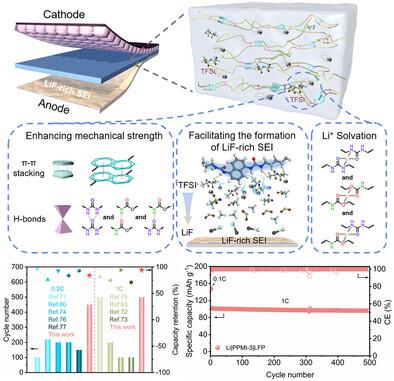
Polyethylene oxide (PEO)-based solid polymer electrolytes (SPEs) are considered as one of the most promising candidates for next-generation lithium metal batteries. However, their application is limited by poor electrode/electrolyte interfacial stability, low Li-ions transference number, and weak mechanical strength. Herein, poly (urethane-urea)-based SPEs are developed to enhance interfacial stability, improve Li-ions transport kinetics, and provide superior mechanical properties. The poly (urethane-urea) structure integrates abundant polar groups and rigid conjugated moieties, which facilitate interactions with the anions of lithium salt in SPEs, promoting the Li-ions transference number and supporting the formation of a LiF-rich solid electrolyte interphase (SEI) to guide uniform lithium deposition and suppress dendrite growth. Furthermore, a supramolecular crosslinked network is formed through multiple hydrogen bonds and π-π stacking interactions, enhancing the mechanical strength and toughness of the SPEs. As a result, Li//Li solid-state symmetric cells assembled with this SPE demonstrate stable cycling for over 3000 h, while LiFePO4 solid-state cells retain 93.6% of their initial capacity after 500 cycles at the rate of 1C. This work presents a feasible design strategy for developing highly functional SPE materials.
期刊介绍:
Established in 2011, Advanced Energy Materials is an international, interdisciplinary, English-language journal that focuses on materials used in energy harvesting, conversion, and storage. It is regarded as a top-quality journal alongside Advanced Materials, Advanced Functional Materials, and Small.
With a 2022 Impact Factor of 27.8, Advanced Energy Materials is considered a prime source for the best energy-related research. The journal covers a wide range of topics in energy-related research, including organic and inorganic photovoltaics, batteries and supercapacitors, fuel cells, hydrogen generation and storage, thermoelectrics, water splitting and photocatalysis, solar fuels and thermosolar power, magnetocalorics, and piezoelectronics.
The readership of Advanced Energy Materials includes materials scientists, chemists, physicists, and engineers in both academia and industry. The journal is indexed in various databases and collections, such as Advanced Technologies & Aerospace Database, FIZ Karlsruhe, INSPEC (IET), Science Citation Index Expanded, Technology Collection, and Web of Science, among others.







 京公网安备 11010802042870号
京ICP备2023020795号-1
京公网安备 11010802042870号
京ICP备2023020795号-1

 分享
分享
 求助内容:
求助内容: 应助结果提醒方式:
 扫码关注我们
