Jinchen Wang, Isaac Harris, Mohamed Ibrahim, Dirk Englund, Ruonan Han
{"title":"A wireless terahertz cryogenic interconnect that minimizes heat-to-information transfer","authors":"Jinchen Wang, Isaac Harris, Mohamed Ibrahim, Dirk Englund, Ruonan Han","doi":"10.1038/s41928-025-01355-9","DOIUrl":null,"url":null,"abstract":"The development of practical quantum computers probably requires error-protected quantum processors with thousands of logical qubits. Reaching this scale potentially involves millions of physical qubits and scaled interconnects. The interconnects need to connect qubits operating at cryogenic temperature with a controller at a high-temperature stage. Conventional coaxial cables introduce conductive heat loads, and thus, optical interconnects using low-thermal-conductivity fibre links have been explored. However, each absorbed photon in the low-temperature stage involves considerable heating, as well as effects such as quasiparticle excitations. Here we report a wireless terahertz cryogenic interconnect that is based on complementary metal–oxide–semiconductor technology and minimizes the heat-to-information transfer ratio. Our architecture consists of integrated wideband transceivers operating at a carrier frequency of 260 GHz, a hot-to-cold ingress based on passive cold field-effect transistor terahertz detector and a cold-to-hot egress using ultralow-power backscatter modulation at the cold reservoir. Our terahertz quantum interconnect technology could potentially provide high-capacity reconfigurable multichannel cryo-interconnects that operate near the fundamental limits of information transfer. A data interface that is based on complementary metal–oxide–semiconductor technology can provide wireless data transfer between cryogenic and room temperature, and minimize the heat-to-information transfer ratio.","PeriodicalId":19064,"journal":{"name":"Nature Electronics","volume":"8 5","pages":"426-436"},"PeriodicalIF":40.9000,"publicationDate":"2025-03-10","publicationTypes":"Journal Article","fieldsOfStudy":null,"isOpenAccess":false,"openAccessPdf":"","citationCount":"0","resultStr":null,"platform":"Semanticscholar","paperid":null,"PeriodicalName":"Nature Electronics","FirstCategoryId":"5","ListUrlMain":"https://www.nature.com/articles/s41928-025-01355-9","RegionNum":1,"RegionCategory":"工程技术","ArticlePicture":[],"TitleCN":null,"AbstractTextCN":null,"PMCID":null,"EPubDate":"","PubModel":"","JCR":"Q1","JCRName":"ENGINEERING, ELECTRICAL & ELECTRONIC","Score":null,"Total":0}
引用次数: 0
Abstract
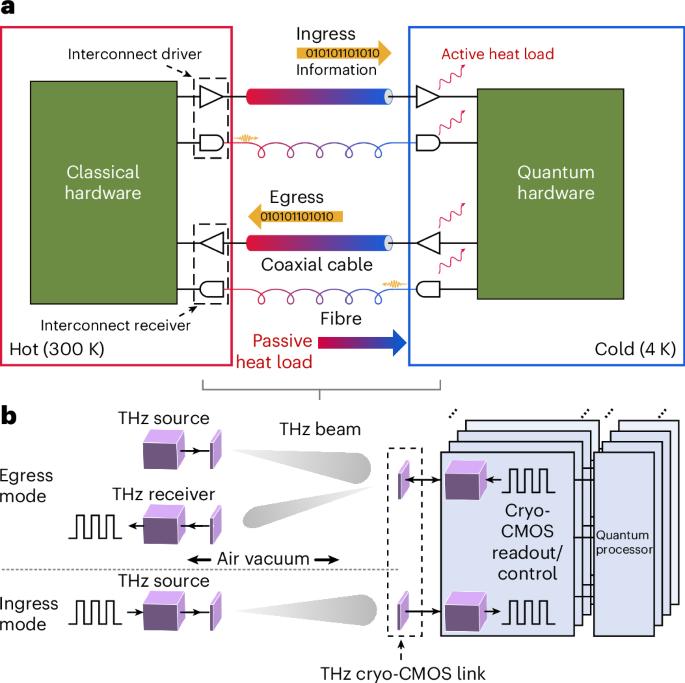
The development of practical quantum computers probably requires error-protected quantum processors with thousands of logical qubits. Reaching this scale potentially involves millions of physical qubits and scaled interconnects. The interconnects need to connect qubits operating at cryogenic temperature with a controller at a high-temperature stage. Conventional coaxial cables introduce conductive heat loads, and thus, optical interconnects using low-thermal-conductivity fibre links have been explored. However, each absorbed photon in the low-temperature stage involves considerable heating, as well as effects such as quasiparticle excitations. Here we report a wireless terahertz cryogenic interconnect that is based on complementary metal–oxide–semiconductor technology and minimizes the heat-to-information transfer ratio. Our architecture consists of integrated wideband transceivers operating at a carrier frequency of 260 GHz, a hot-to-cold ingress based on passive cold field-effect transistor terahertz detector and a cold-to-hot egress using ultralow-power backscatter modulation at the cold reservoir. Our terahertz quantum interconnect technology could potentially provide high-capacity reconfigurable multichannel cryo-interconnects that operate near the fundamental limits of information transfer. A data interface that is based on complementary metal–oxide–semiconductor technology can provide wireless data transfer between cryogenic and room temperature, and minimize the heat-to-information transfer ratio.
期刊介绍:
Nature Electronics is a comprehensive journal that publishes both fundamental and applied research in the field of electronics. It encompasses a wide range of topics, including the study of new phenomena and devices, the design and construction of electronic circuits, and the practical applications of electronics. In addition, the journal explores the commercial and industrial aspects of electronics research.
The primary focus of Nature Electronics is on the development of technology and its potential impact on society. The journal incorporates the contributions of scientists, engineers, and industry professionals, offering a platform for their research findings. Moreover, Nature Electronics provides insightful commentary, thorough reviews, and analysis of the key issues that shape the field, as well as the technologies that are reshaping society.
Like all journals within the prestigious Nature brand, Nature Electronics upholds the highest standards of quality. It maintains a dedicated team of professional editors and follows a fair and rigorous peer-review process. The journal also ensures impeccable copy-editing and production, enabling swift publication. Additionally, Nature Electronics prides itself on its editorial independence, ensuring unbiased and impartial reporting.
In summary, Nature Electronics is a leading journal that publishes cutting-edge research in electronics. With its multidisciplinary approach and commitment to excellence, the journal serves as a valuable resource for scientists, engineers, and industry professionals seeking to stay at the forefront of advancements in the field.



 京公网安备 11010802042870号
京ICP备2023020795号-1
京公网安备 11010802042870号
京ICP备2023020795号-1

 分享
分享
 求助内容:
求助内容: 应助结果提醒方式:
 扫码关注我们
