Milou A. Hogervorst, Rick A. Vreman, Theresa A. Oduol, Aukje K. Mantel-Teeuwisse, Wim G. Goettsch, Aaron S. Kesselheim
{"title":"Evolving Recommendations for Patient Populations Among Oncology Medicines: A Quantitative and Qualitative Analysis","authors":"Milou A. Hogervorst, Rick A. Vreman, Theresa A. Oduol, Aukje K. Mantel-Teeuwisse, Wim G. Goettsch, Aaron S. Kesselheim","doi":"10.1002/cpt.3628","DOIUrl":null,"url":null,"abstract":"<p>After a medicine has been tested in pivotal trials, regulators, health technology assessment (HTA) organizations, and professional societies make decisions about the patients best served by the medicine. This study assesses how the patient populations for oncology medicines (2010–2023) are defined (1) at trial, (2) regulatory submission, (3) upon approval for marketing authorization, (4) at submission, and (5) recommendation by the HTA, and (6) in clinical guidelines in Australia, Canada, the Netherlands, the United Kingdom, and the United States. Based on 25 populations for oncology medicines, we developed a framework for describing oncology populations consisting of 20 elements in four domains: disease specifications, patient characteristics, treatment position, and exclusion criteria. In exploratory analyses, we tabulated any observed variation in these framework elements throughout the six steps in the lifecycle of a medicine. On average, 10 (95% confidence interval [CI]: 9.2–10.9) potential adjustments were made, 2.3 (95% CI: 2.0–2.5) by each decision-maker. The adjustments by pharmaceutical developers focused mostly on the disease specifications (0.5 of the average 0.8 adjustments, 63%), while adjustments by regulators, HTA organizations, and guideline developers predominantly targeted the treatment's position (range: 0.5/1.3 [36%] in guidelines to 0.6/1.0 [58%] in regulatory approvals). Each decision-maker on average modifies 1.0 element (out of 2.3 [43%]) that was previously adjusted by another decision-maker. The multiple differences observed in the description of patient populations reflect inconsistency in reporting between decision-makers, complicating communication to patients and potentially affecting access to medicines. The developed framework can support consistent reporting across stakeholders and countries.</p>","PeriodicalId":153,"journal":{"name":"Clinical Pharmacology & Therapeutics","volume":"118 1","pages":"95-105"},"PeriodicalIF":5.5000,"publicationDate":"2025-03-10","publicationTypes":"Journal Article","fieldsOfStudy":null,"isOpenAccess":false,"openAccessPdf":"https://onlinelibrary.wiley.com/doi/epdf/10.1002/cpt.3628","citationCount":"0","resultStr":null,"platform":"Semanticscholar","paperid":null,"PeriodicalName":"Clinical Pharmacology & Therapeutics","FirstCategoryId":"3","ListUrlMain":"https://ascpt.onlinelibrary.wiley.com/doi/10.1002/cpt.3628","RegionNum":2,"RegionCategory":"医学","ArticlePicture":[],"TitleCN":null,"AbstractTextCN":null,"PMCID":null,"EPubDate":"","PubModel":"","JCR":"Q1","JCRName":"PHARMACOLOGY & PHARMACY","Score":null,"Total":0}
引用次数: 0
Abstract
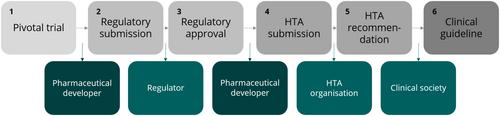
After a medicine has been tested in pivotal trials, regulators, health technology assessment (HTA) organizations, and professional societies make decisions about the patients best served by the medicine. This study assesses how the patient populations for oncology medicines (2010–2023) are defined (1) at trial, (2) regulatory submission, (3) upon approval for marketing authorization, (4) at submission, and (5) recommendation by the HTA, and (6) in clinical guidelines in Australia, Canada, the Netherlands, the United Kingdom, and the United States. Based on 25 populations for oncology medicines, we developed a framework for describing oncology populations consisting of 20 elements in four domains: disease specifications, patient characteristics, treatment position, and exclusion criteria. In exploratory analyses, we tabulated any observed variation in these framework elements throughout the six steps in the lifecycle of a medicine. On average, 10 (95% confidence interval [CI]: 9.2–10.9) potential adjustments were made, 2.3 (95% CI: 2.0–2.5) by each decision-maker. The adjustments by pharmaceutical developers focused mostly on the disease specifications (0.5 of the average 0.8 adjustments, 63%), while adjustments by regulators, HTA organizations, and guideline developers predominantly targeted the treatment's position (range: 0.5/1.3 [36%] in guidelines to 0.6/1.0 [58%] in regulatory approvals). Each decision-maker on average modifies 1.0 element (out of 2.3 [43%]) that was previously adjusted by another decision-maker. The multiple differences observed in the description of patient populations reflect inconsistency in reporting between decision-makers, complicating communication to patients and potentially affecting access to medicines. The developed framework can support consistent reporting across stakeholders and countries.
期刊介绍:
Clinical Pharmacology & Therapeutics (CPT) is the authoritative cross-disciplinary journal in experimental and clinical medicine devoted to publishing advances in the nature, action, efficacy, and evaluation of therapeutics. CPT welcomes original Articles in the emerging areas of translational, predictive and personalized medicine; new therapeutic modalities including gene and cell therapies; pharmacogenomics, proteomics and metabolomics; bioinformation and applied systems biology complementing areas of pharmacokinetics and pharmacodynamics, human investigation and clinical trials, pharmacovigilence, pharmacoepidemiology, pharmacometrics, and population pharmacology.





 京公网安备 11010802042870号
京ICP备2023020795号-1
京公网安备 11010802042870号
京ICP备2023020795号-1

 分享
分享
 求助内容:
求助内容: 应助结果提醒方式:
 扫码关注我们
