Sonia Boga, David Bouzada, Roi Lopez-Blanco, Axel Sarmiento, Iria Salvadó, David Alvar Gil, José Brea, María Isabel Loza, Natalia Barreiro-Piñeiro, José Martínez-Costas, Silvia Mena, Gonzalo Guirado, Alice Santoro, Peter Faller, M Eugenio Vázquez, Miguel Vázquez López
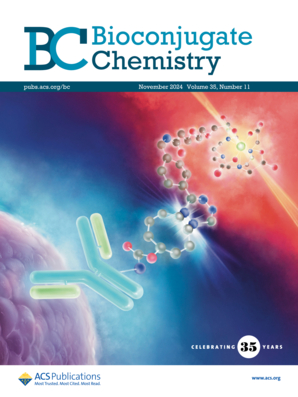
{"title":"Copper(II) Cyclopeptides with High ROS-Mediated Cytotoxicity.","authors":"Sonia Boga, David Bouzada, Roi Lopez-Blanco, Axel Sarmiento, Iria Salvadó, David Alvar Gil, José Brea, María Isabel Loza, Natalia Barreiro-Piñeiro, José Martínez-Costas, Silvia Mena, Gonzalo Guirado, Alice Santoro, Peter Faller, M Eugenio Vázquez, Miguel Vázquez López","doi":"10.1021/acs.bioconjchem.4c00561","DOIUrl":null,"url":null,"abstract":"<p><p>Cu(II) coordination complexes are emerging as promising anticancer agents due to their ability to induce oxidative stress through reactive oxygen species (ROS) generation. In this study, we synthesized and characterized two novel Cu(II) metallopeptide systems, <b>1</b>/Cu(II) and <b>2</b>/Cu(II), derived from the oligocationic bipyridyl cyclopeptides <b>1</b> and <b>2,</b> and designed to enhance the transport of Cu(II) into cells and increase ROS levels. Spectroscopic and electrochemical analyses confirmed the formation of stable metallopeptide species in aqueous media. Inductively coupled plasma mass spectrometry (ICP-MS) studies demonstrated that both metallopeptides significantly increase intracellular Cu(II) accumulation in NCI/ADR-RES cancer cells, highlighting their role as efficient Cu(II) transporters. Additionally, ROS generation assays revealed that <b>1</b>/Cu(II) induces a substantial increase in intracellular ROS levels, supporting the hypothesis of oxidative stress-induced cytotoxicity. Cell-viability assays further confirmed that both <b>1</b>/Cu(II) and <b>2</b>/Cu(II) exhibit strong anticancer activity in a number of cancer cell lines, with IC<sub>50</sub> values significantly lower than those of their free cyclopeptide counterparts or Cu(II) alone, showing an order of activity higher than that of cisplatin. Finally, molecular modeling studies provided further insights into the structural stability and coordination environment of Cu(II) within the metallopeptide complexes. These findings suggest that these Cu(II) cyclometallopeptide systems hold potential as novel metal-based therapeutic agents, leveraging Cu(II) transport and ROS increase as key strategies for cancer treatment.</p>","PeriodicalId":29,"journal":{"name":"Bioconjugate Chemistry","volume":" ","pages":"500-509"},"PeriodicalIF":3.9000,"publicationDate":"2025-03-19","publicationTypes":"Journal Article","fieldsOfStudy":null,"isOpenAccess":false,"openAccessPdf":"https://www.ncbi.nlm.nih.gov/pmc/articles/PMC12128024/pdf/","citationCount":"0","resultStr":null,"platform":"Semanticscholar","paperid":null,"PeriodicalName":"Bioconjugate Chemistry","FirstCategoryId":"1","ListUrlMain":"https://doi.org/10.1021/acs.bioconjchem.4c00561","RegionNum":2,"RegionCategory":"化学","ArticlePicture":[],"TitleCN":null,"AbstractTextCN":null,"PMCID":null,"EPubDate":"2025/3/10 0:00:00","PubModel":"Epub","JCR":"Q1","JCRName":"BIOCHEMICAL RESEARCH METHODS","Score":null,"Total":0}
引用次数: 0
Abstract
Cu(II) coordination complexes are emerging as promising anticancer agents due to their ability to induce oxidative stress through reactive oxygen species (ROS) generation. In this study, we synthesized and characterized two novel Cu(II) metallopeptide systems, 1/Cu(II) and 2/Cu(II), derived from the oligocationic bipyridyl cyclopeptides 1 and 2, and designed to enhance the transport of Cu(II) into cells and increase ROS levels. Spectroscopic and electrochemical analyses confirmed the formation of stable metallopeptide species in aqueous media. Inductively coupled plasma mass spectrometry (ICP-MS) studies demonstrated that both metallopeptides significantly increase intracellular Cu(II) accumulation in NCI/ADR-RES cancer cells, highlighting their role as efficient Cu(II) transporters. Additionally, ROS generation assays revealed that 1/Cu(II) induces a substantial increase in intracellular ROS levels, supporting the hypothesis of oxidative stress-induced cytotoxicity. Cell-viability assays further confirmed that both 1/Cu(II) and 2/Cu(II) exhibit strong anticancer activity in a number of cancer cell lines, with IC50 values significantly lower than those of their free cyclopeptide counterparts or Cu(II) alone, showing an order of activity higher than that of cisplatin. Finally, molecular modeling studies provided further insights into the structural stability and coordination environment of Cu(II) within the metallopeptide complexes. These findings suggest that these Cu(II) cyclometallopeptide systems hold potential as novel metal-based therapeutic agents, leveraging Cu(II) transport and ROS increase as key strategies for cancer treatment.
期刊介绍:
Bioconjugate Chemistry invites original contributions on all research at the interface between man-made and biological materials. The mission of the journal is to communicate to advances in fields including therapeutic delivery, imaging, bionanotechnology, and synthetic biology. Bioconjugate Chemistry is intended to provide a forum for presentation of research relevant to all aspects of bioconjugates, including the preparation, properties and applications of biomolecular conjugates.



 京公网安备 11010802042870号
京ICP备2023020795号-1
京公网安备 11010802042870号
京ICP备2023020795号-1

 分享
分享
 求助内容:
求助内容: 应助结果提醒方式:
 扫码关注我们
