Pasquale Di Letto, Alberto Budillon, Sarah Iffat Rahman, Francesca Del Vecchio Blanco, Mariateresa Zanobio, Margherita Scarpato, Margherita Russo, Maria Elena Onore, Giulio Piluso, TUDP Study Group, Vincenzo Nigro, Gioacchino Scarano, Annalaura Torella
{"title":"Nanopore Sequencing Solves an Elusive Case of Sotos Syndrome","authors":"Pasquale Di Letto, Alberto Budillon, Sarah Iffat Rahman, Francesca Del Vecchio Blanco, Mariateresa Zanobio, Margherita Scarpato, Margherita Russo, Maria Elena Onore, Giulio Piluso, TUDP Study Group, Vincenzo Nigro, Gioacchino Scarano, Annalaura Torella","doi":"10.1002/ajmg.a.64039","DOIUrl":null,"url":null,"abstract":"<p>Sotos syndrome is a rare genetic disorder characterized by distinctive facial features, including a broad and prominent forehead, dolichocephaly, and learning disabilities ranging from mild to severe intellectual impairment. Affected individuals often show overgrowth in height and head circumference over two standard deviations. The syndrome is caused by haploinsufficiency of the <i>NSD1</i> gene, with no evidence of genetic heterogeneity to date. Here we describe the unsolved case of a child of 4 years of age with a clinical diagnosis of Sotos syndrome. However, trio exome sequencing (ES) and exon chromosomal microarray (CMA) analysis excluded both small and large mutations in the <i>NSD1</i> gene. As part of the Telethon Undiagnosed Programme, we used additional tools to investigate the possibility of new genes or elusive mutations that may have been missed by previous molecular diagnostic approaches. Therefore, we performed Nanopore long-read sequencing. This revealed a 447 bp insertion in exon 13 of the <i>NSD1</i> gene. mRNA analysis confirmed in-frame skipping of exon 13 that encodes for two PHD domains. The genomic insertion shows 100% identity with an intronic region, although inverted, containing an <i>AluSx1</i> element 2 kb upstream of the skipped exon, which may drive the event by masking the splice acceptor site of exon 13. Interestingly, this is the first case of Sotos syndrome linked to a pathogenic mechanism involving an insertion enclosing a transposable element generating a protein devoid of two PHDs, which are required for reading histone post-translational modifications.</p>","PeriodicalId":7507,"journal":{"name":"American Journal of Medical Genetics Part A","volume":"197 7","pages":""},"PeriodicalIF":1.7000,"publicationDate":"2025-03-10","publicationTypes":"Journal Article","fieldsOfStudy":null,"isOpenAccess":false,"openAccessPdf":"https://onlinelibrary.wiley.com/doi/epdf/10.1002/ajmg.a.64039","citationCount":"0","resultStr":null,"platform":"Semanticscholar","paperid":null,"PeriodicalName":"American Journal of Medical Genetics Part A","FirstCategoryId":"99","ListUrlMain":"https://onlinelibrary.wiley.com/doi/10.1002/ajmg.a.64039","RegionNum":4,"RegionCategory":"生物学","ArticlePicture":[],"TitleCN":null,"AbstractTextCN":null,"PMCID":null,"EPubDate":"","PubModel":"","JCR":"Q3","JCRName":"GENETICS & HEREDITY","Score":null,"Total":0}
引用次数: 0
Abstract
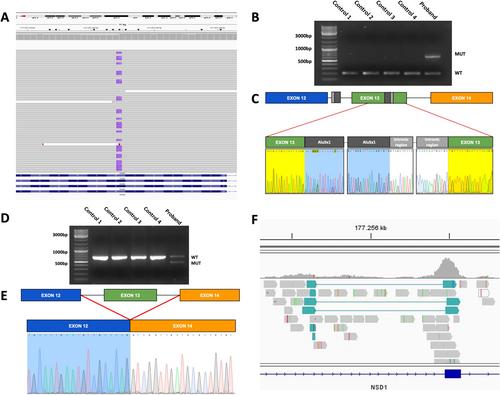
Sotos syndrome is a rare genetic disorder characterized by distinctive facial features, including a broad and prominent forehead, dolichocephaly, and learning disabilities ranging from mild to severe intellectual impairment. Affected individuals often show overgrowth in height and head circumference over two standard deviations. The syndrome is caused by haploinsufficiency of the NSD1 gene, with no evidence of genetic heterogeneity to date. Here we describe the unsolved case of a child of 4 years of age with a clinical diagnosis of Sotos syndrome. However, trio exome sequencing (ES) and exon chromosomal microarray (CMA) analysis excluded both small and large mutations in the NSD1 gene. As part of the Telethon Undiagnosed Programme, we used additional tools to investigate the possibility of new genes or elusive mutations that may have been missed by previous molecular diagnostic approaches. Therefore, we performed Nanopore long-read sequencing. This revealed a 447 bp insertion in exon 13 of the NSD1 gene. mRNA analysis confirmed in-frame skipping of exon 13 that encodes for two PHD domains. The genomic insertion shows 100% identity with an intronic region, although inverted, containing an AluSx1 element 2 kb upstream of the skipped exon, which may drive the event by masking the splice acceptor site of exon 13. Interestingly, this is the first case of Sotos syndrome linked to a pathogenic mechanism involving an insertion enclosing a transposable element generating a protein devoid of two PHDs, which are required for reading histone post-translational modifications.
期刊介绍:
The American Journal of Medical Genetics - Part A (AJMG) gives you continuous coverage of all biological and medical aspects of genetic disorders and birth defects, as well as in-depth documentation of phenotype analysis within the current context of genotype/phenotype correlations. In addition to Part A , AJMG also publishes two other parts:
Part B: Neuropsychiatric Genetics , covering experimental and clinical investigations of the genetic mechanisms underlying neurologic and psychiatric disorders.
Part C: Seminars in Medical Genetics , guest-edited collections of thematic reviews of topical interest to the readership of AJMG .



 京公网安备 11010802042870号
京ICP备2023020795号-1
京公网安备 11010802042870号
京ICP备2023020795号-1

 分享
分享
 求助内容:
求助内容: 应助结果提醒方式:
 扫码关注我们
