Jonguk Kim, Kyung-Do Han, Jeong-Yoon Lee, Ye Seul Yang, Dae Young Cheon, Jae-Jun Lee, Minwoo Lee
{"title":"Diabetes status, duration, and risk of dementia among ischemic stroke patients.","authors":"Jonguk Kim, Kyung-Do Han, Jeong-Yoon Lee, Ye Seul Yang, Dae Young Cheon, Jae-Jun Lee, Minwoo Lee","doi":"10.1186/s13195-025-01708-8","DOIUrl":null,"url":null,"abstract":"<p><strong>Background: </strong>The influence of duration of type 2 diabetes mellitus (T2DM) on the likelihood of developing new-onset dementia in post-stroke population is not well understood. Therefore, we aimed to clarify the relationship between the duration of T2DM and the risk of developing dementia in the post-stroke population.</p><p><strong>Methods: </strong>Leveraging the Korean National Health Insurance Database, this study included 118,790 individuals with a history of stroke but no previous dementia diagnosis. We classified diabetes status into five categories: normoglycemia, impaired fasting glucose (IFG), newly diagnosed T2DM, and established T2DM with durations of less than 5 years and 5 years or more. The primary endpoint was the incidence of all-cause dementia.</p><p><strong>Results: </strong>Among 118,790 participants (average age 64.26 ± 9.95 years, 48% male), 16.7% developed dementia during an average follow-up of 7.3 ± 2.3 years. Participants with a history of T2DM for less than five years at cohort entry had a 26.7% higher risk of developing all-cause dementia compared to those with normoglycemia. Those with T2DM for five years or longer had a 46.7% increased risk, with an adjusted hazard ratio (aHR) of 1.466 (95% confidence interval [CI], 1.408-1.527). Specifically, the risk of developing Alzheimer's disease (AD) and vascular dementia (VaD) rose by 43.4% and 51.4%, respectively, for individuals with T2DM lasting more than five years (aHR 1.434, 95% CI 1.366-1.505; aHR 1.514, 95% CI 1.365-1.679, respectively).</p><p><strong>Conclusions: </strong>Our findings demonstrated a significant association between an extended duration of T2DM and an increased risk of developing all-cause dementia, including AD and VaD in post-stroke population. These results emphasize proactive dementia prevention approaches in stroke survivors, particularly those with longstanding T2DM.</p>","PeriodicalId":7516,"journal":{"name":"Alzheimer's Research & Therapy","volume":"17 1","pages":"58"},"PeriodicalIF":7.6000,"publicationDate":"2025-03-08","publicationTypes":"Journal Article","fieldsOfStudy":null,"isOpenAccess":false,"openAccessPdf":"https://www.ncbi.nlm.nih.gov/pmc/articles/PMC11889840/pdf/","citationCount":"0","resultStr":null,"platform":"Semanticscholar","paperid":null,"PeriodicalName":"Alzheimer's Research & Therapy","FirstCategoryId":"3","ListUrlMain":"https://doi.org/10.1186/s13195-025-01708-8","RegionNum":1,"RegionCategory":"医学","ArticlePicture":[],"TitleCN":null,"AbstractTextCN":null,"PMCID":null,"EPubDate":"","PubModel":"","JCR":"Q1","JCRName":"CLINICAL NEUROLOGY","Score":null,"Total":0}
引用次数: 0
Abstract
Background: The influence of duration of type 2 diabetes mellitus (T2DM) on the likelihood of developing new-onset dementia in post-stroke population is not well understood. Therefore, we aimed to clarify the relationship between the duration of T2DM and the risk of developing dementia in the post-stroke population.
Methods: Leveraging the Korean National Health Insurance Database, this study included 118,790 individuals with a history of stroke but no previous dementia diagnosis. We classified diabetes status into five categories: normoglycemia, impaired fasting glucose (IFG), newly diagnosed T2DM, and established T2DM with durations of less than 5 years and 5 years or more. The primary endpoint was the incidence of all-cause dementia.
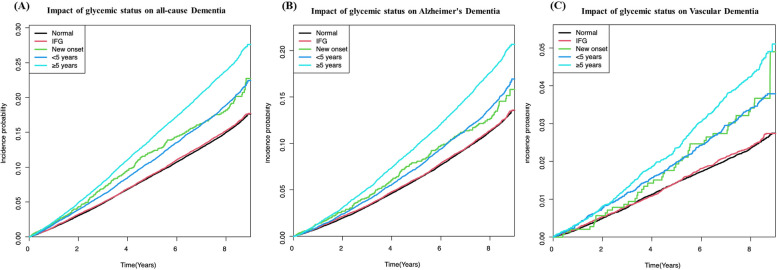
Results: Among 118,790 participants (average age 64.26 ± 9.95 years, 48% male), 16.7% developed dementia during an average follow-up of 7.3 ± 2.3 years. Participants with a history of T2DM for less than five years at cohort entry had a 26.7% higher risk of developing all-cause dementia compared to those with normoglycemia. Those with T2DM for five years or longer had a 46.7% increased risk, with an adjusted hazard ratio (aHR) of 1.466 (95% confidence interval [CI], 1.408-1.527). Specifically, the risk of developing Alzheimer's disease (AD) and vascular dementia (VaD) rose by 43.4% and 51.4%, respectively, for individuals with T2DM lasting more than five years (aHR 1.434, 95% CI 1.366-1.505; aHR 1.514, 95% CI 1.365-1.679, respectively).
Conclusions: Our findings demonstrated a significant association between an extended duration of T2DM and an increased risk of developing all-cause dementia, including AD and VaD in post-stroke population. These results emphasize proactive dementia prevention approaches in stroke survivors, particularly those with longstanding T2DM.
期刊介绍:
Alzheimer's Research & Therapy is an international peer-reviewed journal that focuses on translational research into Alzheimer's disease and other neurodegenerative diseases. It publishes open-access basic research, clinical trials, drug discovery and development studies, and epidemiologic studies. The journal also includes reviews, viewpoints, commentaries, debates, and reports. All articles published in Alzheimer's Research & Therapy are included in several reputable databases such as CAS, Current contents, DOAJ, Embase, Journal Citation Reports/Science Edition, MEDLINE, PubMed, PubMed Central, Science Citation Index Expanded (Web of Science) and Scopus.




 京公网安备 11010802042870号
京ICP备2023020795号-1
京公网安备 11010802042870号
京ICP备2023020795号-1

 分享
分享
 求助内容:
求助内容: 应助结果提醒方式:
 扫码关注我们
