Pretreatment with oral contraceptives benefit POSEIDON group 1 low prognosis patients during GnRH-antagonist protocol: a propensity score-matched retrospective cohort study.
{"title":"Pretreatment with oral contraceptives benefit POSEIDON group 1 low prognosis patients during GnRH-antagonist protocol: a propensity score-matched retrospective cohort study.","authors":"Ning Wu, Xin Li, Cheng Zeng, Jing Shang, Xiuli Yang, Qing Xue","doi":"10.1186/s13048-025-01613-6","DOIUrl":null,"url":null,"abstract":"<p><strong>Background: </strong>Poor ovarian response (POR) is a challenging condition in assisted reproduction technology. Oral contraceptives (OCs) are commonly used to suppress gonadotropin hormone release in POR patients to synchronize the development of antral follicles before ovarian stimulation. Nevertheless, the question of whether such approach confers advantageous outcomes has elicited inconclusive results in previous studies. Therefore, the objective of this study was to investigate the effect of OCs pretreatment in low prognosis patients stratified by Patient-Oriented Strategies Encompassing Individualized Oocyte Number (POSEIDON) criteria.</p><p><strong>Methods: </strong>This retrospective cohort study included 2,222 patients undergoing their first IVF or ICSI cycle from January 2012 to April 2022. After propensity score matching, 369 patients were in the OC pretreatment group and 879 in the control group. Patients were divided into four subgroups based on the POSEIDON criteria. Comparisons of ovarian response and clinical outcomes were conducted, and multivariable logistic regression was used to assess the association between OCs pretreatment and live birth, clinical pregnancy, and pregnancy loss rates.</p><p><strong>Results: </strong>Patients in POSEIDON group 1 who received OCs pretreatment exhibited a significant reduction in the dose and duration of gonadotropin administration, along with an increase in the number of oocytes retrieved, 2 pronuclei, available embryos, and good quality embryos, indicating an improvement in their ovarian response to exogenous gonadotropins. Additionally, the live birth rate (P = 0.030) and clinical pregnancy rate (P = 0.012) were significantly higher in the OCs pretreatment group. Multivariate logistic regression analysis demonstrated a positive association between OCs pretreatment and live birth rate (P = 0.008) and clinical pregnancy rate (P = 0.008). However, in POSEIDON group 2 to group 4, there were no significant differences in ovarian response or clinical outcomes between the OCs pretreatment group and the control group.</p><p><strong>Conclusions: </strong>Administering OCs as pretreatment prior to ovarian stimulation using gonadotrophin releasing hormone antagonist protocol appears to be a more favorable approach than waiting for natural menses in low prognosis patients belonging to POSEIDON group 1.</p>","PeriodicalId":16610,"journal":{"name":"Journal of Ovarian Research","volume":"18 1","pages":"47"},"PeriodicalIF":4.2000,"publicationDate":"2025-03-07","publicationTypes":"Journal Article","fieldsOfStudy":null,"isOpenAccess":false,"openAccessPdf":"https://www.ncbi.nlm.nih.gov/pmc/articles/PMC11889746/pdf/","citationCount":"0","resultStr":null,"platform":"Semanticscholar","paperid":null,"PeriodicalName":"Journal of Ovarian Research","FirstCategoryId":"3","ListUrlMain":"https://doi.org/10.1186/s13048-025-01613-6","RegionNum":3,"RegionCategory":"医学","ArticlePicture":[],"TitleCN":null,"AbstractTextCN":null,"PMCID":null,"EPubDate":"","PubModel":"","JCR":"Q1","JCRName":"REPRODUCTIVE BIOLOGY","Score":null,"Total":0}
引用次数: 0
Abstract
Background: Poor ovarian response (POR) is a challenging condition in assisted reproduction technology. Oral contraceptives (OCs) are commonly used to suppress gonadotropin hormone release in POR patients to synchronize the development of antral follicles before ovarian stimulation. Nevertheless, the question of whether such approach confers advantageous outcomes has elicited inconclusive results in previous studies. Therefore, the objective of this study was to investigate the effect of OCs pretreatment in low prognosis patients stratified by Patient-Oriented Strategies Encompassing Individualized Oocyte Number (POSEIDON) criteria.
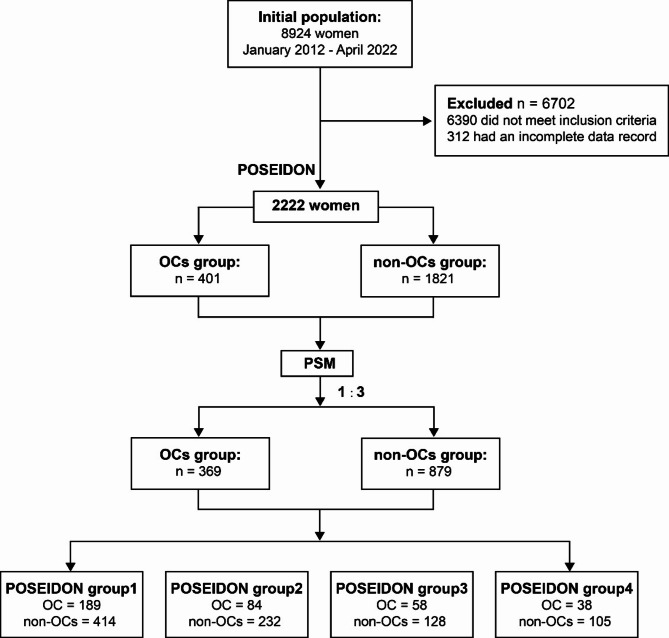
Methods: This retrospective cohort study included 2,222 patients undergoing their first IVF or ICSI cycle from January 2012 to April 2022. After propensity score matching, 369 patients were in the OC pretreatment group and 879 in the control group. Patients were divided into four subgroups based on the POSEIDON criteria. Comparisons of ovarian response and clinical outcomes were conducted, and multivariable logistic regression was used to assess the association between OCs pretreatment and live birth, clinical pregnancy, and pregnancy loss rates.
Results: Patients in POSEIDON group 1 who received OCs pretreatment exhibited a significant reduction in the dose and duration of gonadotropin administration, along with an increase in the number of oocytes retrieved, 2 pronuclei, available embryos, and good quality embryos, indicating an improvement in their ovarian response to exogenous gonadotropins. Additionally, the live birth rate (P = 0.030) and clinical pregnancy rate (P = 0.012) were significantly higher in the OCs pretreatment group. Multivariate logistic regression analysis demonstrated a positive association between OCs pretreatment and live birth rate (P = 0.008) and clinical pregnancy rate (P = 0.008). However, in POSEIDON group 2 to group 4, there were no significant differences in ovarian response or clinical outcomes between the OCs pretreatment group and the control group.
Conclusions: Administering OCs as pretreatment prior to ovarian stimulation using gonadotrophin releasing hormone antagonist protocol appears to be a more favorable approach than waiting for natural menses in low prognosis patients belonging to POSEIDON group 1.
期刊介绍:
Journal of Ovarian Research is an open access, peer reviewed, online journal that aims to provide a forum for high-quality basic and clinical research on ovarian function, abnormalities, and cancer. The journal focuses on research that provides new insights into ovarian functions as well as prevention and treatment of diseases afflicting the organ.
Topical areas include, but are not restricted to:
Ovary development, hormone secretion and regulation
Follicle growth and ovulation
Infertility and Polycystic ovarian syndrome
Regulation of pituitary and other biological functions by ovarian hormones
Ovarian cancer, its prevention, diagnosis and treatment
Drug development and screening
Role of stem cells in ovary development and function.



 京公网安备 11010802042870号
京ICP备2023020795号-1
京公网安备 11010802042870号
京ICP备2023020795号-1

 分享
分享
 求助内容:
求助内容: 应助结果提醒方式:
 扫码关注我们
