Sergio Cotugno, Elda De Vita, Luisa Frallonardo, Roberta Novara, Roberta Papagni, Muhammad Asaduzzaman, Francesco Vladimiro Segala, Nicola Veronese, Emanuele Nicastri, Anna Morea, Ferenc Balázs Farkas, Botond Lakatos, Roberta Iatta, Giovanni Putoto, Annalisa Saracino, Francesco Di Gennaro
{"title":"Antimicrobial Resistance and Migration: Interrelation Between Two Hot Topics in Global Health.","authors":"Sergio Cotugno, Elda De Vita, Luisa Frallonardo, Roberta Novara, Roberta Papagni, Muhammad Asaduzzaman, Francesco Vladimiro Segala, Nicola Veronese, Emanuele Nicastri, Anna Morea, Ferenc Balázs Farkas, Botond Lakatos, Roberta Iatta, Giovanni Putoto, Annalisa Saracino, Francesco Di Gennaro","doi":"10.5334/aogh.4628","DOIUrl":null,"url":null,"abstract":"<p><p><i>Background:</i> Antimicrobial resistance (AMR) and migration are two interlinked issues and both pose an escalating threat to global health. With an increasing trend, there are 281 million migrants globally, while AMR is contributing to over 5 million deaths annually, with a projected rise to 10 million by 2050 if left unaddressed. Both AMR and migration are multifaceted problems that extend beyond human health, involving animals, plants, and the environment-a fact highlighted by the One Health approach. <i>Objective:</i> The aim of this work is: (1) to examine the complex relationship between migration and AMR, drawing on epidemiological data, surveillance strategies, and healthcare access challenges and (2) to address an interventional strategy proposal. <i>Methods:</i> We performed a narrative review of the most updated literature about migration and AMR using three primary databases: PubMed, Scopus, and Embase. <i>Findings:</i> Migrants, particularly from low‑ and middle‑income countries, represent a unique group at increased risk of AMR due to factors such as overcrowded living conditions, limited access to healthcare, uncontrolled use of antibiotics, and high prevalence of AMR in origin countries. Studies reveal higher rates of AMR colonization and infection among migrants compared with native populations, with specific pathogens such as MRSA and multidrug‑resistant gram‑negative bacteria posing significant risks. Migratory conditions, socioeconomic vulnerability, and healthcare barriers contribute to this heightened risk. <i>Conclusion:</i> To address the intersection of migration and AMR, interventions must focus on improving living conditions, enhancing healthcare access, promoting appropriate antibiotic use, and strengthening microbiological surveillance. Multisectoral collaboration is essential to mitigate the spread of AMR and safeguard both migrant and global public health.</p>","PeriodicalId":48857,"journal":{"name":"Annals of Global Health","volume":"91 1","pages":"12"},"PeriodicalIF":3.2000,"publicationDate":"2025-03-06","publicationTypes":"Journal Article","fieldsOfStudy":null,"isOpenAccess":false,"openAccessPdf":"https://www.ncbi.nlm.nih.gov/pmc/articles/PMC11887466/pdf/","citationCount":"0","resultStr":null,"platform":"Semanticscholar","paperid":null,"PeriodicalName":"Annals of Global Health","FirstCategoryId":"3","ListUrlMain":"https://doi.org/10.5334/aogh.4628","RegionNum":4,"RegionCategory":"医学","ArticlePicture":[],"TitleCN":null,"AbstractTextCN":null,"PMCID":null,"EPubDate":"2025/1/1 0:00:00","PubModel":"eCollection","JCR":"Q2","JCRName":"PUBLIC, ENVIRONMENTAL & OCCUPATIONAL HEALTH","Score":null,"Total":0}
引用次数: 0
Abstract
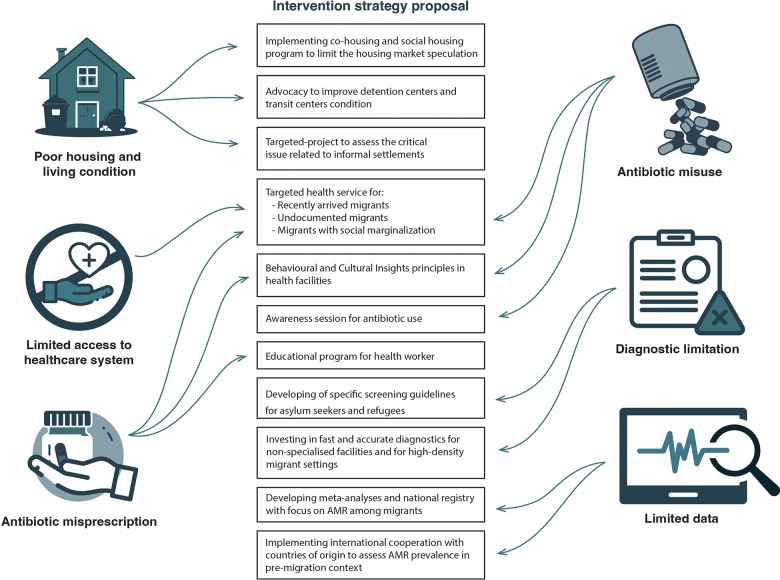
Background: Antimicrobial resistance (AMR) and migration are two interlinked issues and both pose an escalating threat to global health. With an increasing trend, there are 281 million migrants globally, while AMR is contributing to over 5 million deaths annually, with a projected rise to 10 million by 2050 if left unaddressed. Both AMR and migration are multifaceted problems that extend beyond human health, involving animals, plants, and the environment-a fact highlighted by the One Health approach. Objective: The aim of this work is: (1) to examine the complex relationship between migration and AMR, drawing on epidemiological data, surveillance strategies, and healthcare access challenges and (2) to address an interventional strategy proposal. Methods: We performed a narrative review of the most updated literature about migration and AMR using three primary databases: PubMed, Scopus, and Embase. Findings: Migrants, particularly from low‑ and middle‑income countries, represent a unique group at increased risk of AMR due to factors such as overcrowded living conditions, limited access to healthcare, uncontrolled use of antibiotics, and high prevalence of AMR in origin countries. Studies reveal higher rates of AMR colonization and infection among migrants compared with native populations, with specific pathogens such as MRSA and multidrug‑resistant gram‑negative bacteria posing significant risks. Migratory conditions, socioeconomic vulnerability, and healthcare barriers contribute to this heightened risk. Conclusion: To address the intersection of migration and AMR, interventions must focus on improving living conditions, enhancing healthcare access, promoting appropriate antibiotic use, and strengthening microbiological surveillance. Multisectoral collaboration is essential to mitigate the spread of AMR and safeguard both migrant and global public health.
期刊介绍:
ANNALS OF GLOBAL HEALTH is a peer-reviewed, open access journal focused on global health. The journal’s mission is to advance and disseminate knowledge of global health. Its goals are improve the health and well-being of all people, advance health equity and promote wise stewardship of the earth’s environment.
The journal is published by the Boston College Global Public Health Program. It was founded in 1934 by the Icahn School of Medicine at Mount Sinai as the Mount Sinai Journal of Medicine. It is a partner journal of the Consortium of Universities for Global Health.





 京公网安备 11010802042870号
京ICP备2023020795号-1
京公网安备 11010802042870号
京ICP备2023020795号-1

 分享
分享
 求助内容:
求助内容: 应助结果提醒方式:
 扫码关注我们
