Alejandro García-Consuegra, Marta Gimeno-Morales, Mauricio Cambeiro, José María López-Picazo, Juan Alcalde, Luis I Ramos, Luca Tagliaferri, José Luis Guinot, Francesco Bussu, Marta Moreno-Jiménez, Rafael Martinez-Monge
{"title":"Prospective Registry Trial of Adjuvant High-Dose Rate Brachytherapy in Unirradiated Head and Neck Cancer: 20-Year Data","authors":"Alejandro García-Consuegra, Marta Gimeno-Morales, Mauricio Cambeiro, José María López-Picazo, Juan Alcalde, Luis I Ramos, Luca Tagliaferri, José Luis Guinot, Francesco Bussu, Marta Moreno-Jiménez, Rafael Martinez-Monge","doi":"10.1002/hed.28131","DOIUrl":null,"url":null,"abstract":"<div>\n \n \n <section>\n \n <h3> Background and Purpose</h3>\n \n <p>Full-dose postoperative external beam radiation therapy (EBRT)/chemoradiation is the standard of care in patients with resected, unirradiated head and neck cancer (HNC). This study aims to determine the long-term results of adjuvant high-dose rate (HDR) brachytherapy ± intermediate-dose postoperative external beam radiation therapy (EBRT)/chemoradiation in this HNC patient population.</p>\n </section>\n \n <section>\n \n <h3> Materials and Methods</h3>\n \n <p>From 2000 to 2018, a total of 152 patients diagnosed with HNC were treated with surgery and adjuvant HDR brachytherapy alone (<i>n</i> = 32) or combined with EBRT ± chemotherapy (<i>n</i> = 120). Patients treated with brachytherapy alone received 32 or 40 Gy in 8 or 10 b.i.d. fractions. Combined modality patients received 16 or 24 Gy of HDR brachytherapy in 4–6 b.i.d. fractions followed by EBRT 45 Gy in 25 fractions ± chemotherapy.</p>\n </section>\n \n <section>\n \n <h3> Results</h3>\n \n <p>Median follow-up was 8.1 years (range, 0.1–21.6). Forty patients (26.3%) developed RTOG grade ≥ 3 adverse events, mainly soft tissue necrosis (11.2%) and osteoradionecrosis (6.6%). The 5-year local and locoregional control rates were 85.5% and 74.9%, respectively. Five-year disease-free survival and overall survival rates were 54.9% and 62.2%, respectively.</p>\n </section>\n \n <section>\n \n <h3> Conclusion</h3>\n \n <p>Adjuvant HDR brachytherapy alone or combined with EBRT is an adequate treatment option for HNC patients who are candidates to receive postoperative radiation/chemoradiation. The results obtained in terms of toxicity and locoregional control are comparable to standard chemoradiation. In addition, this study identifies a subset of patients that may benefit from adjuvant HDR in terms of reduced toxicity, provided that the high-risk CTV does not exceed 15 cm<sup>3</sup> and is treated to EQD2-DVH TV<sub>100</sub> doses of less than 87 Gy, together with a mandible<sub>2cm3</sub> of less than 61 Gy.</p>\n </section>\n </div>","PeriodicalId":55072,"journal":{"name":"Head and Neck-Journal for the Sciences and Specialties of the Head and Neck","volume":"47 8","pages":"2166-2173"},"PeriodicalIF":2.2000,"publicationDate":"2025-03-10","publicationTypes":"Journal Article","fieldsOfStudy":null,"isOpenAccess":false,"openAccessPdf":"https://onlinelibrary.wiley.com/doi/epdf/10.1002/hed.28131","citationCount":"0","resultStr":null,"platform":"Semanticscholar","paperid":null,"PeriodicalName":"Head and Neck-Journal for the Sciences and Specialties of the Head and Neck","FirstCategoryId":"3","ListUrlMain":"https://onlinelibrary.wiley.com/doi/10.1002/hed.28131","RegionNum":3,"RegionCategory":"医学","ArticlePicture":[],"TitleCN":null,"AbstractTextCN":null,"PMCID":null,"EPubDate":"","PubModel":"","JCR":"Q1","JCRName":"OTORHINOLARYNGOLOGY","Score":null,"Total":0}
引用次数: 0
Abstract
Background and Purpose
Full-dose postoperative external beam radiation therapy (EBRT)/chemoradiation is the standard of care in patients with resected, unirradiated head and neck cancer (HNC). This study aims to determine the long-term results of adjuvant high-dose rate (HDR) brachytherapy ± intermediate-dose postoperative external beam radiation therapy (EBRT)/chemoradiation in this HNC patient population.
Materials and Methods
From 2000 to 2018, a total of 152 patients diagnosed with HNC were treated with surgery and adjuvant HDR brachytherapy alone (n = 32) or combined with EBRT ± chemotherapy (n = 120). Patients treated with brachytherapy alone received 32 or 40 Gy in 8 or 10 b.i.d. fractions. Combined modality patients received 16 or 24 Gy of HDR brachytherapy in 4–6 b.i.d. fractions followed by EBRT 45 Gy in 25 fractions ± chemotherapy.
Results
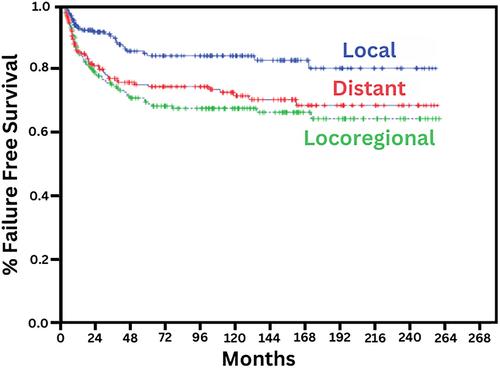
Median follow-up was 8.1 years (range, 0.1–21.6). Forty patients (26.3%) developed RTOG grade ≥ 3 adverse events, mainly soft tissue necrosis (11.2%) and osteoradionecrosis (6.6%). The 5-year local and locoregional control rates were 85.5% and 74.9%, respectively. Five-year disease-free survival and overall survival rates were 54.9% and 62.2%, respectively.
Conclusion
Adjuvant HDR brachytherapy alone or combined with EBRT is an adequate treatment option for HNC patients who are candidates to receive postoperative radiation/chemoradiation. The results obtained in terms of toxicity and locoregional control are comparable to standard chemoradiation. In addition, this study identifies a subset of patients that may benefit from adjuvant HDR in terms of reduced toxicity, provided that the high-risk CTV does not exceed 15 cm3 and is treated to EQD2-DVH TV100 doses of less than 87 Gy, together with a mandible2cm3 of less than 61 Gy.
期刊介绍:
Head & Neck is an international multidisciplinary publication of original contributions concerning the diagnosis and management of diseases of the head and neck. This area involves the overlapping interests and expertise of several surgical and medical specialties, including general surgery, neurosurgery, otolaryngology, plastic surgery, oral surgery, dermatology, ophthalmology, pathology, radiotherapy, medical oncology, and the corresponding basic sciences.



 京公网安备 11010802042870号
京ICP备2023020795号-1
京公网安备 11010802042870号
京ICP备2023020795号-1

 分享
分享
 求助内容:
求助内容: 应助结果提醒方式:
 扫码关注我们
