Suja Joseph, Jose Jacob, Angel M Joseph, Rene Kuriakose, Mohammed Z Mustafa, Venu Yasodharan, Pradeep C Dathan, Nazia Rasheed
{"title":"Evaluation of Maxibloc Bone Grafts Biocompatibility and Osteoconductivity: An Animal Study.","authors":"Suja Joseph, Jose Jacob, Angel M Joseph, Rene Kuriakose, Mohammed Z Mustafa, Venu Yasodharan, Pradeep C Dathan, Nazia Rasheed","doi":"10.4103/jpbs.jpbs_505_24","DOIUrl":null,"url":null,"abstract":"<p><strong>Context: </strong>Alveolar bone resorption poses a significant challenge in rehabilitating edentulous patients. Ridge augmentation materials can stimulate bone growth in deficient areas.</p><p><strong>Aim: </strong>To evaluate the biocompatibility and osteoconductivity of maxibloc bone grafts in rabbits.</p><p><strong>Materials and methods: </strong>Maxibloc was packed into bony voids created surgically in the mandible and femur of rabbits, which were sacrificed at the fourth, eighth, and twelfth weeks. Radiography and histopathology evaluations assessed the osteoconductivity; hematology and toxicology evaluations assessed the biocompatibility of maxibloc.</p><p><strong>Results: </strong>Radiography revealed bone formation and homogenization without osteolysis. Histopathology revealed new bone formation with osteoblasts, fibrous and collagen tissue, cartilage formation, and no foreign body reaction or inflammation. Hematology revealed stable hemoglobin concentration, white blood cell count, eosinophil count, and absence of leucocytosis. Toxicology revealed elevated mortality rates at higher doses, whereas lower doses were safe. Animals exhibited no signs of systemic toxicity or behavioral changes.</p><p><strong>Conclusions: </strong>Maxibloc has demonstrated biocompatibility and osteoconductivity, presenting as a promising alloplastic bone graft.</p>","PeriodicalId":94339,"journal":{"name":"Journal of pharmacy & bioallied sciences","volume":"16 Suppl 5","pages":"S4349-S4353"},"PeriodicalIF":0.9000,"publicationDate":"2024-12-01","publicationTypes":"Journal Article","fieldsOfStudy":null,"isOpenAccess":false,"openAccessPdf":"https://www.ncbi.nlm.nih.gov/pmc/articles/PMC11888754/pdf/","citationCount":"0","resultStr":null,"platform":"Semanticscholar","paperid":null,"PeriodicalName":"Journal of pharmacy & bioallied sciences","FirstCategoryId":"1085","ListUrlMain":"https://doi.org/10.4103/jpbs.jpbs_505_24","RegionNum":0,"RegionCategory":null,"ArticlePicture":[],"TitleCN":null,"AbstractTextCN":null,"PMCID":null,"EPubDate":"2025/1/30 0:00:00","PubModel":"Epub","JCR":"Q4","JCRName":"PHARMACOLOGY & PHARMACY","Score":null,"Total":0}
引用次数: 0
Abstract
Context: Alveolar bone resorption poses a significant challenge in rehabilitating edentulous patients. Ridge augmentation materials can stimulate bone growth in deficient areas.
Aim: To evaluate the biocompatibility and osteoconductivity of maxibloc bone grafts in rabbits.
Materials and methods: Maxibloc was packed into bony voids created surgically in the mandible and femur of rabbits, which were sacrificed at the fourth, eighth, and twelfth weeks. Radiography and histopathology evaluations assessed the osteoconductivity; hematology and toxicology evaluations assessed the biocompatibility of maxibloc.
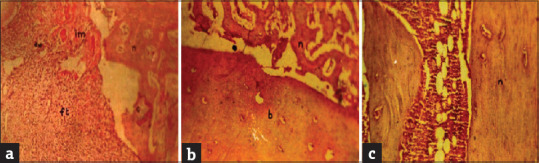
Results: Radiography revealed bone formation and homogenization without osteolysis. Histopathology revealed new bone formation with osteoblasts, fibrous and collagen tissue, cartilage formation, and no foreign body reaction or inflammation. Hematology revealed stable hemoglobin concentration, white blood cell count, eosinophil count, and absence of leucocytosis. Toxicology revealed elevated mortality rates at higher doses, whereas lower doses were safe. Animals exhibited no signs of systemic toxicity or behavioral changes.
Conclusions: Maxibloc has demonstrated biocompatibility and osteoconductivity, presenting as a promising alloplastic bone graft.




 京公网安备 11010802042870号
京ICP备2023020795号-1
京公网安备 11010802042870号
京ICP备2023020795号-1

 分享
分享

 求助内容:
求助内容: 应助结果提醒方式:
 扫码关注我们
