Alexander Mader, Andrew I Rodriguez, Tianyu Yuan, Ivan Surovtsev, Megan C King, Simon G J Mochrie
{"title":"Coarse-grained chromatin dynamics by tracking multiple similarly labeled gene loci.","authors":"Alexander Mader, Andrew I Rodriguez, Tianyu Yuan, Ivan Surovtsev, Megan C King, Simon G J Mochrie","doi":"10.1101/2025.02.27.640402","DOIUrl":null,"url":null,"abstract":"<p><p>The \"holy grail\" of chromatin research would be to follow the chromatin configuration in individual live cells over time. One way to achieve this goal would be to track the positions of multiple loci arranged along the chromatin polymer with fluorescent labels. Use of distinguishable labels would define each locus uniquely in a microscopic image but would restrict the number of loci that could be observed simultaneously, because of experimental limits to the number of distinguishable labels. Use of the same label for all loci circumvents this limitation but requires a (currently lacking) framework for how to establish each observed locus identity, i.e. to which genomic position it corresponds. Here we analyze theoretically, using simulations of Rouse-model polymers, how single-particle-tracking of multiple identically-labeled loci enables determination of loci identity. We show that the probability of correctly assigning observed loci to genomic positions converges exponentially to unity as the number of observed loci configurations increases. The convergence rate depends only weakly on the number of labeled loci, so that even large numbers of loci can be identified with high fidelity by tracking them across about 8 independent chromatin configurations. In the case of two distinct labels that alternate along the chromatin polymer, we find that the probability of the correct assignment converges faster than for same-labeled loci, requiring observation of fewer independent chromatin configurations to establish loci identities. Finally, for a modified Rouse-model polymer, that realizes a population of dynamic loops, we find that the success probability also converges to unity exponentially as the number of observed loci configurations increases, albeit slightly more slowly than for a classical Rouse model polymer. Altogether, these results establish particle tracking of multiple identically- or alternately-labeled loci over time as a feasible way to infer temporal dynamics of the coarse-grained configuration of the chromatin polymer in individual living cells.</p>","PeriodicalId":519960,"journal":{"name":"bioRxiv : the preprint server for biology","volume":" ","pages":""},"PeriodicalIF":0.0000,"publicationDate":"2025-03-02","publicationTypes":"Journal Article","fieldsOfStudy":null,"isOpenAccess":false,"openAccessPdf":"https://www.ncbi.nlm.nih.gov/pmc/articles/PMC11888427/pdf/","citationCount":"0","resultStr":null,"platform":"Semanticscholar","paperid":null,"PeriodicalName":"bioRxiv : the preprint server for biology","FirstCategoryId":"1085","ListUrlMain":"https://doi.org/10.1101/2025.02.27.640402","RegionNum":0,"RegionCategory":null,"ArticlePicture":[],"TitleCN":null,"AbstractTextCN":null,"PMCID":null,"EPubDate":"","PubModel":"","JCR":"","JCRName":"","Score":null,"Total":0}
引用次数: 0
Abstract
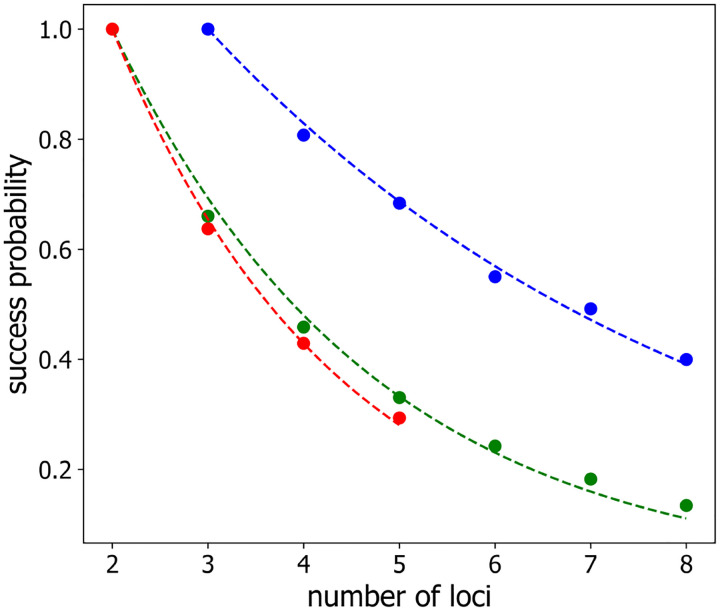
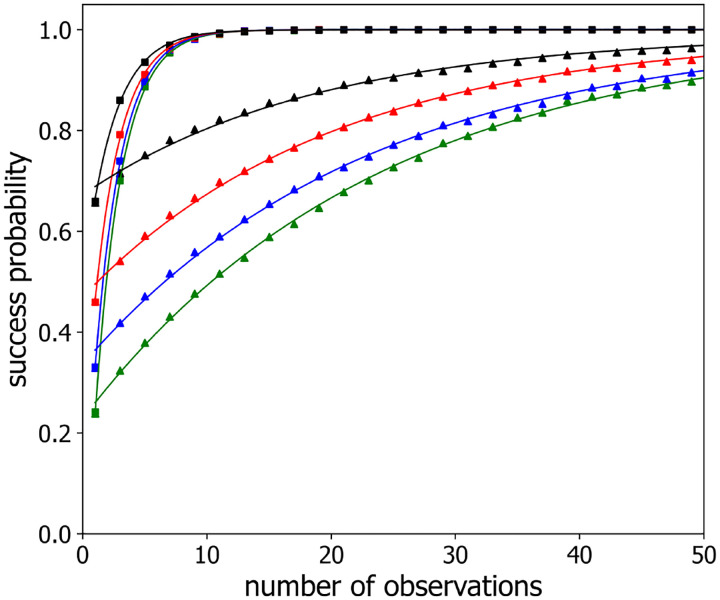
The "holy grail" of chromatin research would be to follow the chromatin configuration in individual live cells over time. One way to achieve this goal would be to track the positions of multiple loci arranged along the chromatin polymer with fluorescent labels. Use of distinguishable labels would define each locus uniquely in a microscopic image but would restrict the number of loci that could be observed simultaneously, because of experimental limits to the number of distinguishable labels. Use of the same label for all loci circumvents this limitation but requires a (currently lacking) framework for how to establish each observed locus identity, i.e. to which genomic position it corresponds. Here we analyze theoretically, using simulations of Rouse-model polymers, how single-particle-tracking of multiple identically-labeled loci enables determination of loci identity. We show that the probability of correctly assigning observed loci to genomic positions converges exponentially to unity as the number of observed loci configurations increases. The convergence rate depends only weakly on the number of labeled loci, so that even large numbers of loci can be identified with high fidelity by tracking them across about 8 independent chromatin configurations. In the case of two distinct labels that alternate along the chromatin polymer, we find that the probability of the correct assignment converges faster than for same-labeled loci, requiring observation of fewer independent chromatin configurations to establish loci identities. Finally, for a modified Rouse-model polymer, that realizes a population of dynamic loops, we find that the success probability also converges to unity exponentially as the number of observed loci configurations increases, albeit slightly more slowly than for a classical Rouse model polymer. Altogether, these results establish particle tracking of multiple identically- or alternately-labeled loci over time as a feasible way to infer temporal dynamics of the coarse-grained configuration of the chromatin polymer in individual living cells.




 京公网安备 11010802042870号
京ICP备2023020795号-1
京公网安备 11010802042870号
京ICP备2023020795号-1

 分享
分享

 求助内容:
求助内容: 应助结果提醒方式:
 扫码关注我们
