Clinton M Holt, Alexis K Janke, Parastoo Amlashi, Parker J Jamieson, Toma M Marinov, Ivelin S Georgiev
{"title":"Contrastive Learning Enables Epitope Overlap Predictions for Targeted Antibody Discovery.","authors":"Clinton M Holt, Alexis K Janke, Parastoo Amlashi, Parker J Jamieson, Toma M Marinov, Ivelin S Georgiev","doi":"10.1101/2025.02.25.640114","DOIUrl":null,"url":null,"abstract":"<p><p>Computational epitope prediction remains an unmet need for therapeutic antibody development. We present three complementary approaches for predicting epitope relationships from antibody amino acid sequences. First, we analyze ~18 million antibody pairs targeting ~250 protein families and establish that a threshold of >70% CDRH3 sequence identity among antibodies sharing both heavy and light chain V-genes reliably predicts overlapping-epitope antibody pairs. Next, we develop a supervised contrastive fine-tuning framework for antibody large language models which results in embeddings that better correlate with epitope information than those from pretrained models. Applying this contrastive learning approach to SARS-CoV-2 receptor binding domain antibodies, we achieve 82.7% balanced accuracy in distinguishing same-epitope versus different-epitope antibody pairs and demonstrate the ability to predict relative levels of structural overlap from learning on functional epitope bins (Spearman <i>ρ</i> = 0.25). Finally, we create AbLang-PDB, a generalized model for predicting overlapping-epitope antibodies for a broad range of protein families. AbLang-PDB achieves five-fold improvement in average precision for predicting overlapping-epitope antibody pairs compared to sequence-based methods, and effectively predicts the amount of epitope overlap among overlapping-epitope pairs (<i>ρ</i> = 0.81). In an antibody discovery campaign searching for overlapping-epitope antibodies to the HIV-1 broadly neutralizing antibody 8ANC195, 70% of computationally selected candidates demonstrated HIV-1 specificity, with 50% showing competitive binding with 8ANC195. Together, the computational models presented here provide powerful tools for epitope-targeted antibody discovery, while demonstrating the efficacy of contrastive learning for improving epitope-representation.</p>","PeriodicalId":519960,"journal":{"name":"bioRxiv : the preprint server for biology","volume":" ","pages":""},"PeriodicalIF":0.0000,"publicationDate":"2025-04-01","publicationTypes":"Journal Article","fieldsOfStudy":null,"isOpenAccess":false,"openAccessPdf":"https://www.ncbi.nlm.nih.gov/pmc/articles/PMC11888244/pdf/","citationCount":"0","resultStr":null,"platform":"Semanticscholar","paperid":null,"PeriodicalName":"bioRxiv : the preprint server for biology","FirstCategoryId":"1085","ListUrlMain":"https://doi.org/10.1101/2025.02.25.640114","RegionNum":0,"RegionCategory":null,"ArticlePicture":[],"TitleCN":null,"AbstractTextCN":null,"PMCID":null,"EPubDate":"","PubModel":"","JCR":"","JCRName":"","Score":null,"Total":0}
引用次数: 0
Abstract
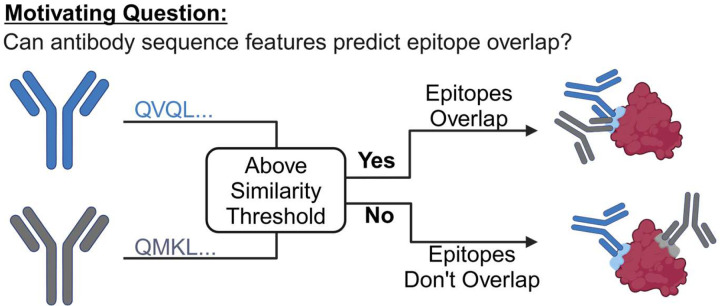
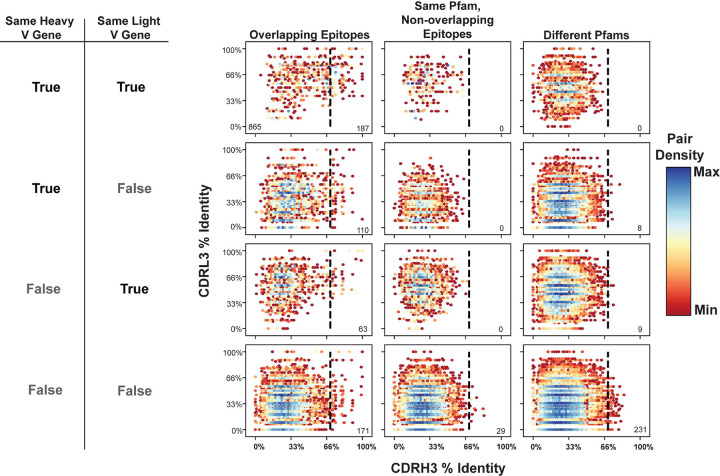
Computational epitope prediction remains an unmet need for therapeutic antibody development. We present three complementary approaches for predicting epitope relationships from antibody amino acid sequences. First, we analyze ~18 million antibody pairs targeting ~250 protein families and establish that a threshold of >70% CDRH3 sequence identity among antibodies sharing both heavy and light chain V-genes reliably predicts overlapping-epitope antibody pairs. Next, we develop a supervised contrastive fine-tuning framework for antibody large language models which results in embeddings that better correlate with epitope information than those from pretrained models. Applying this contrastive learning approach to SARS-CoV-2 receptor binding domain antibodies, we achieve 82.7% balanced accuracy in distinguishing same-epitope versus different-epitope antibody pairs and demonstrate the ability to predict relative levels of structural overlap from learning on functional epitope bins (Spearman ρ = 0.25). Finally, we create AbLang-PDB, a generalized model for predicting overlapping-epitope antibodies for a broad range of protein families. AbLang-PDB achieves five-fold improvement in average precision for predicting overlapping-epitope antibody pairs compared to sequence-based methods, and effectively predicts the amount of epitope overlap among overlapping-epitope pairs (ρ = 0.81). In an antibody discovery campaign searching for overlapping-epitope antibodies to the HIV-1 broadly neutralizing antibody 8ANC195, 70% of computationally selected candidates demonstrated HIV-1 specificity, with 50% showing competitive binding with 8ANC195. Together, the computational models presented here provide powerful tools for epitope-targeted antibody discovery, while demonstrating the efficacy of contrastive learning for improving epitope-representation.




 京公网安备 11010802042870号
京ICP备2023020795号-1
京公网安备 11010802042870号
京ICP备2023020795号-1

 分享
分享

 求助内容:
求助内容: 应助结果提醒方式:
 扫码关注我们
