Mingxin Shi, Yeongseok Oh, Debra A Mitchell, James A MacLean, Ryan J McLaughlin, Kanako Hayashi
{"title":"Transgenerational effects of perinatal cannabis exposure on female reproductive parameters in mice.","authors":"Mingxin Shi, Yeongseok Oh, Debra A Mitchell, James A MacLean, Ryan J McLaughlin, Kanako Hayashi","doi":"10.1101/2025.02.24.639897","DOIUrl":null,"url":null,"abstract":"<p><p>The use of cannabis during pregnancy and nursing is a growing public health concern, and the multigenerational impacts of perinatal cannabis exposure remain largely unknown. To address this knowledge gap, we sought to examine the long-term consequences of perinatal cannabis use on reproductive function and how it might impact subsequent generations. Pregnant female mice were exposed to control vehicle or cannabis extract [25, 100, or 200 mg/ml Δ9-tetrahydrocannabinol (THC) in the cannabis extract] from gestational day 1 to postnatal day 21 (twice/day), encompassing the duration of pregnancy through weaning. Based on plasma THC concentrations in F0 females, we chose 100 and 200 mg/ml THC in the cannabis extract for subsequent studies. The selected doses and exposure conditions did not disrupt pregnancy or nursing in F0 females. Pregnancy and neonatal outcomes, including gestational length, litter size, and sexual ratio, were not affected by cannabis exposure. However, cannabis-exposed neonatal F1 pups were smaller. Cannabis exposure delayed vaginal opening as a sign of puberty onset and disrupted estrous cyclicity in F1 females. However, its effects were minor in F2 and F3 females. F1-F3 females showed no abnormal ovarian and uterine histology or plasma estradiol-17β levels and could produce normal offspring without pregnancy issues. These results suggest that the hypothalamus and pituitary are likely perturbed by perinatal cannabis exposure, and the early hypothalamus-pituitary-ovarian axis is disrupted in F1 females. However, they are not sufficient to compromise adult reproductive function. The present results indicate limited transgenerational effects of perinatal cannabis exposure on female reproductive parameters.</p>","PeriodicalId":519960,"journal":{"name":"bioRxiv : the preprint server for biology","volume":" ","pages":""},"PeriodicalIF":0.0000,"publicationDate":"2025-02-28","publicationTypes":"Journal Article","fieldsOfStudy":null,"isOpenAccess":false,"openAccessPdf":"https://www.ncbi.nlm.nih.gov/pmc/articles/PMC11888374/pdf/","citationCount":"0","resultStr":null,"platform":"Semanticscholar","paperid":null,"PeriodicalName":"bioRxiv : the preprint server for biology","FirstCategoryId":"1085","ListUrlMain":"https://doi.org/10.1101/2025.02.24.639897","RegionNum":0,"RegionCategory":null,"ArticlePicture":[],"TitleCN":null,"AbstractTextCN":null,"PMCID":null,"EPubDate":"","PubModel":"","JCR":"","JCRName":"","Score":null,"Total":0}
引用次数: 0
Abstract
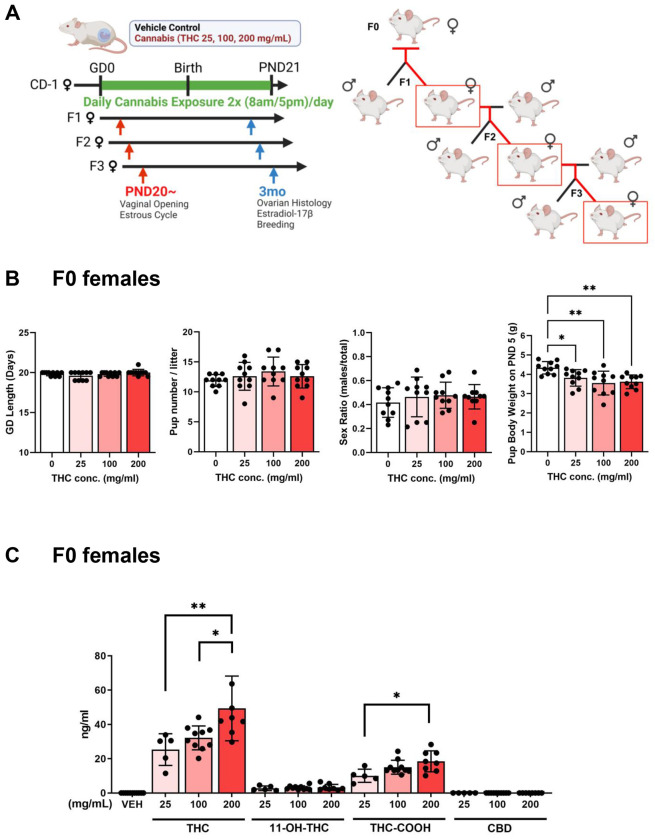
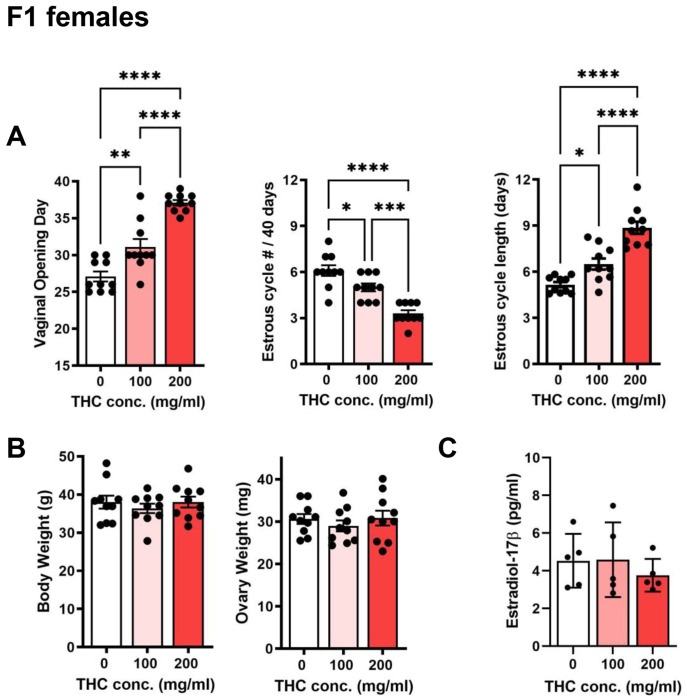
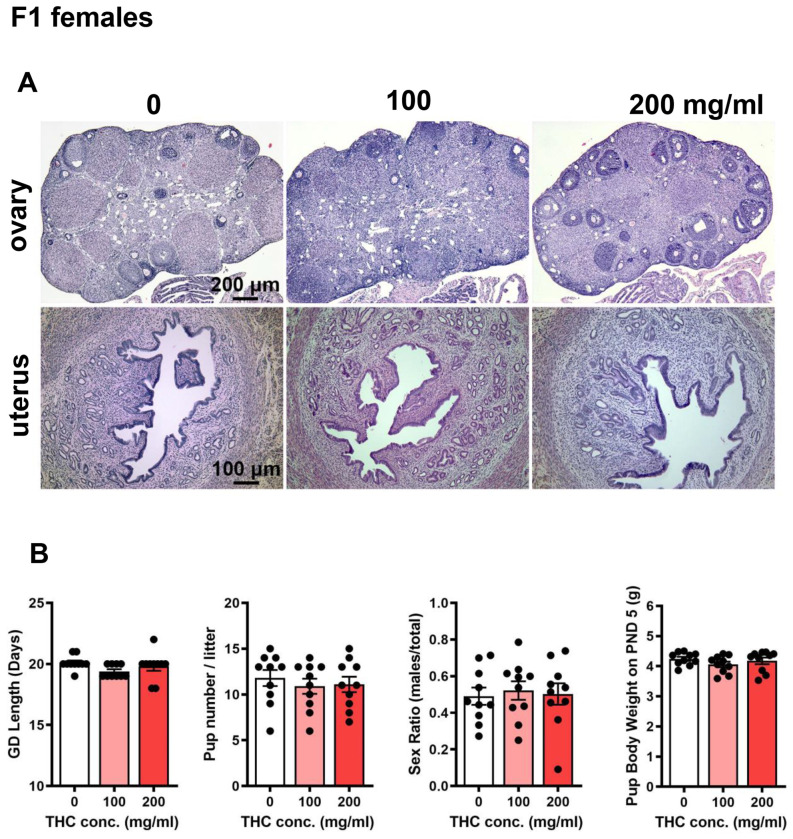
The use of cannabis during pregnancy and nursing is a growing public health concern, and the multigenerational impacts of perinatal cannabis exposure remain largely unknown. To address this knowledge gap, we sought to examine the long-term consequences of perinatal cannabis use on reproductive function and how it might impact subsequent generations. Pregnant female mice were exposed to control vehicle or cannabis extract [25, 100, or 200 mg/ml Δ9-tetrahydrocannabinol (THC) in the cannabis extract] from gestational day 1 to postnatal day 21 (twice/day), encompassing the duration of pregnancy through weaning. Based on plasma THC concentrations in F0 females, we chose 100 and 200 mg/ml THC in the cannabis extract for subsequent studies. The selected doses and exposure conditions did not disrupt pregnancy or nursing in F0 females. Pregnancy and neonatal outcomes, including gestational length, litter size, and sexual ratio, were not affected by cannabis exposure. However, cannabis-exposed neonatal F1 pups were smaller. Cannabis exposure delayed vaginal opening as a sign of puberty onset and disrupted estrous cyclicity in F1 females. However, its effects were minor in F2 and F3 females. F1-F3 females showed no abnormal ovarian and uterine histology or plasma estradiol-17β levels and could produce normal offspring without pregnancy issues. These results suggest that the hypothalamus and pituitary are likely perturbed by perinatal cannabis exposure, and the early hypothalamus-pituitary-ovarian axis is disrupted in F1 females. However, they are not sufficient to compromise adult reproductive function. The present results indicate limited transgenerational effects of perinatal cannabis exposure on female reproductive parameters.



 京公网安备 11010802042870号
京ICP备2023020795号-1
京公网安备 11010802042870号
京ICP备2023020795号-1

 分享
分享

 求助内容:
求助内容: 应助结果提醒方式:
 扫码关注我们
