Gold nanorods as multidimensional optical nanomaterials: machine learning-enhanced quantitative fingerprinting of proteins for diagnostic applications†
Afsaneh Orouji, Mahdi Ghamsari, Samira Abbasi-Moayed, Mahmood Akbari, Malik Maaza and Mohammad Reza Hormozi-Nezhad
{"title":"Gold nanorods as multidimensional optical nanomaterials: machine learning-enhanced quantitative fingerprinting of proteins for diagnostic applications†","authors":"Afsaneh Orouji, Mahdi Ghamsari, Samira Abbasi-Moayed, Mahmood Akbari, Malik Maaza and Mohammad Reza Hormozi-Nezhad","doi":"10.1039/D4NR04797D","DOIUrl":null,"url":null,"abstract":"<p >The rapid and precise quantification and identification of proteins as key diagnostic biomarkers hold significant promise in allergy testing, disease diagnosis, clinical treatment, and proteomics. This is crucial because alterations in disease-associated genetic information during pathogenesis often result in changes in protein types and levels. Therefore, the design of portable, fast, user-friendly, and affordable sensing platforms rather than a single-sensor-per-analyte strategy for multiplex protein detection is quite consequential. In the present research, a robust multicolorimetric probe based on the inhibited etching of gold nanorods (AuNRs) allowing unambiguous high-performance visual and spectral quantification and identification of proteins in human urine samples was designed. Most recently, we discovered that <em>N</em>-bromosuccinimide (NBS) can quickly etch AuNRs with a distinct color change, allowing convenient and accurate visual recognition of all amino acids. Herein, further explorations revealed that the presence of proteins, as amino acids’ polymers, reduces the effective concentration of NBS to different amounts and in turn prevents the etching of AuNRs to various degrees, thereby allowing precise quantification and identification of various proteins ranging from phosphatase (ACP), pepsin (Pep), hemoglobin (Hem), and transferrin (TRF) to immunoglobulin G (IgG), lysozyme (Lys), fibrinogen (Fib), and human serum albumin (HSA). The acquired dataset was statistically analyzed using linear discriminant analysis (LDA), partial least-squares regression (PLSR), and hierarchical cluster analysis (HCA) to accurately classify and identify individual proteins and their combinations at various levels. The multivariate regression models indicated that the colorimetric responses were linearly dependent on protein concentrations with low detection limits of around 1 ppm. Most importantly, the proposed multidimensional colorimetric probe was successfully utilized for protein discrimination in real urine samples. The diverse rainbow responses exhibited by the AuNRs in the proposed probe greatly enhance the accuracy of visual detection, making it a practical tool for straightforward protein monitoring in real samples.</p>","PeriodicalId":92,"journal":{"name":"Nanoscale","volume":" 13","pages":" 7957-7969"},"PeriodicalIF":5.1000,"publicationDate":"2025-03-11","publicationTypes":"Journal Article","fieldsOfStudy":null,"isOpenAccess":false,"openAccessPdf":"","citationCount":"0","resultStr":null,"platform":"Semanticscholar","paperid":null,"PeriodicalName":"Nanoscale","FirstCategoryId":"88","ListUrlMain":"https://pubs.rsc.org/en/content/articlelanding/2025/nr/d4nr04797d","RegionNum":3,"RegionCategory":"材料科学","ArticlePicture":[],"TitleCN":null,"AbstractTextCN":null,"PMCID":null,"EPubDate":"","PubModel":"","JCR":"Q1","JCRName":"CHEMISTRY, MULTIDISCIPLINARY","Score":null,"Total":0}
引用次数: 0
Abstract
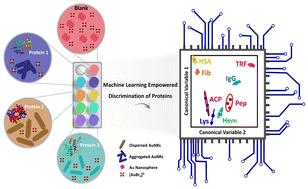
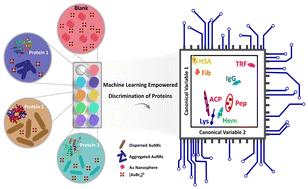
The rapid and precise quantification and identification of proteins as key diagnostic biomarkers hold significant promise in allergy testing, disease diagnosis, clinical treatment, and proteomics. This is crucial because alterations in disease-associated genetic information during pathogenesis often result in changes in protein types and levels. Therefore, the design of portable, fast, user-friendly, and affordable sensing platforms rather than a single-sensor-per-analyte strategy for multiplex protein detection is quite consequential. In the present research, a robust multicolorimetric probe based on the inhibited etching of gold nanorods (AuNRs) allowing unambiguous high-performance visual and spectral quantification and identification of proteins in human urine samples was designed. Most recently, we discovered that N-bromosuccinimide (NBS) can quickly etch AuNRs with a distinct color change, allowing convenient and accurate visual recognition of all amino acids. Herein, further explorations revealed that the presence of proteins, as amino acids’ polymers, reduces the effective concentration of NBS to different amounts and in turn prevents the etching of AuNRs to various degrees, thereby allowing precise quantification and identification of various proteins ranging from phosphatase (ACP), pepsin (Pep), hemoglobin (Hem), and transferrin (TRF) to immunoglobulin G (IgG), lysozyme (Lys), fibrinogen (Fib), and human serum albumin (HSA). The acquired dataset was statistically analyzed using linear discriminant analysis (LDA), partial least-squares regression (PLSR), and hierarchical cluster analysis (HCA) to accurately classify and identify individual proteins and their combinations at various levels. The multivariate regression models indicated that the colorimetric responses were linearly dependent on protein concentrations with low detection limits of around 1 ppm. Most importantly, the proposed multidimensional colorimetric probe was successfully utilized for protein discrimination in real urine samples. The diverse rainbow responses exhibited by the AuNRs in the proposed probe greatly enhance the accuracy of visual detection, making it a practical tool for straightforward protein monitoring in real samples.
期刊介绍:
Nanoscale is a high-impact international journal, publishing high-quality research across nanoscience and nanotechnology. Nanoscale publishes a full mix of research articles on experimental and theoretical work, including reviews, communications, and full papers.Highly interdisciplinary, this journal appeals to scientists, researchers and professionals interested in nanoscience and nanotechnology, quantum materials and quantum technology, including the areas of physics, chemistry, biology, medicine, materials, energy/environment, information technology, detection science, healthcare and drug discovery, and electronics.



 京公网安备 11010802042870号
京ICP备2023020795号-1
京公网安备 11010802042870号
京ICP备2023020795号-1

 分享
分享
 求助内容:
求助内容: 应助结果提醒方式:
 扫码关注我们
