{"title":"Unraveling the α-effect in α-fluorinated carbanionic nucleophiles: origins and synthetic implications†","authors":"Jimin Yang , Xiao-Song Xue","doi":"10.1039/d5qo00292c","DOIUrl":null,"url":null,"abstract":"<div><div>The α-effect refers to the dramatically enhanced reactivity of α-nucleophiles bearing a heteroatom with an adjacent lone-pair (R–Y–X:<sup>−</sup>) compared to normal nucleophiles (R–X:<sup>−</sup>), as predicted by Brønsted-type correlation. Despite extensive research, the underlying mechanisms of this phenomenon remain debated, and previous studies have predominantly focused on O-, N-, and S-based nucleophiles, leaving carbanions—key intermediates in organic synthesis—comparatively underexplored. Here, we present an in-depth computational investigation into the intriguing influence of α-fluorine substitution on carbanion nucleophilicity. Despite fluorine's strong electron-withdrawing capability, our results reveal that α-fluorocarbanions could exhibit the α-effect when they satisfy Hamlin's two criteria originally proposed for heteroatom-based anionic α-nucleophiles. This study extends the scope of the α-effect from heteroatom-based nucleophiles to carbanionic nucleophiles, offering new insights into this fundamental chemical phenomenon.</div></div>","PeriodicalId":94379,"journal":{"name":"Organic chemistry frontiers : an international journal of organic chemistry","volume":"12 9","pages":"Pages 2926-2934"},"PeriodicalIF":0.0000,"publicationDate":"2025-02-27","publicationTypes":"Journal Article","fieldsOfStudy":null,"isOpenAccess":false,"openAccessPdf":"","citationCount":"0","resultStr":null,"platform":"Semanticscholar","paperid":null,"PeriodicalName":"Organic chemistry frontiers : an international journal of organic chemistry","FirstCategoryId":"1085","ListUrlMain":"https://www.sciencedirect.com/org/science/article/pii/S2052412925001391","RegionNum":0,"RegionCategory":null,"ArticlePicture":[],"TitleCN":null,"AbstractTextCN":null,"PMCID":null,"EPubDate":"","PubModel":"","JCR":"","JCRName":"","Score":null,"Total":0}
引用次数: 0
Abstract
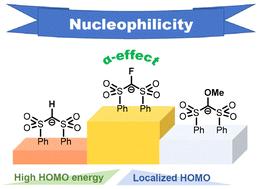
The α-effect refers to the dramatically enhanced reactivity of α-nucleophiles bearing a heteroatom with an adjacent lone-pair (R–Y–X:−) compared to normal nucleophiles (R–X:−), as predicted by Brønsted-type correlation. Despite extensive research, the underlying mechanisms of this phenomenon remain debated, and previous studies have predominantly focused on O-, N-, and S-based nucleophiles, leaving carbanions—key intermediates in organic synthesis—comparatively underexplored. Here, we present an in-depth computational investigation into the intriguing influence of α-fluorine substitution on carbanion nucleophilicity. Despite fluorine's strong electron-withdrawing capability, our results reveal that α-fluorocarbanions could exhibit the α-effect when they satisfy Hamlin's two criteria originally proposed for heteroatom-based anionic α-nucleophiles. This study extends the scope of the α-effect from heteroatom-based nucleophiles to carbanionic nucleophiles, offering new insights into this fundamental chemical phenomenon.



 京公网安备 11010802042870号
京ICP备2023020795号-1
京公网安备 11010802042870号
京ICP备2023020795号-1

 分享
分享

 求助内容:
求助内容: 应助结果提醒方式:
 扫码关注我们
