Hyekyung Kwon, Hyuk Choi, Yeji Yoon, Beomjoon Jeon, Mincheol Kang, Jeong Young Park, Hyun You Kim, Si Woo Lee
{"title":"Electronic Switching between Hot Electrons and Hot Holes via Schottky Junctions during Chemical Reactions","authors":"Hyekyung Kwon, Hyuk Choi, Yeji Yoon, Beomjoon Jeon, Mincheol Kang, Jeong Young Park, Hyun You Kim, Si Woo Lee","doi":"10.1021/acsnano.5c01261","DOIUrl":null,"url":null,"abstract":"Hot carriers, generated through nonadiabatic energy dissipation during exothermic catalytic reactions, play a pivotal role in enhancing catalytic performance. Upon generation, hot electrons typically reside in the sp-band above the Fermi level, while hot holes are formed in the <i>d</i>-band below the Fermi level, following the energy distribution of the metal’s electronic structure. However, it has been technically challenging to simultaneously capture and understand the flow of these two opposite charges during chemical reactions. In this study, we employed Pt/Si Schottky nanodiodes to detect reaction-induced hot carriers. The flux of hot electrons and hot holes was observed to vary depending on whether the Pt catalyst was deposited on n<i>-</i>Si or p<i>-</i>Si, respectively. Indeed, the detection probability of hot holes was lower compared to hot electrons, attributed to the shorter mean free path of hot holes. This demonstrates that for quantitative capture of hot carriers at the metal–semiconductor Schottky junction, the transport process through which the excited carrier passes the metal must also be considered. When a forward bias was applied to the Pt/p<i>-</i>Si nanodiode, a switch from hot hole to hot electron transfer was observed, due to the perturbation of the band structures. Our first prototype platforms, which self-control the transfer of hot carriers during the chemical reaction using Schottky junctions, may offer insights into potential applications of hot carriers in catalytic devices, energy conversion<i>-</i>based devices, or chemical sensors.","PeriodicalId":21,"journal":{"name":"ACS Nano","volume":"49 1","pages":""},"PeriodicalIF":16.0000,"publicationDate":"2025-03-11","publicationTypes":"Journal Article","fieldsOfStudy":null,"isOpenAccess":false,"openAccessPdf":"","citationCount":"0","resultStr":null,"platform":"Semanticscholar","paperid":null,"PeriodicalName":"ACS Nano","FirstCategoryId":"88","ListUrlMain":"https://doi.org/10.1021/acsnano.5c01261","RegionNum":1,"RegionCategory":"材料科学","ArticlePicture":[],"TitleCN":null,"AbstractTextCN":null,"PMCID":null,"EPubDate":"","PubModel":"","JCR":"Q1","JCRName":"CHEMISTRY, MULTIDISCIPLINARY","Score":null,"Total":0}
引用次数: 0
Abstract
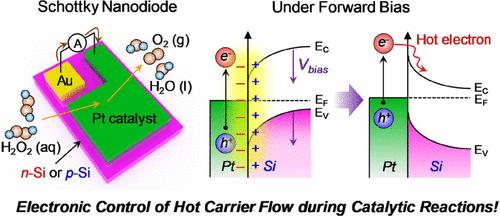
Hot carriers, generated through nonadiabatic energy dissipation during exothermic catalytic reactions, play a pivotal role in enhancing catalytic performance. Upon generation, hot electrons typically reside in the sp-band above the Fermi level, while hot holes are formed in the d-band below the Fermi level, following the energy distribution of the metal’s electronic structure. However, it has been technically challenging to simultaneously capture and understand the flow of these two opposite charges during chemical reactions. In this study, we employed Pt/Si Schottky nanodiodes to detect reaction-induced hot carriers. The flux of hot electrons and hot holes was observed to vary depending on whether the Pt catalyst was deposited on n-Si or p-Si, respectively. Indeed, the detection probability of hot holes was lower compared to hot electrons, attributed to the shorter mean free path of hot holes. This demonstrates that for quantitative capture of hot carriers at the metal–semiconductor Schottky junction, the transport process through which the excited carrier passes the metal must also be considered. When a forward bias was applied to the Pt/p-Si nanodiode, a switch from hot hole to hot electron transfer was observed, due to the perturbation of the band structures. Our first prototype platforms, which self-control the transfer of hot carriers during the chemical reaction using Schottky junctions, may offer insights into potential applications of hot carriers in catalytic devices, energy conversion-based devices, or chemical sensors.
期刊介绍:
ACS Nano, published monthly, serves as an international forum for comprehensive articles on nanoscience and nanotechnology research at the intersections of chemistry, biology, materials science, physics, and engineering. The journal fosters communication among scientists in these communities, facilitating collaboration, new research opportunities, and advancements through discoveries. ACS Nano covers synthesis, assembly, characterization, theory, and simulation of nanostructures, nanobiotechnology, nanofabrication, methods and tools for nanoscience and nanotechnology, and self- and directed-assembly. Alongside original research articles, it offers thorough reviews, perspectives on cutting-edge research, and discussions envisioning the future of nanoscience and nanotechnology.



 京公网安备 11010802042870号
京ICP备2023020795号-1
京公网安备 11010802042870号
京ICP备2023020795号-1

 分享
分享
 求助内容:
求助内容: 应助结果提醒方式:
 扫码关注我们
