{"title":"Artificial Intelligence in Gas Sensing: A Review","authors":"M. A. Z. Chowdhury, M. A. Oehlschlaeger","doi":"10.1021/acssensors.4c02272","DOIUrl":null,"url":null,"abstract":"The role of artificial intelligence (AI), machine learning (ML), and deep learning (DL) in enhancing and automating gas sensing methods and the implications of these technologies for emergent gas sensor systems is reviewed. Applications of AI-based intelligent gas sensors include environmental monitoring, industrial safety, remote sensing, and medical diagnostics. AI, ML, and DL methods can process and interpret complex sensor data, allowing for improved accuracy, sensitivity, and selectivity, enabling rapid gas detection and quantitative concentration measurements based on sophisticated multiband, multispecies sensor systems. These methods can discern subtle patterns in sensor signals, allowing sensors to readily distinguish between gases with similar sensor signatures, enabling adaptable, cross-sensitive sensor systems for multigas detection under various environmental conditions. Integrating AI in gas sensor technology represents a paradigm shift, enabling sensors to achieve unprecedented performance, selectivity, and adaptability. This review describes gas sensor technologies and AI while highlighting approaches to AI–sensor integration.","PeriodicalId":24,"journal":{"name":"ACS Sensors","volume":"1 1","pages":""},"PeriodicalIF":9.1000,"publicationDate":"2025-03-11","publicationTypes":"Journal Article","fieldsOfStudy":null,"isOpenAccess":false,"openAccessPdf":"","citationCount":"0","resultStr":null,"platform":"Semanticscholar","paperid":null,"PeriodicalName":"ACS Sensors","FirstCategoryId":"92","ListUrlMain":"https://doi.org/10.1021/acssensors.4c02272","RegionNum":1,"RegionCategory":"化学","ArticlePicture":[],"TitleCN":null,"AbstractTextCN":null,"PMCID":null,"EPubDate":"","PubModel":"","JCR":"Q1","JCRName":"CHEMISTRY, ANALYTICAL","Score":null,"Total":0}
引用次数: 0
Abstract
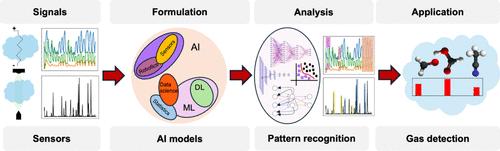
The role of artificial intelligence (AI), machine learning (ML), and deep learning (DL) in enhancing and automating gas sensing methods and the implications of these technologies for emergent gas sensor systems is reviewed. Applications of AI-based intelligent gas sensors include environmental monitoring, industrial safety, remote sensing, and medical diagnostics. AI, ML, and DL methods can process and interpret complex sensor data, allowing for improved accuracy, sensitivity, and selectivity, enabling rapid gas detection and quantitative concentration measurements based on sophisticated multiband, multispecies sensor systems. These methods can discern subtle patterns in sensor signals, allowing sensors to readily distinguish between gases with similar sensor signatures, enabling adaptable, cross-sensitive sensor systems for multigas detection under various environmental conditions. Integrating AI in gas sensor technology represents a paradigm shift, enabling sensors to achieve unprecedented performance, selectivity, and adaptability. This review describes gas sensor technologies and AI while highlighting approaches to AI–sensor integration.
期刊介绍:
ACS Sensors is a peer-reviewed research journal that focuses on the dissemination of new and original knowledge in the field of sensor science, particularly those that selectively sense chemical or biological species or processes. The journal covers a broad range of topics, including but not limited to biosensors, chemical sensors, gas sensors, intracellular sensors, single molecule sensors, cell chips, and microfluidic devices. It aims to publish articles that address conceptual advances in sensing technology applicable to various types of analytes or application papers that report on the use of existing sensing concepts in new ways or for new analytes.




 京公网安备 11010802042870号
京ICP备2023020795号-1
京公网安备 11010802042870号
京ICP备2023020795号-1

 分享
分享
 求助内容:
求助内容: 应助结果提醒方式:
 扫码关注我们
