{"title":"In Situ Electrochemical Activation Strategy toward Organic Cation Preintercalated Layered Vanadium-Based Oxide Cathode for High-Performance Aqueous Zinc-Ion Batteries","authors":"Yucheng Zhu, Youzhong Dong, Jianguo Li, Yunbo Li, Qinghua Fan, Quan Kuang, Yanming Zhao","doi":"10.1021/acsami.4c19917","DOIUrl":null,"url":null,"abstract":"Layered vanadium-based oxides with preintercalated metal cations are attracting extensive attention as highly promising candidates for aqueous zinc-ion batteries (AZIBs) due to the increase in structural stability originating from the pillar effect. However, the strong electrostatic interaction between the rigid metal cation pillars and zinc ions results in sluggish ionic transport, thereby limiting the high-rate performance. Herein, a layered vanadium-based oxide with protonated 1,4-diaminobutane organic cation (BDA) pillars is designed as a cathode material for AZIBs. Due to the larger radius and stronger interconnection with the VO layers, the organic cation guests acting as pillars not only ensure a large interlayer space but also significantly enhance the structural stability of the layered host. Furthermore, by adopting an in situ electrochemical activation strategy, the quantitative control of the organic cation pillar content is effectively achieved. The irreversible removal of partial pillar guests not only weakens its steric buckling effects on the zinc ion but also provides more effective sites for zinc ion storage. As anticipated, the resulting (H<sub>3</sub>N(CH<sub>2</sub>)<sub>4</sub>NH<sub>3</sub>)[V<sub>6</sub>O<sub>14</sub>] (BDA-VO) electrode material exhibits an excellent electrochemical property with a high reversible specific capacity of 345 mAh g<sup>–1</sup> at a current density of 0.1 A g<sup>–1</sup> and an excellent cycle stability with 93.2% capacity retention over 2000 cycles at 5 A g<sup>–1</sup>.","PeriodicalId":5,"journal":{"name":"ACS Applied Materials & Interfaces","volume":"38 1","pages":""},"PeriodicalIF":8.2000,"publicationDate":"2025-03-11","publicationTypes":"Journal Article","fieldsOfStudy":null,"isOpenAccess":false,"openAccessPdf":"","citationCount":"0","resultStr":null,"platform":"Semanticscholar","paperid":null,"PeriodicalName":"ACS Applied Materials & Interfaces","FirstCategoryId":"88","ListUrlMain":"https://doi.org/10.1021/acsami.4c19917","RegionNum":2,"RegionCategory":"材料科学","ArticlePicture":[],"TitleCN":null,"AbstractTextCN":null,"PMCID":null,"EPubDate":"","PubModel":"","JCR":"Q1","JCRName":"MATERIALS SCIENCE, MULTIDISCIPLINARY","Score":null,"Total":0}
引用次数: 0
Abstract
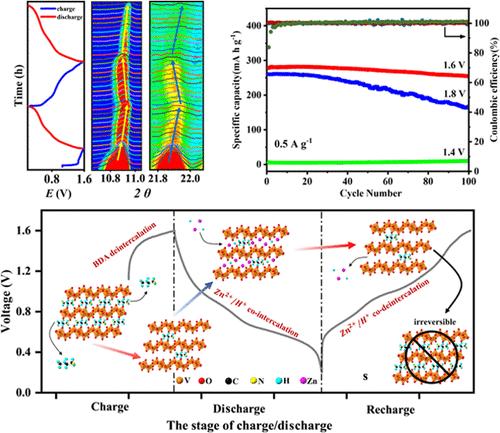
Layered vanadium-based oxides with preintercalated metal cations are attracting extensive attention as highly promising candidates for aqueous zinc-ion batteries (AZIBs) due to the increase in structural stability originating from the pillar effect. However, the strong electrostatic interaction between the rigid metal cation pillars and zinc ions results in sluggish ionic transport, thereby limiting the high-rate performance. Herein, a layered vanadium-based oxide with protonated 1,4-diaminobutane organic cation (BDA) pillars is designed as a cathode material for AZIBs. Due to the larger radius and stronger interconnection with the VO layers, the organic cation guests acting as pillars not only ensure a large interlayer space but also significantly enhance the structural stability of the layered host. Furthermore, by adopting an in situ electrochemical activation strategy, the quantitative control of the organic cation pillar content is effectively achieved. The irreversible removal of partial pillar guests not only weakens its steric buckling effects on the zinc ion but also provides more effective sites for zinc ion storage. As anticipated, the resulting (H3N(CH2)4NH3)[V6O14] (BDA-VO) electrode material exhibits an excellent electrochemical property with a high reversible specific capacity of 345 mAh g–1 at a current density of 0.1 A g–1 and an excellent cycle stability with 93.2% capacity retention over 2000 cycles at 5 A g–1.
具有预插层金属阳离子的层状钒基氧化物作为极有前途的水性锌离子电池(azib)候选者引起了广泛的关注,因为柱效应增加了结构稳定性。然而,刚性金属阳离子柱与锌离子之间的强静电相互作用导致离子传输缓慢,从而限制了高速率性能。本文设计了一种具有质子化1,4-二氨基丁烷有机阳离子(BDA)柱的层状钒基氧化物作为AZIBs的正极材料。由于有机阳离子客体半径更大,与VO层的互连更强,作为支柱的有机阳离子客体不仅保证了较大的层间空间,而且显著提高了层状主体的结构稳定性。此外,采用原位电化学活化策略,有效地实现了有机阳离子柱含量的定量控制。部分柱状客体的不可逆去除不仅削弱了柱状客体对锌离子的空间屈曲作用,而且为锌离子的储存提供了更有效的场所。正如预期的那样,所得到的(H3N(CH2)4NH3)[V6O14] (BDA-VO)电极材料表现出优异的电化学性能,在0.1 a g-1电流密度下具有345 mAh g-1的高可逆比容量,并且在5 a g-1下具有优异的循环稳定性,在2000次循环中具有93.2%的容量保持率。
期刊介绍:
ACS Applied Materials & Interfaces is a leading interdisciplinary journal that brings together chemists, engineers, physicists, and biologists to explore the development and utilization of newly-discovered materials and interfacial processes for specific applications. Our journal has experienced remarkable growth since its establishment in 2009, both in terms of the number of articles published and the impact of the research showcased. We are proud to foster a truly global community, with the majority of published articles originating from outside the United States, reflecting the rapid growth of applied research worldwide.



 京公网安备 11010802042870号
京ICP备2023020795号-1
京公网安备 11010802042870号
京ICP备2023020795号-1

 分享
分享
 求助内容:
求助内容: 应助结果提醒方式:
 扫码关注我们
