Adrian Seitz, Felix Lott, Julian Henseler, Michael Geißelbrecht, Christian Wondra, Peter Treiber, Jürgen Karl, Patrick Schühle, Peter Wasserscheid
{"title":"Combining Biomass Gasification and LOHC Mixed Gas Hydrogenation for High Purity Hydrogen Production and Storage","authors":"Adrian Seitz, Felix Lott, Julian Henseler, Michael Geißelbrecht, Christian Wondra, Peter Treiber, Jürgen Karl, Patrick Schühle, Peter Wasserscheid","doi":"10.1021/acssuschemeng.4c10235","DOIUrl":null,"url":null,"abstract":"Hydrogen produced by steam gasification of biomass contains a complex mixture of byproducts, such as carbon oxides and aromatic tar species. We propose purification of such mixtures and subsequent hydrogen storage using liquid organic hydrogen carrier (LOHC) systems. Our concept includes the direct use of crude biomass gasification product gas for the LOHC hydrogenation step without previous tar removal. While hydrogen is bound to the aromatic LOHC component and to aromatic tar species, gaseous impurities like CO<sub>2</sub>, CH<sub>4</sub> and CO remain in the gas phase. The hydrogenated LOHC mixture is then purified by removing hydrogenated tar species with different vapor pressure and adsorption properties via distillation or adsorption. These removed saturated tar compounds may serve as biofuels or biofuel additives. The biogenic component remaining in the LOHC system after purification can act themselves as LOHC molecules in subsequent hydrogen storage cycles. To demonstrate this concept, we investigated the Pd-catalyzed hydrogenation of benzyltoluene that was premixed with model tar compounds in relevant concentrations. Our experiments demonstrate that tar compounds with up to three rings do not affect the rate of the LOHC hydrogenation. The same is true for heteroaromatic, oxygen-containing tars. Nitrogen-containing tars, however, were found to lead to a moderate but reversible deactivation. Rapid deactivation of the catalyst was observed with sulfur-containing tars and tar compounds with more than three aromatic rings. The latter strongly adsorb to the Pd/Al<sub>2</sub>O<sub>3</sub> catalyst, a fact that could be shown via thermogravimetric temperature-programmed oxidation.","PeriodicalId":25,"journal":{"name":"ACS Sustainable Chemistry & Engineering","volume":"2 1","pages":""},"PeriodicalIF":7.3000,"publicationDate":"2025-03-11","publicationTypes":"Journal Article","fieldsOfStudy":null,"isOpenAccess":false,"openAccessPdf":"","citationCount":"0","resultStr":null,"platform":"Semanticscholar","paperid":null,"PeriodicalName":"ACS Sustainable Chemistry & Engineering","FirstCategoryId":"92","ListUrlMain":"https://doi.org/10.1021/acssuschemeng.4c10235","RegionNum":1,"RegionCategory":"化学","ArticlePicture":[],"TitleCN":null,"AbstractTextCN":null,"PMCID":null,"EPubDate":"","PubModel":"","JCR":"Q1","JCRName":"CHEMISTRY, MULTIDISCIPLINARY","Score":null,"Total":0}
引用次数: 0
Abstract
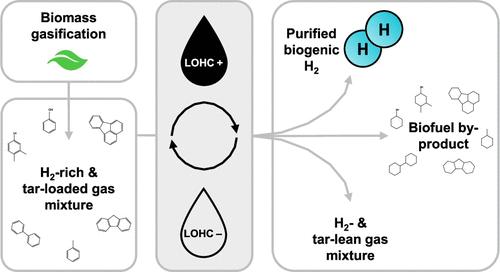
Hydrogen produced by steam gasification of biomass contains a complex mixture of byproducts, such as carbon oxides and aromatic tar species. We propose purification of such mixtures and subsequent hydrogen storage using liquid organic hydrogen carrier (LOHC) systems. Our concept includes the direct use of crude biomass gasification product gas for the LOHC hydrogenation step without previous tar removal. While hydrogen is bound to the aromatic LOHC component and to aromatic tar species, gaseous impurities like CO2, CH4 and CO remain in the gas phase. The hydrogenated LOHC mixture is then purified by removing hydrogenated tar species with different vapor pressure and adsorption properties via distillation or adsorption. These removed saturated tar compounds may serve as biofuels or biofuel additives. The biogenic component remaining in the LOHC system after purification can act themselves as LOHC molecules in subsequent hydrogen storage cycles. To demonstrate this concept, we investigated the Pd-catalyzed hydrogenation of benzyltoluene that was premixed with model tar compounds in relevant concentrations. Our experiments demonstrate that tar compounds with up to three rings do not affect the rate of the LOHC hydrogenation. The same is true for heteroaromatic, oxygen-containing tars. Nitrogen-containing tars, however, were found to lead to a moderate but reversible deactivation. Rapid deactivation of the catalyst was observed with sulfur-containing tars and tar compounds with more than three aromatic rings. The latter strongly adsorb to the Pd/Al2O3 catalyst, a fact that could be shown via thermogravimetric temperature-programmed oxidation.
期刊介绍:
ACS Sustainable Chemistry & Engineering is a prestigious weekly peer-reviewed scientific journal published by the American Chemical Society. Dedicated to advancing the principles of green chemistry and green engineering, it covers a wide array of research topics including green chemistry, green engineering, biomass, alternative energy, and life cycle assessment.
The journal welcomes submissions in various formats, including Letters, Articles, Features, and Perspectives (Reviews), that address the challenges of sustainability in the chemical enterprise and contribute to the advancement of sustainable practices. Join us in shaping the future of sustainable chemistry and engineering.



 京公网安备 11010802042870号
京ICP备2023020795号-1
京公网安备 11010802042870号
京ICP备2023020795号-1

 分享
分享
 求助内容:
求助内容: 应助结果提醒方式:
 扫码关注我们
