Yunduo Charles Zhao, Zihao Wang, Haimei Zhao, Nicole Alexis Yap, Ren Wang, Wenlong Cheng, Xin Xu, Lining Arnold Ju
{"title":"Sensing the Future of Thrombosis Management: Integrating Vessel-on-a-Chip Models, Advanced Biosensors, and AI-Driven Digital Twins","authors":"Yunduo Charles Zhao, Zihao Wang, Haimei Zhao, Nicole Alexis Yap, Ren Wang, Wenlong Cheng, Xin Xu, Lining Arnold Ju","doi":"10.1021/acssensors.4c02764","DOIUrl":null,"url":null,"abstract":"Thrombotic events, such as strokes and deep vein thrombosis, remain a significant global health burden, with traditional diagnostic methods often failing to capture the complex, patient-specific nuances of thrombosis risk. This Perspective explores the revolutionary potential of microengineered vessel-on-chip platforms in thrombosis research and personalized medicine. We discuss the evolution from basic microfluidic channels to advanced 3D-printed, patient-specific models that accurately replicate complex vascular geometries, incorporating all elements of Virchow’s triad. Integrating these platforms with cutting-edge sensing technologies, including wearable ultrasonic devices and electrochemical biosensors, enables real-time monitoring of thrombosis-related parameters. Crucially, we highlight the transformative role of artificial intelligence and digital twin technology in leveraging vast patient-specific data collected from these models. This integration allows for the development of predictive algorithms and personalized digital twins, offering unprecedented thrombosis risk assessment, treatment optimization, and drug screening capabilities. The clinical relevance and validation of these models are examined, showcasing their potential to predict thrombotic events and guide personalized treatment strategies. While challenges in scalability, standardization, and regulatory approval persist, the convergence of vessel-on-chip platforms, advanced sensing, and AI-driven digital twins promises to revolutionize thrombosis management. This approach paves the way for a new era of precision cardiovascular care, offering noninvasive, predictive, and personalized strategies for thrombosis prevention and treatment, ultimately improving patient outcomes and reducing the global burden of cardiovascular diseases.","PeriodicalId":24,"journal":{"name":"ACS Sensors","volume":"16 1","pages":""},"PeriodicalIF":9.1000,"publicationDate":"2025-03-11","publicationTypes":"Journal Article","fieldsOfStudy":null,"isOpenAccess":false,"openAccessPdf":"","citationCount":"0","resultStr":null,"platform":"Semanticscholar","paperid":null,"PeriodicalName":"ACS Sensors","FirstCategoryId":"92","ListUrlMain":"https://doi.org/10.1021/acssensors.4c02764","RegionNum":1,"RegionCategory":"化学","ArticlePicture":[],"TitleCN":null,"AbstractTextCN":null,"PMCID":null,"EPubDate":"","PubModel":"","JCR":"Q1","JCRName":"CHEMISTRY, ANALYTICAL","Score":null,"Total":0}
引用次数: 0
Abstract
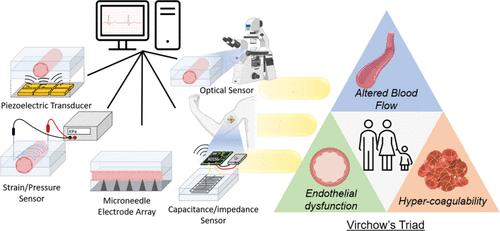
Thrombotic events, such as strokes and deep vein thrombosis, remain a significant global health burden, with traditional diagnostic methods often failing to capture the complex, patient-specific nuances of thrombosis risk. This Perspective explores the revolutionary potential of microengineered vessel-on-chip platforms in thrombosis research and personalized medicine. We discuss the evolution from basic microfluidic channels to advanced 3D-printed, patient-specific models that accurately replicate complex vascular geometries, incorporating all elements of Virchow’s triad. Integrating these platforms with cutting-edge sensing technologies, including wearable ultrasonic devices and electrochemical biosensors, enables real-time monitoring of thrombosis-related parameters. Crucially, we highlight the transformative role of artificial intelligence and digital twin technology in leveraging vast patient-specific data collected from these models. This integration allows for the development of predictive algorithms and personalized digital twins, offering unprecedented thrombosis risk assessment, treatment optimization, and drug screening capabilities. The clinical relevance and validation of these models are examined, showcasing their potential to predict thrombotic events and guide personalized treatment strategies. While challenges in scalability, standardization, and regulatory approval persist, the convergence of vessel-on-chip platforms, advanced sensing, and AI-driven digital twins promises to revolutionize thrombosis management. This approach paves the way for a new era of precision cardiovascular care, offering noninvasive, predictive, and personalized strategies for thrombosis prevention and treatment, ultimately improving patient outcomes and reducing the global burden of cardiovascular diseases.
期刊介绍:
ACS Sensors is a peer-reviewed research journal that focuses on the dissemination of new and original knowledge in the field of sensor science, particularly those that selectively sense chemical or biological species or processes. The journal covers a broad range of topics, including but not limited to biosensors, chemical sensors, gas sensors, intracellular sensors, single molecule sensors, cell chips, and microfluidic devices. It aims to publish articles that address conceptual advances in sensing technology applicable to various types of analytes or application papers that report on the use of existing sensing concepts in new ways or for new analytes.



 京公网安备 11010802042870号
京ICP备2023020795号-1
京公网安备 11010802042870号
京ICP备2023020795号-1

 分享
分享
 求助内容:
求助内容: 应助结果提醒方式:
 扫码关注我们
