Michał S. Bućko , Katarzyna Jaworek , Katarzyna Janoszka , Joanna Kernert , Justyna Klyta , Tenzin Tsering , Arto Koistinen , Michał Sobota , Marta Musioł
{"title":"Aging properties of polymer pellets, release of secondary microplastics and additives in the water environment under laboratory-controlled conditions","authors":"Michał S. Bućko , Katarzyna Jaworek , Katarzyna Janoszka , Joanna Kernert , Justyna Klyta , Tenzin Tsering , Arto Koistinen , Michał Sobota , Marta Musioł","doi":"10.1016/j.jhazmat.2025.137882","DOIUrl":null,"url":null,"abstract":"<div><div>In this work, the long-term degradation of polymer pellets (also known as the primary microplastics/MPs) was monitored under laboratory-controlled conditions. Polymers of different origin such as the ABS, HDPE and PA (non-processed, recycled) were exposed to demineralized and artificial seawater, stored in room (20–24 °C) and cold (4–8 °C) temperatures during 20 months period. Surface topography and thermal characteristics of selected primary MPs were examined with the use of digital microscope and thermogravimetric (TGA) analysis. Release of secondary MPs into the water solutions was monitored with digital microscopy observations and µ-FTIR analyses. Additionally, leaching of the additives/plasticizers was studied by the GC-MS technique. Periodical, microscopic observations of the surface topography of single pellets show that some polymers undergo deformation over time in the water environment. According to results of the surface roughness, the external structure of the primary MPs (e.g. HDPE and PA) deteriorate after 6 months of exposure to water and cold temperatures. As indicated by the TGA analysis the water penetrates the polymer-matrix (HDPE), changing its physicochemical properties. The µFTIR analyses confirm that primary MPs fragment into smaller particles (secondary MPs), while exposed to various degradation factors (e.g. temperature, pH and salinity changes). The average size of all identified secondary MPs ranges between 13 and 1055 µm. The MP-like particles in the size range of ∼3–230 µm have been identified by the microscopic analyses. While exposing the primary MPs to different degradation factors for 20 months, no significant concentrations of phthalates were released into the water solutions.</div></div>","PeriodicalId":361,"journal":{"name":"Journal of Hazardous Materials","volume":"491 ","pages":"Article 137882"},"PeriodicalIF":11.3000,"publicationDate":"2025-03-11","publicationTypes":"Journal Article","fieldsOfStudy":null,"isOpenAccess":false,"openAccessPdf":"","citationCount":"0","resultStr":null,"platform":"Semanticscholar","paperid":null,"PeriodicalName":"Journal of Hazardous Materials","FirstCategoryId":"93","ListUrlMain":"https://www.sciencedirect.com/science/article/pii/S0304389425007964","RegionNum":1,"RegionCategory":"环境科学与生态学","ArticlePicture":[],"TitleCN":null,"AbstractTextCN":null,"PMCID":null,"EPubDate":"","PubModel":"","JCR":"Q1","JCRName":"ENGINEERING, ENVIRONMENTAL","Score":null,"Total":0}
引用次数: 0
Abstract
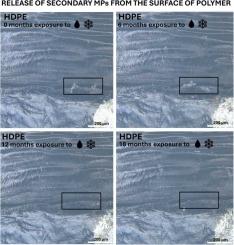
In this work, the long-term degradation of polymer pellets (also known as the primary microplastics/MPs) was monitored under laboratory-controlled conditions. Polymers of different origin such as the ABS, HDPE and PA (non-processed, recycled) were exposed to demineralized and artificial seawater, stored in room (20–24 °C) and cold (4–8 °C) temperatures during 20 months period. Surface topography and thermal characteristics of selected primary MPs were examined with the use of digital microscope and thermogravimetric (TGA) analysis. Release of secondary MPs into the water solutions was monitored with digital microscopy observations and µ-FTIR analyses. Additionally, leaching of the additives/plasticizers was studied by the GC-MS technique. Periodical, microscopic observations of the surface topography of single pellets show that some polymers undergo deformation over time in the water environment. According to results of the surface roughness, the external structure of the primary MPs (e.g. HDPE and PA) deteriorate after 6 months of exposure to water and cold temperatures. As indicated by the TGA analysis the water penetrates the polymer-matrix (HDPE), changing its physicochemical properties. The µFTIR analyses confirm that primary MPs fragment into smaller particles (secondary MPs), while exposed to various degradation factors (e.g. temperature, pH and salinity changes). The average size of all identified secondary MPs ranges between 13 and 1055 µm. The MP-like particles in the size range of ∼3–230 µm have been identified by the microscopic analyses. While exposing the primary MPs to different degradation factors for 20 months, no significant concentrations of phthalates were released into the water solutions.
期刊介绍:
The Journal of Hazardous Materials serves as a global platform for promoting cutting-edge research in the field of Environmental Science and Engineering. Our publication features a wide range of articles, including full-length research papers, review articles, and perspectives, with the aim of enhancing our understanding of the dangers and risks associated with various materials concerning public health and the environment. It is important to note that the term "environmental contaminants" refers specifically to substances that pose hazardous effects through contamination, while excluding those that do not have such impacts on the environment or human health. Moreover, we emphasize the distinction between wastes and hazardous materials in order to provide further clarity on the scope of the journal. We have a keen interest in exploring specific compounds and microbial agents that have adverse effects on the environment.



 京公网安备 11010802042870号
京ICP备2023020795号-1
京公网安备 11010802042870号
京ICP备2023020795号-1

 分享
分享
 求助内容:
求助内容: 应助结果提醒方式:
 扫码关注我们
