Fengxiao Zhao , Danni Li , Hongyuan Chen , Xianhai Zeng , Lu Lin , Haoran Yuan , Rui Shan , Yong Chen
{"title":"Pyrolysis of pig waste from intensive farming operations: Kinetics, product distribution, and transformation of endogenous heavy metals","authors":"Fengxiao Zhao , Danni Li , Hongyuan Chen , Xianhai Zeng , Lu Lin , Haoran Yuan , Rui Shan , Yong Chen","doi":"10.1016/j.jhazmat.2025.137916","DOIUrl":null,"url":null,"abstract":"<div><div>This study addresses the critical challenge of safe disposal and resource utilization of pig waste from intensive farming by investigating its pyrolysis behavior, product mechanisms, and heavy metal immobilization. The pyrolysis process was divided into four distinct stages, with kinetic parameters determined using the model-free FWO and KAS methods, ensuring accuracy without prior assumptions, complemented by the master plot method to elucidate reaction mechanisms. The optimal kinetic models identified as <span><math><mrow><mi>f</mi><mo>(</mo><mi>α</mi><mo>)</mo><mo>=</mo><mn>4</mn><msup><mrow><mi>α</mi></mrow><mrow><mfrac><mn>3</mn><mn>4</mn></mfrac></mrow></msup></mrow></math></span>, <span><math><mrow><mi>f</mi><mo>(</mo><mi>α</mi><mo>)</mo><mo>=</mo><mn>3</mn><mo>(</mo><mn>1</mn><mo>−</mo><mi>α</mi><mo>)</mo><msup><mrow><mo>[</mo><mo>−</mo><mspace></mspace><mi>ln</mi><mo>(</mo><mn>1</mn><mo>−</mo><mi>α</mi><mo>)</mo><mo>]</mo></mrow><mrow><mfrac><mn>2</mn><mn>3</mn></mfrac></mrow></msup></mrow></math></span>, <span><math><mrow><mi>f</mi><mo>(</mo><mi>α</mi><mo>)</mo><mo>=</mo><mn>3</mn><msup><mrow><mi>α</mi></mrow><mrow><mfrac><mn>2</mn><mn>3</mn></mfrac></mrow></msup></mrow></math></span>, <span><math><mrow><mi>f</mi><mo>(</mo><mi>α</mi><mo>)</mo><mo>=</mo><mn>2</mn><msup><mrow><mi>α</mi></mrow><mrow><mfrac><mn>1</mn><mn>2</mn></mfrac></mrow></msup></mrow></math></span>. The volatile products, identified via TG-FTIR and Py-GC/MS, included CO₂, H₂O, CH₄, CO, carbonyl compounds, while pyrolysis oils were enriched with nitrogen-containing organics and ketones. Biochar produced at 450–750 °C demonstrated rich porosity, aromaticity, and high biochemical stability, with heavy metals predominantly immobilized in oxidizable and residual fractions (F3 +F4). FactSage 7.1 simulations provided novel insights into the phase transformations and migration trends of Zn, Mn, Cu, and Cr, highlighting the formation of stable slag or solid compounds at elevated temperatures, consistent with experimental findings. TCLP tests and ecological risk assessments confirmed the environmental safety of pig waste biochars, emphasizing the potential of pyrolysis for heavy metal stabilization. This work advances the understanding of pyrolysis mechanisms for pig waste from intensive farming and offers innovative solutions for sustainable pig waste management.</div></div>","PeriodicalId":361,"journal":{"name":"Journal of Hazardous Materials","volume":"491 ","pages":"Article 137916"},"PeriodicalIF":11.3000,"publicationDate":"2025-03-10","publicationTypes":"Journal Article","fieldsOfStudy":null,"isOpenAccess":false,"openAccessPdf":"","citationCount":"0","resultStr":null,"platform":"Semanticscholar","paperid":null,"PeriodicalName":"Journal of Hazardous Materials","FirstCategoryId":"93","ListUrlMain":"https://www.sciencedirect.com/science/article/pii/S0304389425008301","RegionNum":1,"RegionCategory":"环境科学与生态学","ArticlePicture":[],"TitleCN":null,"AbstractTextCN":null,"PMCID":null,"EPubDate":"","PubModel":"","JCR":"Q1","JCRName":"ENGINEERING, ENVIRONMENTAL","Score":null,"Total":0}
引用次数: 0
Abstract
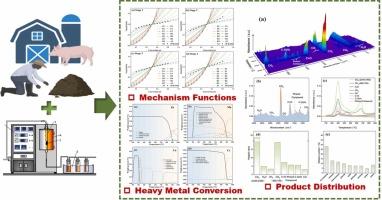
This study addresses the critical challenge of safe disposal and resource utilization of pig waste from intensive farming by investigating its pyrolysis behavior, product mechanisms, and heavy metal immobilization. The pyrolysis process was divided into four distinct stages, with kinetic parameters determined using the model-free FWO and KAS methods, ensuring accuracy without prior assumptions, complemented by the master plot method to elucidate reaction mechanisms. The optimal kinetic models identified as , , , . The volatile products, identified via TG-FTIR and Py-GC/MS, included CO₂, H₂O, CH₄, CO, carbonyl compounds, while pyrolysis oils were enriched with nitrogen-containing organics and ketones. Biochar produced at 450–750 °C demonstrated rich porosity, aromaticity, and high biochemical stability, with heavy metals predominantly immobilized in oxidizable and residual fractions (F3 +F4). FactSage 7.1 simulations provided novel insights into the phase transformations and migration trends of Zn, Mn, Cu, and Cr, highlighting the formation of stable slag or solid compounds at elevated temperatures, consistent with experimental findings. TCLP tests and ecological risk assessments confirmed the environmental safety of pig waste biochars, emphasizing the potential of pyrolysis for heavy metal stabilization. This work advances the understanding of pyrolysis mechanisms for pig waste from intensive farming and offers innovative solutions for sustainable pig waste management.
期刊介绍:
The Journal of Hazardous Materials serves as a global platform for promoting cutting-edge research in the field of Environmental Science and Engineering. Our publication features a wide range of articles, including full-length research papers, review articles, and perspectives, with the aim of enhancing our understanding of the dangers and risks associated with various materials concerning public health and the environment. It is important to note that the term "environmental contaminants" refers specifically to substances that pose hazardous effects through contamination, while excluding those that do not have such impacts on the environment or human health. Moreover, we emphasize the distinction between wastes and hazardous materials in order to provide further clarity on the scope of the journal. We have a keen interest in exploring specific compounds and microbial agents that have adverse effects on the environment.



 京公网安备 11010802042870号
京ICP备2023020795号-1
京公网安备 11010802042870号
京ICP备2023020795号-1

 分享
分享
 求助内容:
求助内容: 应助结果提醒方式:
 扫码关注我们
