{"title":"P3OT-Based Organic Polymer Memristors for Artificial Synaptic Behavior and Neuromorphic Computing Applications","authors":"Hongguang Zhang*, Linkai Li, Aiqian Guo, Jianda Li, Yong-Tao Li*, Wen Li, Mingdong Yi* and Liang Xie, ","doi":"10.1021/acsaelm.4c02278","DOIUrl":null,"url":null,"abstract":"<p >Organic synaptic memristors have recently attracted considerable interest due to the ease of fabrication enabled by solution processing and their potential roles in neuromorphic electronics. In this research, an organic polymer memristor based on poly(3-octylthiophene-2,5-diyl) (P3OT) was designed, and a systematic characterization of its electrical properties was experimentally demonstrated. The device successfully emulated multiple synaptic behaviors, including paired-pulse facilitation (PPF), paired-pulse depression (PPD), post-tetanic potentiation (PTP), spike-timing-dependent plasticity (STDP), and short-term plasticity (STP) to long-term plasticity (LTP) transition, as well as experience learning. Detailed analysis of the <i>I–V</i> characteristics indicated that resistance switching resulted from a combination of tunneling, space charge-limited conduction (SCLC), and Schottky emission mechanisms. The electrical performance of the device remained stable even after being stored in an air environment for more than 90 days. Furthermore, an artificial neural network (ANN) implemented using this device achieved a recognition accuracy of 91% on the MNIST data set. This study offers valuable theoretical insights and experimental references for advancing the use of organic polymer memristors in simulating synaptic functions and implementing artificial neural networks.</p>","PeriodicalId":3,"journal":{"name":"ACS Applied Electronic Materials","volume":"7 5","pages":"2001–2011 2001–2011"},"PeriodicalIF":4.7000,"publicationDate":"2025-02-26","publicationTypes":"Journal Article","fieldsOfStudy":null,"isOpenAccess":false,"openAccessPdf":"","citationCount":"0","resultStr":null,"platform":"Semanticscholar","paperid":null,"PeriodicalName":"ACS Applied Electronic Materials","FirstCategoryId":"88","ListUrlMain":"https://pubs.acs.org/doi/10.1021/acsaelm.4c02278","RegionNum":3,"RegionCategory":"材料科学","ArticlePicture":[],"TitleCN":null,"AbstractTextCN":null,"PMCID":null,"EPubDate":"","PubModel":"","JCR":"Q1","JCRName":"ENGINEERING, ELECTRICAL & ELECTRONIC","Score":null,"Total":0}
引用次数: 0
Abstract
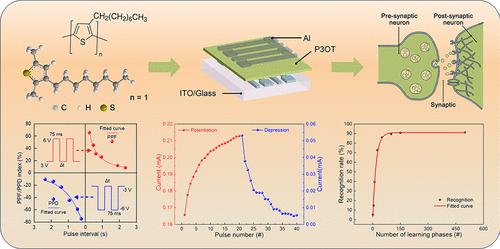
Organic synaptic memristors have recently attracted considerable interest due to the ease of fabrication enabled by solution processing and their potential roles in neuromorphic electronics. In this research, an organic polymer memristor based on poly(3-octylthiophene-2,5-diyl) (P3OT) was designed, and a systematic characterization of its electrical properties was experimentally demonstrated. The device successfully emulated multiple synaptic behaviors, including paired-pulse facilitation (PPF), paired-pulse depression (PPD), post-tetanic potentiation (PTP), spike-timing-dependent plasticity (STDP), and short-term plasticity (STP) to long-term plasticity (LTP) transition, as well as experience learning. Detailed analysis of the I–V characteristics indicated that resistance switching resulted from a combination of tunneling, space charge-limited conduction (SCLC), and Schottky emission mechanisms. The electrical performance of the device remained stable even after being stored in an air environment for more than 90 days. Furthermore, an artificial neural network (ANN) implemented using this device achieved a recognition accuracy of 91% on the MNIST data set. This study offers valuable theoretical insights and experimental references for advancing the use of organic polymer memristors in simulating synaptic functions and implementing artificial neural networks.
期刊介绍:
ACS Applied Electronic Materials is an interdisciplinary journal publishing original research covering all aspects of electronic materials. The journal is devoted to reports of new and original experimental and theoretical research of an applied nature that integrate knowledge in the areas of materials science, engineering, optics, physics, and chemistry into important applications of electronic materials. Sample research topics that span the journal's scope are inorganic, organic, ionic and polymeric materials with properties that include conducting, semiconducting, superconducting, insulating, dielectric, magnetic, optoelectronic, piezoelectric, ferroelectric and thermoelectric.
Indexed/Abstracted:
Web of Science SCIE
Scopus
CAS
INSPEC
Portico




 京公网安备 11010802042870号
京ICP备2023020795号-1
京公网安备 11010802042870号
京ICP备2023020795号-1

 分享
分享
 求助内容:
求助内容: 应助结果提醒方式:
 扫码关注我们
