Yu Gao, Zijian Zhang, Xinming Ma, Xiuyang Tang, Lipin Chen, Song Xue, Gangri Cai* and Jin Shi Zhao*,
{"title":"Fully Solution-Processed Flexible and Self-Rectifying Memristor for Synapse Emulation","authors":"Yu Gao, Zijian Zhang, Xinming Ma, Xiuyang Tang, Lipin Chen, Song Xue, Gangri Cai* and Jin Shi Zhao*, ","doi":"10.1021/acsaelm.4c02323","DOIUrl":null,"url":null,"abstract":"<p >Self-rectifying organic memristors with integrated biosynaptic functionalities show significant potential for enabling high-density neuromorphic networks by inherently suppressing stealth current effects. In this study, we present a fully solution-processed PEDOT:PSS-based memristor that combines resistive switching and self-rectifying properties. The device features spin-coated PEDOT:PSS as both the top and the bottom electrodes. To enhance the conductivity of the PEDOT:PSS film, ethylene glycol was added to the spin-coating solution, followed by sequential methanol cleaning. The functionalities are achieved through enhancing the redox activity of PEDOT and the transformation of the ionic PSS within the hybrid film. The inclusion of ZnO nanoparticles (ZnO NPs) significantly enhances device performance, resulting in a higher on/off current ratio and sophisticated synaptic behaviors, including transitions from short- to long-term plasticity and improved linear potentiation and depression. This work underscores the potential of solution-processed PEDOT-metal oxide hybrid systems as a foundation for advancing neuromorphic computing architectures.</p>","PeriodicalId":3,"journal":{"name":"ACS Applied Electronic Materials","volume":"7 5","pages":"2075–2083 2075–2083"},"PeriodicalIF":4.7000,"publicationDate":"2025-02-27","publicationTypes":"Journal Article","fieldsOfStudy":null,"isOpenAccess":false,"openAccessPdf":"","citationCount":"0","resultStr":null,"platform":"Semanticscholar","paperid":null,"PeriodicalName":"ACS Applied Electronic Materials","FirstCategoryId":"88","ListUrlMain":"https://pubs.acs.org/doi/10.1021/acsaelm.4c02323","RegionNum":3,"RegionCategory":"材料科学","ArticlePicture":[],"TitleCN":null,"AbstractTextCN":null,"PMCID":null,"EPubDate":"","PubModel":"","JCR":"Q1","JCRName":"ENGINEERING, ELECTRICAL & ELECTRONIC","Score":null,"Total":0}
引用次数: 0
Abstract
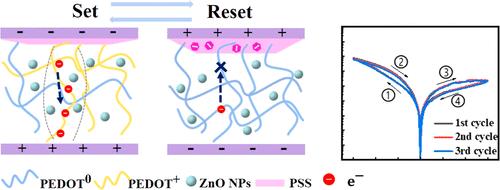
Self-rectifying organic memristors with integrated biosynaptic functionalities show significant potential for enabling high-density neuromorphic networks by inherently suppressing stealth current effects. In this study, we present a fully solution-processed PEDOT:PSS-based memristor that combines resistive switching and self-rectifying properties. The device features spin-coated PEDOT:PSS as both the top and the bottom electrodes. To enhance the conductivity of the PEDOT:PSS film, ethylene glycol was added to the spin-coating solution, followed by sequential methanol cleaning. The functionalities are achieved through enhancing the redox activity of PEDOT and the transformation of the ionic PSS within the hybrid film. The inclusion of ZnO nanoparticles (ZnO NPs) significantly enhances device performance, resulting in a higher on/off current ratio and sophisticated synaptic behaviors, including transitions from short- to long-term plasticity and improved linear potentiation and depression. This work underscores the potential of solution-processed PEDOT-metal oxide hybrid systems as a foundation for advancing neuromorphic computing architectures.
期刊介绍:
ACS Applied Electronic Materials is an interdisciplinary journal publishing original research covering all aspects of electronic materials. The journal is devoted to reports of new and original experimental and theoretical research of an applied nature that integrate knowledge in the areas of materials science, engineering, optics, physics, and chemistry into important applications of electronic materials. Sample research topics that span the journal's scope are inorganic, organic, ionic and polymeric materials with properties that include conducting, semiconducting, superconducting, insulating, dielectric, magnetic, optoelectronic, piezoelectric, ferroelectric and thermoelectric.
Indexed/Abstracted:
Web of Science SCIE
Scopus
CAS
INSPEC
Portico




 京公网安备 11010802042870号
京ICP备2023020795号-1
京公网安备 11010802042870号
京ICP备2023020795号-1

 分享
分享
 求助内容:
求助内容: 应助结果提醒方式:
 扫码关注我们
