Andrea Ruiz-Perona, Thien Duc Ngo, David Hernández-Pinilla, Wataru Hayami and Tadaaki Nagao*,
{"title":"Optimizing the Optical Response of Uniaxial Cerium Hexaboride Films for High-Temperature Plasmonic Applications","authors":"Andrea Ruiz-Perona, Thien Duc Ngo, David Hernández-Pinilla, Wataru Hayami and Tadaaki Nagao*, ","doi":"10.1021/acsaelm.5c00022","DOIUrl":null,"url":null,"abstract":"<p >Refractory materials with good optical properties are required for the development of novel high-temperature photonic and plasmonic photothermal applications. Whereas conventional plasmonic materials have excellent optical properties but low melting points, most refractory metals exhibit low plasmonic responses and oxidize easily in the atmosphere. Hence, in this study, cerium hexaboride (CeB<sub>6</sub>) thin films are grown via electron-beam deposition on Si(100) and sapphire substrates. Epitaxial growth of this material is achieved under specific conditions, thus yielding high crystallinity and strong plasmonic polarizability within the infrared spectral region. The optical properties of CeB<sub>6</sub> improved significantly depending on the template substrate and growth conditions, achieving a six times higher plasmonic figure-of-merit on R-sapphire compared with on Si substrates. The high performance of CeB<sub>6</sub> films, as reflected by their superior plasmonic figures-of-merit particularly in the near-infrared region (1.0–2.0 μm) compared with conventional refractory materials, renders them highly promising candidates for photothermal and optoelectronic applications.</p>","PeriodicalId":3,"journal":{"name":"ACS Applied Electronic Materials","volume":"7 5","pages":"2093–2101 2093–2101"},"PeriodicalIF":4.7000,"publicationDate":"2025-02-27","publicationTypes":"Journal Article","fieldsOfStudy":null,"isOpenAccess":false,"openAccessPdf":"","citationCount":"0","resultStr":null,"platform":"Semanticscholar","paperid":null,"PeriodicalName":"ACS Applied Electronic Materials","FirstCategoryId":"88","ListUrlMain":"https://pubs.acs.org/doi/10.1021/acsaelm.5c00022","RegionNum":3,"RegionCategory":"材料科学","ArticlePicture":[],"TitleCN":null,"AbstractTextCN":null,"PMCID":null,"EPubDate":"","PubModel":"","JCR":"Q1","JCRName":"ENGINEERING, ELECTRICAL & ELECTRONIC","Score":null,"Total":0}
引用次数: 0
Abstract
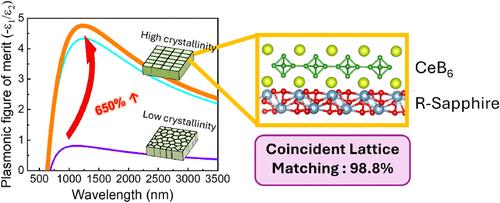
Refractory materials with good optical properties are required for the development of novel high-temperature photonic and plasmonic photothermal applications. Whereas conventional plasmonic materials have excellent optical properties but low melting points, most refractory metals exhibit low plasmonic responses and oxidize easily in the atmosphere. Hence, in this study, cerium hexaboride (CeB6) thin films are grown via electron-beam deposition on Si(100) and sapphire substrates. Epitaxial growth of this material is achieved under specific conditions, thus yielding high crystallinity and strong plasmonic polarizability within the infrared spectral region. The optical properties of CeB6 improved significantly depending on the template substrate and growth conditions, achieving a six times higher plasmonic figure-of-merit on R-sapphire compared with on Si substrates. The high performance of CeB6 films, as reflected by their superior plasmonic figures-of-merit particularly in the near-infrared region (1.0–2.0 μm) compared with conventional refractory materials, renders them highly promising candidates for photothermal and optoelectronic applications.
期刊介绍:
ACS Applied Electronic Materials is an interdisciplinary journal publishing original research covering all aspects of electronic materials. The journal is devoted to reports of new and original experimental and theoretical research of an applied nature that integrate knowledge in the areas of materials science, engineering, optics, physics, and chemistry into important applications of electronic materials. Sample research topics that span the journal's scope are inorganic, organic, ionic and polymeric materials with properties that include conducting, semiconducting, superconducting, insulating, dielectric, magnetic, optoelectronic, piezoelectric, ferroelectric and thermoelectric.
Indexed/Abstracted:
Web of Science SCIE
Scopus
CAS
INSPEC
Portico




 京公网安备 11010802042870号
京ICP备2023020795号-1
京公网安备 11010802042870号
京ICP备2023020795号-1

 分享
分享
 求助内容:
求助内容: 应助结果提醒方式:
 扫码关注我们
