{"title":"Unveiling origin and enrichment of fluoride in the Daihai lake basin, China, using a hybrid hydrochemical and multi-isotopic method","authors":"Shen Qu , Xiaohui Ren , Yuanzhen Zhao , Hairu Mao , Shaogang Dong , Ruihong Yu","doi":"10.1016/j.jhydrol.2025.133030","DOIUrl":null,"url":null,"abstract":"<div><div>Excessive fluoride in lakes threatens lake ecosystem balance. However, the fluoride origin and enrichment associated with lacustrine groundwater discharge (LGD) in closed inland lakes are not fully understood. Based on multiple isotopes (δD, δ<sup>18</sup>O<sub>water</sub>, δ<sup>34</sup>S, δ<sup>18</sup>O<sub>sulfate</sub>,<!--> <sup>87</sup>Sr/<sup>86</sup>Sr and<!--> <sup>222</sup>Rn), this study investigated the enrichment of fluoride and the impact of LGD on the migration of fluoride in a typical closed inland lake (Daihai Lake) in the semi-arid region of China. The results showed that 65.9 % of the water samples had pH values that exceeded the permissible range with alkalinity. In addition, groundwater (with an average TDS of 359 mg/L) and river water (with an average TDS of 364 mg/L) were freshwater. However, the lake water (with an average TDS of 16,474 mg/L) and pore water (with an average TDS of 17,287 mg/L) belonged to saline water. In this case, there were significant differences in fluoride concentrations in different water bodies: lake water > pore water > groundwater > river water.<!--> <!-->The fluoride in groundwater and river water primarily originated from fluorite dissolution, which was promoted by silicate weathering, gypsum dissolution, sulfide oxidation and cation exchange. In contrast, fluoride enrichment in the lake was promoted by evaporation, competitive adsorption and gypsum dissolution. Notably, the LGD process promoted the migration of fluoride from groundwater to lake water. In this case, the annual average fluxes of fluoride from groundwater into the lake was 7.66 × 10<sup>4</sup> <!-->g/d, respectively, which posed significant threats to the lake ecosystem. This study can enhance the ability to identify the genesis of lake water quality degradation in semi-arid regions.</div></div>","PeriodicalId":362,"journal":{"name":"Journal of Hydrology","volume":"656 ","pages":"Article 133030"},"PeriodicalIF":6.3000,"publicationDate":"2025-08-01","publicationTypes":"Journal Article","fieldsOfStudy":null,"isOpenAccess":false,"openAccessPdf":"","citationCount":"0","resultStr":null,"platform":"Semanticscholar","paperid":null,"PeriodicalName":"Journal of Hydrology","FirstCategoryId":"89","ListUrlMain":"https://www.sciencedirect.com/science/article/pii/S0022169425003683","RegionNum":1,"RegionCategory":"地球科学","ArticlePicture":[],"TitleCN":null,"AbstractTextCN":null,"PMCID":null,"EPubDate":"2025/3/5 0:00:00","PubModel":"Epub","JCR":"Q1","JCRName":"ENGINEERING, CIVIL","Score":null,"Total":0}
引用次数: 0
Abstract
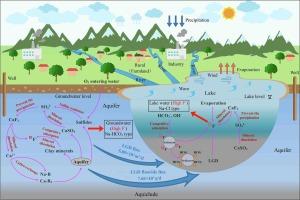
Excessive fluoride in lakes threatens lake ecosystem balance. However, the fluoride origin and enrichment associated with lacustrine groundwater discharge (LGD) in closed inland lakes are not fully understood. Based on multiple isotopes (δD, δ18Owater, δ34S, δ18Osulfate, 87Sr/86Sr and 222Rn), this study investigated the enrichment of fluoride and the impact of LGD on the migration of fluoride in a typical closed inland lake (Daihai Lake) in the semi-arid region of China. The results showed that 65.9 % of the water samples had pH values that exceeded the permissible range with alkalinity. In addition, groundwater (with an average TDS of 359 mg/L) and river water (with an average TDS of 364 mg/L) were freshwater. However, the lake water (with an average TDS of 16,474 mg/L) and pore water (with an average TDS of 17,287 mg/L) belonged to saline water. In this case, there were significant differences in fluoride concentrations in different water bodies: lake water > pore water > groundwater > river water. The fluoride in groundwater and river water primarily originated from fluorite dissolution, which was promoted by silicate weathering, gypsum dissolution, sulfide oxidation and cation exchange. In contrast, fluoride enrichment in the lake was promoted by evaporation, competitive adsorption and gypsum dissolution. Notably, the LGD process promoted the migration of fluoride from groundwater to lake water. In this case, the annual average fluxes of fluoride from groundwater into the lake was 7.66 × 10⁴ g/d, respectively, which posed significant threats to the lake ecosystem. This study can enhance the ability to identify the genesis of lake water quality degradation in semi-arid regions.
期刊介绍:
The Journal of Hydrology publishes original research papers and comprehensive reviews in all the subfields of the hydrological sciences including water based management and policy issues that impact on economics and society. These comprise, but are not limited to the physical, chemical, biogeochemical, stochastic and systems aspects of surface and groundwater hydrology, hydrometeorology and hydrogeology. Relevant topics incorporating the insights and methodologies of disciplines such as climatology, water resource systems, hydraulics, agrohydrology, geomorphology, soil science, instrumentation and remote sensing, civil and environmental engineering are included. Social science perspectives on hydrological problems such as resource and ecological economics, environmental sociology, psychology and behavioural science, management and policy analysis are also invited. Multi-and interdisciplinary analyses of hydrological problems are within scope. The science published in the Journal of Hydrology is relevant to catchment scales rather than exclusively to a local scale or site.



 京公网安备 11010802042870号
京ICP备2023020795号-1
京公网安备 11010802042870号
京ICP备2023020795号-1

 分享
分享
 求助内容:
求助内容: 应助结果提醒方式:
 扫码关注我们
