Dietary Triterpenoids in Functional Food and Drug Ingredients: A review of structure-activity relationships, biosynthesis, applications, and AI-driven strategies
Chao Fang , Haixia Yang , Daidi Fan , Jianjun Deng
{"title":"Dietary Triterpenoids in Functional Food and Drug Ingredients: A review of structure-activity relationships, biosynthesis, applications, and AI-driven strategies","authors":"Chao Fang , Haixia Yang , Daidi Fan , Jianjun Deng","doi":"10.1016/j.tifs.2025.104961","DOIUrl":null,"url":null,"abstract":"<div><h3>Background</h3><div>Terpenoids, a broad category of natural bioactive compounds from plants and their metabolites, are known for their diverse structures, high bioactive potential and embodying the concept of “Food as medicine”. As one of the typically representative subclasses within terpenoids, triterpenoids retain these advantages, but also feature characteristics with wide sources, great variety and low content. These do not diminish their significant potential and application prospects in functional food and drug ingredients. Triterpenoids are capable of exerting their high bioactive potential through a multitude of mechanisms, including but not limited to the regulation of inflammation, oxidative stress, immune imbalance, and metabolic disorders. Despite the promise of triterpenoids as functional food and drug ingredients, their low content and complex structures have, to some extent, limited the elucidation of their structure-activity relationships, limiting the progress of the research on triterpenoids.</div></div><div><h3>Scope</h3><div>In this review, the significance and feasibility of triterpenoids as functional food and drug ingredients are discussed based on their biosynthesis and bioactivity. The work explores the biosynthesis of dietary triterpenoids and their potential mechanisms against aging and obesity. Furthermore, strategies are proposed to address the challenges during the process using machine learning (ML) technology.</div></div><div><h3>Key findings and conclusions</h3><div>The elaborate structure-activity relationships of triterpenoids shape their substantial functions in anti-obesity and anti-aging. As functional food and drug ingredients, triterpenoids participate in multiple regulatory mechanisms, such as modulating the microbial flora, improving immunity, and regulating glycolipid metabolism, to exert a wide range of bioactivities. Moreover, they play crucial roles in food function optimization, preservation, and flavor regulation. Furthermore, artificial intelligence (AI) and ML techniques have provided innovative ideas and strategies for advanced research on triterpenoids by processing vast amounts of data and complex analyses to identify and predict structure-activity relationships.</div></div>","PeriodicalId":441,"journal":{"name":"Trends in Food Science & Technology","volume":"159 ","pages":"Article 104961"},"PeriodicalIF":15.4000,"publicationDate":"2025-03-06","publicationTypes":"Journal Article","fieldsOfStudy":null,"isOpenAccess":false,"openAccessPdf":"","citationCount":"0","resultStr":null,"platform":"Semanticscholar","paperid":null,"PeriodicalName":"Trends in Food Science & Technology","FirstCategoryId":"97","ListUrlMain":"https://www.sciencedirect.com/science/article/pii/S0924224425000974","RegionNum":1,"RegionCategory":"农林科学","ArticlePicture":[],"TitleCN":null,"AbstractTextCN":null,"PMCID":null,"EPubDate":"","PubModel":"","JCR":"Q1","JCRName":"FOOD SCIENCE & TECHNOLOGY","Score":null,"Total":0}
引用次数: 0
Abstract
Background
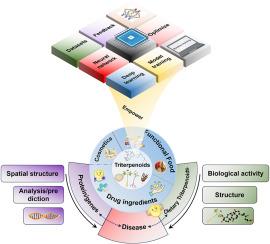
Terpenoids, a broad category of natural bioactive compounds from plants and their metabolites, are known for their diverse structures, high bioactive potential and embodying the concept of “Food as medicine”. As one of the typically representative subclasses within terpenoids, triterpenoids retain these advantages, but also feature characteristics with wide sources, great variety and low content. These do not diminish their significant potential and application prospects in functional food and drug ingredients. Triterpenoids are capable of exerting their high bioactive potential through a multitude of mechanisms, including but not limited to the regulation of inflammation, oxidative stress, immune imbalance, and metabolic disorders. Despite the promise of triterpenoids as functional food and drug ingredients, their low content and complex structures have, to some extent, limited the elucidation of their structure-activity relationships, limiting the progress of the research on triterpenoids.
Scope
In this review, the significance and feasibility of triterpenoids as functional food and drug ingredients are discussed based on their biosynthesis and bioactivity. The work explores the biosynthesis of dietary triterpenoids and their potential mechanisms against aging and obesity. Furthermore, strategies are proposed to address the challenges during the process using machine learning (ML) technology.
Key findings and conclusions
The elaborate structure-activity relationships of triterpenoids shape their substantial functions in anti-obesity and anti-aging. As functional food and drug ingredients, triterpenoids participate in multiple regulatory mechanisms, such as modulating the microbial flora, improving immunity, and regulating glycolipid metabolism, to exert a wide range of bioactivities. Moreover, they play crucial roles in food function optimization, preservation, and flavor regulation. Furthermore, artificial intelligence (AI) and ML techniques have provided innovative ideas and strategies for advanced research on triterpenoids by processing vast amounts of data and complex analyses to identify and predict structure-activity relationships.
期刊介绍:
Trends in Food Science & Technology is a prestigious international journal that specializes in peer-reviewed articles covering the latest advancements in technology, food science, and human nutrition. It serves as a bridge between specialized primary journals and general trade magazines, providing readable and scientifically rigorous reviews and commentaries on current research developments and their potential applications in the food industry.
Unlike traditional journals, Trends in Food Science & Technology does not publish original research papers. Instead, it focuses on critical and comprehensive reviews to offer valuable insights for professionals in the field. By bringing together cutting-edge research and industry applications, this journal plays a vital role in disseminating knowledge and facilitating advancements in the food science and technology sector.



 京公网安备 11010802042870号
京ICP备2023020795号-1
京公网安备 11010802042870号
京ICP备2023020795号-1

 分享
分享
 求助内容:
求助内容: 应助结果提醒方式:
 扫码关注我们
