Grapevine red blotch virus detection in the vineyard: Leveraging machine learning with VIS/NIR hyperspectral images for asymptomatic and symptomatic vines
E. Laroche-Pinel , K. Singh , M. Flasco , M.L. Cooper , M. Fuchs , L. Brillante
{"title":"Grapevine red blotch virus detection in the vineyard: Leveraging machine learning with VIS/NIR hyperspectral images for asymptomatic and symptomatic vines","authors":"E. Laroche-Pinel , K. Singh , M. Flasco , M.L. Cooper , M. Fuchs , L. Brillante","doi":"10.1016/j.compag.2025.110251","DOIUrl":null,"url":null,"abstract":"<div><div>A decade after the discovery of grapevine red blotch virus (GRBV), there is ample evidence of its detrimental impacts on grapevine physiology, grape composition, and wine production. To mitigate the spread of GRBV in vineyards, roguing is recommended as a disease management response. The imperative to identify and remove diseased vines justifies the development of autonomous scouting. In this study, nearly 700 ground-based hyperspectral images, encompassing both symptomatic and asymptomatic vine canopies, were collected in a Cabernet Franc vineyard during two growing seasons, capturing pre- and post-veraison vine development stages. Spanning 230 bands from visible (VIS) to near-infrared (NIR) domains (510 to 900 nm with 1.7 nm width), canopy spectral signals were isolated from the background through semantic segmentation using U-Net. Simultaneously, the GRBV status of each vine was established in the laboratory through polymerase chain reaction. These two intertwined datasets were used for training various machine learning algorithms and their ensembles. In addition, strategies to reduce dataset size through spectral binning and testing three different feature selection methods (Recursive Feature Elimination, Univariate Feature Selection, and taking into consideration autocorrelation) were explored. Our findings revealed that hyperspectral imagery identified GRBV-infected vines with an accuracy of 75.7 % around harvest, coinciding with the peak of disease symptom expression, utilizing only 19 bands with a 16 nm bin width. Prior to veraison when most vines are asymptomatic, an accuracy of 74.2 % was achieved, employing 5 bands with a 16 nm bin width. This study substantiates the utility of hyperspectral images in the identification of GRBV-infected vines, offering a robust foundation for the development of a streamlined sensing system that holds great promise for the grape and wine industry in effectively scouting vineyards for GRBV.</div></div>","PeriodicalId":50627,"journal":{"name":"Computers and Electronics in Agriculture","volume":"234 ","pages":"Article 110251"},"PeriodicalIF":8.9000,"publicationDate":"2025-07-01","publicationTypes":"Journal Article","fieldsOfStudy":null,"isOpenAccess":false,"openAccessPdf":"","citationCount":"0","resultStr":null,"platform":"Semanticscholar","paperid":null,"PeriodicalName":"Computers and Electronics in Agriculture","FirstCategoryId":"97","ListUrlMain":"https://www.sciencedirect.com/science/article/pii/S0168169925003576","RegionNum":1,"RegionCategory":"农林科学","ArticlePicture":[],"TitleCN":null,"AbstractTextCN":null,"PMCID":null,"EPubDate":"2025/3/10 0:00:00","PubModel":"Epub","JCR":"Q1","JCRName":"AGRICULTURE, MULTIDISCIPLINARY","Score":null,"Total":0}
引用次数: 0
Abstract
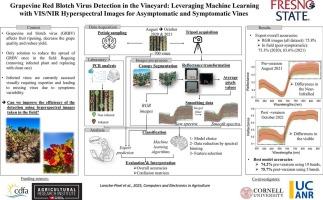
A decade after the discovery of grapevine red blotch virus (GRBV), there is ample evidence of its detrimental impacts on grapevine physiology, grape composition, and wine production. To mitigate the spread of GRBV in vineyards, roguing is recommended as a disease management response. The imperative to identify and remove diseased vines justifies the development of autonomous scouting. In this study, nearly 700 ground-based hyperspectral images, encompassing both symptomatic and asymptomatic vine canopies, were collected in a Cabernet Franc vineyard during two growing seasons, capturing pre- and post-veraison vine development stages. Spanning 230 bands from visible (VIS) to near-infrared (NIR) domains (510 to 900 nm with 1.7 nm width), canopy spectral signals were isolated from the background through semantic segmentation using U-Net. Simultaneously, the GRBV status of each vine was established in the laboratory through polymerase chain reaction. These two intertwined datasets were used for training various machine learning algorithms and their ensembles. In addition, strategies to reduce dataset size through spectral binning and testing three different feature selection methods (Recursive Feature Elimination, Univariate Feature Selection, and taking into consideration autocorrelation) were explored. Our findings revealed that hyperspectral imagery identified GRBV-infected vines with an accuracy of 75.7 % around harvest, coinciding with the peak of disease symptom expression, utilizing only 19 bands with a 16 nm bin width. Prior to veraison when most vines are asymptomatic, an accuracy of 74.2 % was achieved, employing 5 bands with a 16 nm bin width. This study substantiates the utility of hyperspectral images in the identification of GRBV-infected vines, offering a robust foundation for the development of a streamlined sensing system that holds great promise for the grape and wine industry in effectively scouting vineyards for GRBV.
期刊介绍:
Computers and Electronics in Agriculture provides international coverage of advancements in computer hardware, software, electronic instrumentation, and control systems applied to agricultural challenges. Encompassing agronomy, horticulture, forestry, aquaculture, and animal farming, the journal publishes original papers, reviews, and applications notes. It explores the use of computers and electronics in plant or animal agricultural production, covering topics like agricultural soils, water, pests, controlled environments, and waste. The scope extends to on-farm post-harvest operations and relevant technologies, including artificial intelligence, sensors, machine vision, robotics, networking, and simulation modeling. Its companion journal, Smart Agricultural Technology, continues the focus on smart applications in production agriculture.





 京公网安备 11010802042870号
京ICP备2023020795号-1
京公网安备 11010802042870号
京ICP备2023020795号-1

 分享
分享
 求助内容:
求助内容: 应助结果提醒方式:
 扫码关注我们
