Measurement of density, viscosity and vapor pressure of tetrakis(trimethylsiloxy)silane, 3-ethenyl-1,1,1,5,5,5-hexamethyl-3-[(trimethylsilyl)oxy]trisiloxane and (γ-chloropropyl)tri(trimethylsiloxy)silane
Xu Long, Tingyu Liu, Shuting Zhang, Hong Dong, Chuan Wu
{"title":"Measurement of density, viscosity and vapor pressure of tetrakis(trimethylsiloxy)silane, 3-ethenyl-1,1,1,5,5,5-hexamethyl-3-[(trimethylsilyl)oxy]trisiloxane and (γ-chloropropyl)tri(trimethylsiloxy)silane","authors":"Xu Long, Tingyu Liu, Shuting Zhang, Hong Dong, Chuan Wu","doi":"10.1016/j.fluid.2025.114367","DOIUrl":null,"url":null,"abstract":"<div><div>The saturation temperatures of tetrakis(trimethylsiloxy)silane (TTMS), 3-ethenyl-1,1,1,5,5,5-hexamethyl-3-[(trimethylsilyl)oxy]trisiloxane (VTMS) and (γ-chloropropyl)tri(trimethylsiloxy)silane (TClTMS) were measured over the pressure ranges (3.000 to 91.000) kPa. The density data and viscosity values of TTMS, VTMS, and TClTMS were obtained over the temperature ranges (298.15 to 328.15) K. The density values show a reasonable correlation that can be accurately described with a linear equation. The relationship between the viscosity of these compounds and temperature is strongly supported by the Ghatee, Litovitz, Andrade, and Vogel-Tammann-Fulcher equations, demonstrating their reliability and predictive power. The saturated vapor pressure values were estimated using the Clarke-Glew and Antoine equations. The critical properties of pressure, temperature, and volume were calculated using the group contribution method, specifically the Nannoolal model. The acentric factor (<em>ω</em>) at a reduced vapor pressure was calculated by these critical parameters. The calculated ESP map, HOMO and LUMO energy display the electron density and potential energy. The thermodynamic properties of TTMS, VTMS, and TClTMS are crucial values for designing and operating industrial separation processes.</div></div>","PeriodicalId":12170,"journal":{"name":"Fluid Phase Equilibria","volume":"595 ","pages":"Article 114367"},"PeriodicalIF":2.7000,"publicationDate":"2025-08-01","publicationTypes":"Journal Article","fieldsOfStudy":null,"isOpenAccess":false,"openAccessPdf":"","citationCount":"0","resultStr":null,"platform":"Semanticscholar","paperid":null,"PeriodicalName":"Fluid Phase Equilibria","FirstCategoryId":"5","ListUrlMain":"https://www.sciencedirect.com/science/article/pii/S0378381225000378","RegionNum":3,"RegionCategory":"工程技术","ArticlePicture":[],"TitleCN":null,"AbstractTextCN":null,"PMCID":null,"EPubDate":"2025/2/6 0:00:00","PubModel":"Epub","JCR":"Q3","JCRName":"CHEMISTRY, PHYSICAL","Score":null,"Total":0}
引用次数: 0
Abstract
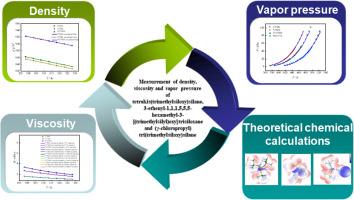
The saturation temperatures of tetrakis(trimethylsiloxy)silane (TTMS), 3-ethenyl-1,1,1,5,5,5-hexamethyl-3-[(trimethylsilyl)oxy]trisiloxane (VTMS) and (γ-chloropropyl)tri(trimethylsiloxy)silane (TClTMS) were measured over the pressure ranges (3.000 to 91.000) kPa. The density data and viscosity values of TTMS, VTMS, and TClTMS were obtained over the temperature ranges (298.15 to 328.15) K. The density values show a reasonable correlation that can be accurately described with a linear equation. The relationship between the viscosity of these compounds and temperature is strongly supported by the Ghatee, Litovitz, Andrade, and Vogel-Tammann-Fulcher equations, demonstrating their reliability and predictive power. The saturated vapor pressure values were estimated using the Clarke-Glew and Antoine equations. The critical properties of pressure, temperature, and volume were calculated using the group contribution method, specifically the Nannoolal model. The acentric factor (ω) at a reduced vapor pressure was calculated by these critical parameters. The calculated ESP map, HOMO and LUMO energy display the electron density and potential energy. The thermodynamic properties of TTMS, VTMS, and TClTMS are crucial values for designing and operating industrial separation processes.
期刊介绍:
Fluid Phase Equilibria publishes high-quality papers dealing with experimental, theoretical, and applied research related to equilibrium and transport properties of fluids, solids, and interfaces. Subjects of interest include physical/phase and chemical equilibria; equilibrium and nonequilibrium thermophysical properties; fundamental thermodynamic relations; and stability. The systems central to the journal include pure substances and mixtures of organic and inorganic materials, including polymers, biochemicals, and surfactants with sufficient characterization of composition and purity for the results to be reproduced. Alloys are of interest only when thermodynamic studies are included, purely material studies will not be considered. In all cases, authors are expected to provide physical or chemical interpretations of the results.
Experimental research can include measurements under all conditions of temperature, pressure, and composition, including critical and supercritical. Measurements are to be associated with systems and conditions of fundamental or applied interest, and may not be only a collection of routine data, such as physical property or solubility measurements at limited pressures and temperatures close to ambient, or surfactant studies focussed strictly on micellisation or micelle structure. Papers reporting common data must be accompanied by new physical insights and/or contemporary or new theory or techniques.



 京公网安备 11010802042870号
京ICP备2023020795号-1
京公网安备 11010802042870号
京ICP备2023020795号-1

 分享
分享
 求助内容:
求助内容: 应助结果提醒方式:
 扫码关注我们
