Šimon Jech , Neill Bartie , Gulsah Tas , Kati Miettunen , Rodrigo Serna-Guerrero , Annukka Santasalo-Aarnio
{"title":"“Beyond material recovery: Exergy and environmental analysis of silicon solar panel recycling”","authors":"Šimon Jech , Neill Bartie , Gulsah Tas , Kati Miettunen , Rodrigo Serna-Guerrero , Annukka Santasalo-Aarnio","doi":"10.1016/j.solmat.2025.113561","DOIUrl":null,"url":null,"abstract":"<div><div>The recycling of silicon solar panels is vital to ensure critical material recovery and to sustain the manufacturing of new panels in line with the United Nations Sustainable Development Goals. While various recycling methods based on thermal, chemical, or mechanical separation of the solar panel layers have been studied, a comprehensive thermodynamic and environmental analysis is required to allow holistic comparison within the circular economy framework. Here, such an analysis is performed for four different silicon solar panel recycling processes. First, the processes were simulated in HSC chemistry<sup>TM</sup> to analyse the flows of exergy. Subsequently, a Life Cycle Assessment (LCA) was conducted to understand the environmental benefits and drawbacks of each method. Combined Exergy-LCA analysis showed that a slightly less exergy-efficient process, namely pyrolysis can ultimately has the lowest environmental impact out of the four processes. In contrast chemical treatment of the encapsulant exhibited comparably worse performance due to its increased resource consumption. On the material level, high-value material recovery, if realized, could be thermodynamically and environmentally advantageous. The recovery methods presented here could be further improved if heat integration or the use of natural solvents would be considered. These unique findings demonstrate that weighing exergy - Life Cycle Analysis trade-offs across different recycling approaches could navigate future developments towards more sustainable solar panel recycling. Therefore, such an approach is recommended over solely focusing on material recovery.</div></div>","PeriodicalId":429,"journal":{"name":"Solar Energy Materials and Solar Cells","volume":"286 ","pages":"Article 113561"},"PeriodicalIF":6.3000,"publicationDate":"2025-07-01","publicationTypes":"Journal Article","fieldsOfStudy":null,"isOpenAccess":false,"openAccessPdf":"","citationCount":"0","resultStr":null,"platform":"Semanticscholar","paperid":null,"PeriodicalName":"Solar Energy Materials and Solar Cells","FirstCategoryId":"88","ListUrlMain":"https://www.sciencedirect.com/science/article/pii/S092702482500162X","RegionNum":2,"RegionCategory":"材料科学","ArticlePicture":[],"TitleCN":null,"AbstractTextCN":null,"PMCID":null,"EPubDate":"2025/3/10 0:00:00","PubModel":"Epub","JCR":"Q2","JCRName":"ENERGY & FUELS","Score":null,"Total":0}
引用次数: 0
Abstract
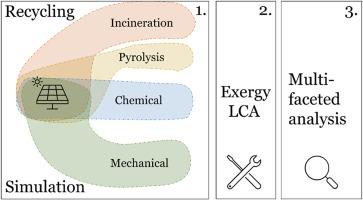
The recycling of silicon solar panels is vital to ensure critical material recovery and to sustain the manufacturing of new panels in line with the United Nations Sustainable Development Goals. While various recycling methods based on thermal, chemical, or mechanical separation of the solar panel layers have been studied, a comprehensive thermodynamic and environmental analysis is required to allow holistic comparison within the circular economy framework. Here, such an analysis is performed for four different silicon solar panel recycling processes. First, the processes were simulated in HSC chemistryTM to analyse the flows of exergy. Subsequently, a Life Cycle Assessment (LCA) was conducted to understand the environmental benefits and drawbacks of each method. Combined Exergy-LCA analysis showed that a slightly less exergy-efficient process, namely pyrolysis can ultimately has the lowest environmental impact out of the four processes. In contrast chemical treatment of the encapsulant exhibited comparably worse performance due to its increased resource consumption. On the material level, high-value material recovery, if realized, could be thermodynamically and environmentally advantageous. The recovery methods presented here could be further improved if heat integration or the use of natural solvents would be considered. These unique findings demonstrate that weighing exergy - Life Cycle Analysis trade-offs across different recycling approaches could navigate future developments towards more sustainable solar panel recycling. Therefore, such an approach is recommended over solely focusing on material recovery.
期刊介绍:
Solar Energy Materials & Solar Cells is intended as a vehicle for the dissemination of research results on materials science and technology related to photovoltaic, photothermal and photoelectrochemical solar energy conversion. Materials science is taken in the broadest possible sense and encompasses physics, chemistry, optics, materials fabrication and analysis for all types of materials.



 京公网安备 11010802042870号
京ICP备2023020795号-1
京公网安备 11010802042870号
京ICP备2023020795号-1

 分享
分享
 求助内容:
求助内容: 应助结果提醒方式:
 扫码关注我们
