{"title":"Rapid diagnosis of lung cancer by multi-modal spectral data combined with deep learning","authors":"Han Xu, Ruichan Lv","doi":"10.1016/j.saa.2025.125997","DOIUrl":null,"url":null,"abstract":"<div><div>Lung cancer is a malignant tumor that poses a serious threat to human health. Existing lung cancer diagnostic techniques face the challenges of high cost and slow diagnosis. Early and rapid diagnosis and treatment are essential to improve the outcome of lung cancer. In this study, a deep learning-based multi-modal spectral information fusion (MSIF) network is proposed for lung adenocarcinoma cell detection. First, multi-modal data of Fourier transform infrared spectra, UV–vis absorbance spectra, and fluorescence spectra of normal and patient cells were collected. Subsequently, the spectral text data were efficiently processed by one-dimensional convolutional neural network. The global and local features of the spectral images are deeply mined by the hybrid model of ResNet and Transformer. An adaptive depth-wise convolution (ADConv) is introduced to be applied to feature extraction, overcoming the shortcomings of conventional convolution. In order to achieve feature learning between multi-modalities, a cross-modal interaction fusion (CMIF) module is designed. This module fuses the extracted spectral image and text features in a multi-faceted interaction, enabling full utilization of multi-modal features through feature sharing. The method demonstrated excellent performance on the test sets of Fourier transform infrared spectra, UV–vis absorbance spectra and fluorescence spectra, achieving 95.83 %, 97.92 % and 100 % accuracy, respectively. In addition, experiments validate the superiority of multi-modal spectral data and the robustness of the model generalization capability. This study not only provides strong technical support for the early diagnosis of lung cancer, but also opens a new chapter for the application of multi-modal data fusion in spectroscopy.</div></div>","PeriodicalId":433,"journal":{"name":"Spectrochimica Acta Part A: Molecular and Biomolecular Spectroscopy","volume":"335 ","pages":"Article 125997"},"PeriodicalIF":4.6000,"publicationDate":"2025-07-05","publicationTypes":"Journal Article","fieldsOfStudy":null,"isOpenAccess":false,"openAccessPdf":"","citationCount":"0","resultStr":null,"platform":"Semanticscholar","paperid":null,"PeriodicalName":"Spectrochimica Acta Part A: Molecular and Biomolecular Spectroscopy","FirstCategoryId":"92","ListUrlMain":"https://www.sciencedirect.com/science/article/pii/S1386142525003038","RegionNum":2,"RegionCategory":"化学","ArticlePicture":[],"TitleCN":null,"AbstractTextCN":null,"PMCID":null,"EPubDate":"2025/3/6 0:00:00","PubModel":"Epub","JCR":"Q1","JCRName":"SPECTROSCOPY","Score":null,"Total":0}
引用次数: 0
Abstract
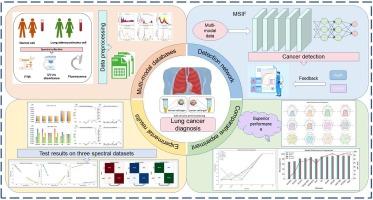
Lung cancer is a malignant tumor that poses a serious threat to human health. Existing lung cancer diagnostic techniques face the challenges of high cost and slow diagnosis. Early and rapid diagnosis and treatment are essential to improve the outcome of lung cancer. In this study, a deep learning-based multi-modal spectral information fusion (MSIF) network is proposed for lung adenocarcinoma cell detection. First, multi-modal data of Fourier transform infrared spectra, UV–vis absorbance spectra, and fluorescence spectra of normal and patient cells were collected. Subsequently, the spectral text data were efficiently processed by one-dimensional convolutional neural network. The global and local features of the spectral images are deeply mined by the hybrid model of ResNet and Transformer. An adaptive depth-wise convolution (ADConv) is introduced to be applied to feature extraction, overcoming the shortcomings of conventional convolution. In order to achieve feature learning between multi-modalities, a cross-modal interaction fusion (CMIF) module is designed. This module fuses the extracted spectral image and text features in a multi-faceted interaction, enabling full utilization of multi-modal features through feature sharing. The method demonstrated excellent performance on the test sets of Fourier transform infrared spectra, UV–vis absorbance spectra and fluorescence spectra, achieving 95.83 %, 97.92 % and 100 % accuracy, respectively. In addition, experiments validate the superiority of multi-modal spectral data and the robustness of the model generalization capability. This study not only provides strong technical support for the early diagnosis of lung cancer, but also opens a new chapter for the application of multi-modal data fusion in spectroscopy.
期刊介绍:
Spectrochimica Acta, Part A: Molecular and Biomolecular Spectroscopy (SAA) is an interdisciplinary journal which spans from basic to applied aspects of optical spectroscopy in chemistry, medicine, biology, and materials science.
The journal publishes original scientific papers that feature high-quality spectroscopic data and analysis. From the broad range of optical spectroscopies, the emphasis is on electronic, vibrational or rotational spectra of molecules, rather than on spectroscopy based on magnetic moments.
Criteria for publication in SAA are novelty, uniqueness, and outstanding quality. Routine applications of spectroscopic techniques and computational methods are not appropriate.
Topics of particular interest of Spectrochimica Acta Part A include, but are not limited to:
Spectroscopy and dynamics of bioanalytical, biomedical, environmental, and atmospheric sciences,
Novel experimental techniques or instrumentation for molecular spectroscopy,
Novel theoretical and computational methods,
Novel applications in photochemistry and photobiology,
Novel interpretational approaches as well as advances in data analysis based on electronic or vibrational spectroscopy.



 京公网安备 11010802042870号
京ICP备2023020795号-1
京公网安备 11010802042870号
京ICP备2023020795号-1

 分享
分享
 求助内容:
求助内容: 应助结果提醒方式:
 扫码关注我们
