Spectrofluorimetric determination of bupropion using N,S co-doped carbon quantum dots: Mechanistic investigation, response surface optimization, and application to pharmaceutical formulations, spiked plasma and environmental samples
Farooq M. Almutairi , Yusuf S. Althobaiti , Maram H. Abduljabbar , Rami M. Alzhrani , Reem M. Alnemari , Muneef M. Aldhafeeri , Ahmed Serag , Atiah H. Almalki
{"title":"Spectrofluorimetric determination of bupropion using N,S co-doped carbon quantum dots: Mechanistic investigation, response surface optimization, and application to pharmaceutical formulations, spiked plasma and environmental samples","authors":"Farooq M. Almutairi , Yusuf S. Althobaiti , Maram H. Abduljabbar , Rami M. Alzhrani , Reem M. Alnemari , Muneef M. Aldhafeeri , Ahmed Serag , Atiah H. Almalki","doi":"10.1016/j.saa.2025.126000","DOIUrl":null,"url":null,"abstract":"<div><div>In this study, a novel analytical method was developed for the determination of bupropion in pharmaceutical formulations and spiked plasma samples using N, S co-doped carbon quantum dots (N,S CQDs) as a fluorescent probe. The N,S CQDs were thoroughly characterized and its optical properties were investigated. The developed N,S CQDs exhibited blue emission at 435 nm upon excitation at 357 nm. Detailed studies on the sensing mechanism revealed that the fluorescence quenching of the N,S CQDs by bupropion follows a static quenching mechanism, as confirmed by Stern-Volmer analysis and thermodynamic parameters. The quenching parameters were further optimized using a central composite experimental design, and the method was validated according to ICH guidelines. The method displayed excellent linearity in the range of 0.05–1.5 μg/mL, with a limit of detection of 0.016 μg/mL. The developed method was successfully applied for the analysis of bupropion in pharmaceutical formulations and spiked human plasma samples, with satisfactory recoveries. Moreover, statistical analysis revealed no significant differences between the results obtained using the proposed method and a reference HPLC method, indicating the reliability of the developed approach. Greenness and blueness of the method was evaluated using the AGREE and BAGI tools respectively, demonstrating the environmentally friendly and analytical practicality of the proposed technique.</div></div>","PeriodicalId":433,"journal":{"name":"Spectrochimica Acta Part A: Molecular and Biomolecular Spectroscopy","volume":"335 ","pages":"Article 126000"},"PeriodicalIF":4.6000,"publicationDate":"2025-07-05","publicationTypes":"Journal Article","fieldsOfStudy":null,"isOpenAccess":false,"openAccessPdf":"","citationCount":"0","resultStr":null,"platform":"Semanticscholar","paperid":null,"PeriodicalName":"Spectrochimica Acta Part A: Molecular and Biomolecular Spectroscopy","FirstCategoryId":"92","ListUrlMain":"https://www.sciencedirect.com/science/article/pii/S1386142525003063","RegionNum":2,"RegionCategory":"化学","ArticlePicture":[],"TitleCN":null,"AbstractTextCN":null,"PMCID":null,"EPubDate":"2025/3/6 0:00:00","PubModel":"Epub","JCR":"Q1","JCRName":"SPECTROSCOPY","Score":null,"Total":0}
引用次数: 0
Abstract
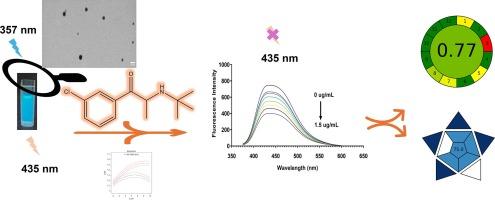
In this study, a novel analytical method was developed for the determination of bupropion in pharmaceutical formulations and spiked plasma samples using N, S co-doped carbon quantum dots (N,S CQDs) as a fluorescent probe. The N,S CQDs were thoroughly characterized and its optical properties were investigated. The developed N,S CQDs exhibited blue emission at 435 nm upon excitation at 357 nm. Detailed studies on the sensing mechanism revealed that the fluorescence quenching of the N,S CQDs by bupropion follows a static quenching mechanism, as confirmed by Stern-Volmer analysis and thermodynamic parameters. The quenching parameters were further optimized using a central composite experimental design, and the method was validated according to ICH guidelines. The method displayed excellent linearity in the range of 0.05–1.5 μg/mL, with a limit of detection of 0.016 μg/mL. The developed method was successfully applied for the analysis of bupropion in pharmaceutical formulations and spiked human plasma samples, with satisfactory recoveries. Moreover, statistical analysis revealed no significant differences between the results obtained using the proposed method and a reference HPLC method, indicating the reliability of the developed approach. Greenness and blueness of the method was evaluated using the AGREE and BAGI tools respectively, demonstrating the environmentally friendly and analytical practicality of the proposed technique.
期刊介绍:
Spectrochimica Acta, Part A: Molecular and Biomolecular Spectroscopy (SAA) is an interdisciplinary journal which spans from basic to applied aspects of optical spectroscopy in chemistry, medicine, biology, and materials science.
The journal publishes original scientific papers that feature high-quality spectroscopic data and analysis. From the broad range of optical spectroscopies, the emphasis is on electronic, vibrational or rotational spectra of molecules, rather than on spectroscopy based on magnetic moments.
Criteria for publication in SAA are novelty, uniqueness, and outstanding quality. Routine applications of spectroscopic techniques and computational methods are not appropriate.
Topics of particular interest of Spectrochimica Acta Part A include, but are not limited to:
Spectroscopy and dynamics of bioanalytical, biomedical, environmental, and atmospheric sciences,
Novel experimental techniques or instrumentation for molecular spectroscopy,
Novel theoretical and computational methods,
Novel applications in photochemistry and photobiology,
Novel interpretational approaches as well as advances in data analysis based on electronic or vibrational spectroscopy.




 京公网安备 11010802042870号
京ICP备2023020795号-1
京公网安备 11010802042870号
京ICP备2023020795号-1

 分享
分享
 求助内容:
求助内容: 应助结果提醒方式:
 扫码关注我们
