Unique isophorone-based NIR fluorescent probe with a high fluorescence quantum yield and larger stokes shift for Al3+ and Zn2+ level simultaneous monitoring in biological system
Ya-Tong Liu , Qian-Qian Zhang , Si-Yi Yao , Zhi-Bo Jiang , Hao Wang , Yue-Li Zou , Li-Xia Zhao
{"title":"Unique isophorone-based NIR fluorescent probe with a high fluorescence quantum yield and larger stokes shift for Al3+ and Zn2+ level simultaneous monitoring in biological system","authors":"Ya-Tong Liu , Qian-Qian Zhang , Si-Yi Yao , Zhi-Bo Jiang , Hao Wang , Yue-Li Zou , Li-Xia Zhao","doi":"10.1016/j.saa.2025.126001","DOIUrl":null,"url":null,"abstract":"<div><div>Given the profound implications of Al<sup>3+</sup> and Zn<sup>2+</sup> in the ecosystem and organism, there is a compelling demand for a robust method to simultaneously detect these ions. The novel near-infrared (NIR) fluorescent probe <strong>DDLH</strong> based on isophorone, offers efficient in vivo monitoring capabilities for Al<sup>3+</sup>/Zn<sup>2+</sup>. Simultaneously, <strong>DDLH</strong> displayed excellent selectivity, anti-interference, a low detection limit and rapidity responsiveness to Al<sup>3+</sup>/Zn<sup>2+</sup>, coupled with a high fluorescence quantum yield and substantial Stokes shift (220 nm). The binding mechanisms of <strong>DDLH</strong> to Al<sup>3+</sup> (ESIPT effect)/Zn<sup>2+</sup> (ICT effect) were unambiguously established through a series of comprehensive analytical techniques. Furthermore, the probe <strong>DDLH</strong> was also applied for bioimaging in Hela cells. Critically, <strong>DDLH</strong> exhibited remarkable performance in detecting Al<sup>3+</sup> and Zn<sup>2+</sup> in zebrafish. Therefore, the study demonstrated enormous potential in environmental monitoring and ecosystems, showing broad application prospects in living organisms.</div></div>","PeriodicalId":433,"journal":{"name":"Spectrochimica Acta Part A: Molecular and Biomolecular Spectroscopy","volume":"335 ","pages":"Article 126001"},"PeriodicalIF":4.6000,"publicationDate":"2025-03-05","publicationTypes":"Journal Article","fieldsOfStudy":null,"isOpenAccess":false,"openAccessPdf":"","citationCount":"0","resultStr":null,"platform":"Semanticscholar","paperid":null,"PeriodicalName":"Spectrochimica Acta Part A: Molecular and Biomolecular Spectroscopy","FirstCategoryId":"92","ListUrlMain":"https://www.sciencedirect.com/science/article/pii/S1386142525003075","RegionNum":2,"RegionCategory":"化学","ArticlePicture":[],"TitleCN":null,"AbstractTextCN":null,"PMCID":null,"EPubDate":"","PubModel":"","JCR":"Q1","JCRName":"SPECTROSCOPY","Score":null,"Total":0}
引用次数: 0
Abstract
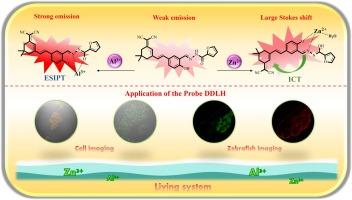
Given the profound implications of Al3+ and Zn2+ in the ecosystem and organism, there is a compelling demand for a robust method to simultaneously detect these ions. The novel near-infrared (NIR) fluorescent probe DDLH based on isophorone, offers efficient in vivo monitoring capabilities for Al3+/Zn2+. Simultaneously, DDLH displayed excellent selectivity, anti-interference, a low detection limit and rapidity responsiveness to Al3+/Zn2+, coupled with a high fluorescence quantum yield and substantial Stokes shift (220 nm). The binding mechanisms of DDLH to Al3+ (ESIPT effect)/Zn2+ (ICT effect) were unambiguously established through a series of comprehensive analytical techniques. Furthermore, the probe DDLH was also applied for bioimaging in Hela cells. Critically, DDLH exhibited remarkable performance in detecting Al3+ and Zn2+ in zebrafish. Therefore, the study demonstrated enormous potential in environmental monitoring and ecosystems, showing broad application prospects in living organisms.
期刊介绍:
Spectrochimica Acta, Part A: Molecular and Biomolecular Spectroscopy (SAA) is an interdisciplinary journal which spans from basic to applied aspects of optical spectroscopy in chemistry, medicine, biology, and materials science.
The journal publishes original scientific papers that feature high-quality spectroscopic data and analysis. From the broad range of optical spectroscopies, the emphasis is on electronic, vibrational or rotational spectra of molecules, rather than on spectroscopy based on magnetic moments.
Criteria for publication in SAA are novelty, uniqueness, and outstanding quality. Routine applications of spectroscopic techniques and computational methods are not appropriate.
Topics of particular interest of Spectrochimica Acta Part A include, but are not limited to:
Spectroscopy and dynamics of bioanalytical, biomedical, environmental, and atmospheric sciences,
Novel experimental techniques or instrumentation for molecular spectroscopy,
Novel theoretical and computational methods,
Novel applications in photochemistry and photobiology,
Novel interpretational approaches as well as advances in data analysis based on electronic or vibrational spectroscopy.



 京公网安备 11010802042870号
京ICP备2023020795号-1
京公网安备 11010802042870号
京ICP备2023020795号-1

 分享
分享
 求助内容:
求助内容: 应助结果提醒方式:
 扫码关注我们
