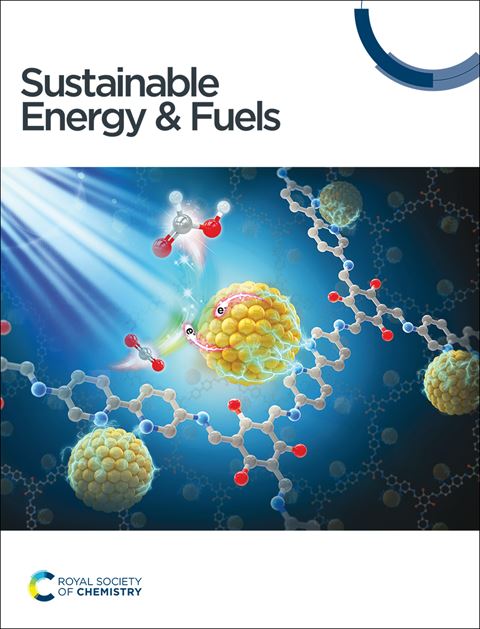
Improving the electrocatalytic activity of Pd nanoparticles through electronic coupling interaction with a Ni2P–MoS2 hybrid support for ethanol electro-oxidation in an alkaline medium†
Thabo Matthews, Makhaokane Paulina Chabalala, Siyabonga Patrick Mbokazi, Memory Zikhali, Tarekegn Heliso Dolla, Anatolijs Šarakovskis, Guntars Vaivars, Tunde Lewis Yusuf, Rhiyaad Mohamed and Nobanathi Wendy Maxakato
{"title":"Improving the electrocatalytic activity of Pd nanoparticles through electronic coupling interaction with a Ni2P–MoS2 hybrid support for ethanol electro-oxidation in an alkaline medium†","authors":"Thabo Matthews, Makhaokane Paulina Chabalala, Siyabonga Patrick Mbokazi, Memory Zikhali, Tarekegn Heliso Dolla, Anatolijs Šarakovskis, Guntars Vaivars, Tunde Lewis Yusuf, Rhiyaad Mohamed and Nobanathi Wendy Maxakato","doi":"10.1039/D4SE01223B","DOIUrl":null,"url":null,"abstract":"<p >To improve the performance of direct ethanol fuel cells (DEFCs), which are hindered by traditional catalysts, having matters pertaining to stability, activity, and selectivity in reaction environments, various electrocatalysts such as Pd/Ni<small><sub>2</sub></small>P, Pd/MoS<small><sub>2</sub></small>, and Pd/Ni<small><sub>2</sub></small>P–MoS<small><sub>2</sub></small> were synthesized using the microwave-assisted NaBH<small><sub>4</sub></small>–ethylene glycol reduction method. The research findings suggest that the Pd/Ni<small><sub>2</sub></small>P–MoS<small><sub>2</sub></small> catalyst we developed had the highest activity (1579 mA mg<small><sub>Pd</sub></small><small><sup>−1</sup></small>), approximately 21 times greater than that of commercial Pd/C. The stability of the electrocatalysts were examined using chronoamperometry (CA) and cyclic voltammetry (CV) measurements, which indicated that the Pd/Ni<small><sub>2</sub></small>P–MoS<small><sub>2</sub></small> electrocatalyst had good stability towards the ethanol oxidation reaction (EOR) in alkaline electrolyte. Electrochemical impedance spectroscopy (EIS) analysis showed that the Pd/Ni<small><sub>2</sub></small>P–MoS<small><sub>2</sub></small> electrocatalyst had lower charge transfer resistance, indicating better electrochemical kinetics. According to XRD, HR-TEM, XPS, and electrochemical analysis, the enhanced electrocatalytic activity, long-term stability of the Pd/Ni<small><sub>2</sub></small>P–MoS<small><sub>2</sub></small> electrocatalyst were attributable to the interface synergism as well as electronic and strain effects between the Pd, Ni<small><sub>2</sub></small>P, and MoS<small><sub>2</sub></small> interactions. This resulted in a downshift in the d-band center of the Pd/Ni<small><sub>2</sub></small>P–MoS<small><sub>2</sub></small> electrocatalyst, weakening intermediate adsorption and the adsorbate metal interaction.</p>","PeriodicalId":104,"journal":{"name":"Sustainable Energy & Fuels","volume":" 6","pages":" 1552-1564"},"PeriodicalIF":4.1000,"publicationDate":"2025-02-13","publicationTypes":"Journal Article","fieldsOfStudy":null,"isOpenAccess":false,"openAccessPdf":"https://pubs.rsc.org/en/content/articlepdf/2025/se/d4se01223b?page=search","citationCount":"0","resultStr":null,"platform":"Semanticscholar","paperid":null,"PeriodicalName":"Sustainable Energy & Fuels","FirstCategoryId":"88","ListUrlMain":"https://pubs.rsc.org/en/content/articlelanding/2025/se/d4se01223b","RegionNum":3,"RegionCategory":"材料科学","ArticlePicture":[],"TitleCN":null,"AbstractTextCN":null,"PMCID":null,"EPubDate":"","PubModel":"","JCR":"Q2","JCRName":"CHEMISTRY, PHYSICAL","Score":null,"Total":0}
引用次数: 0
Abstract
To improve the performance of direct ethanol fuel cells (DEFCs), which are hindered by traditional catalysts, having matters pertaining to stability, activity, and selectivity in reaction environments, various electrocatalysts such as Pd/Ni2P, Pd/MoS2, and Pd/Ni2P–MoS2 were synthesized using the microwave-assisted NaBH4–ethylene glycol reduction method. The research findings suggest that the Pd/Ni2P–MoS2 catalyst we developed had the highest activity (1579 mA mgPd−1), approximately 21 times greater than that of commercial Pd/C. The stability of the electrocatalysts were examined using chronoamperometry (CA) and cyclic voltammetry (CV) measurements, which indicated that the Pd/Ni2P–MoS2 electrocatalyst had good stability towards the ethanol oxidation reaction (EOR) in alkaline electrolyte. Electrochemical impedance spectroscopy (EIS) analysis showed that the Pd/Ni2P–MoS2 electrocatalyst had lower charge transfer resistance, indicating better electrochemical kinetics. According to XRD, HR-TEM, XPS, and electrochemical analysis, the enhanced electrocatalytic activity, long-term stability of the Pd/Ni2P–MoS2 electrocatalyst were attributable to the interface synergism as well as electronic and strain effects between the Pd, Ni2P, and MoS2 interactions. This resulted in a downshift in the d-band center of the Pd/Ni2P–MoS2 electrocatalyst, weakening intermediate adsorption and the adsorbate metal interaction.
期刊介绍:
Sustainable Energy & Fuels will publish research that contributes to the development of sustainable energy technologies with a particular emphasis on new and next-generation technologies.




 京公网安备 11010802042870号
京ICP备2023020795号-1
京公网安备 11010802042870号
京ICP备2023020795号-1

 分享
分享
 求助内容:
求助内容: 应助结果提醒方式:
 扫码关注我们
