Liang Zhang, Jiahao Qian, Xinyuan Zhang, Yanwei Lv, Jiulong Zhao, Prof. Shige Wang, Prof. Hao Xu
{"title":"Dual-Responsive PPy-AIPH@LA Nanoplatform for Synergistic Photothermal and Thermodynamic Therapy of Colorectal Cancer","authors":"Liang Zhang, Jiahao Qian, Xinyuan Zhang, Yanwei Lv, Jiulong Zhao, Prof. Shige Wang, Prof. Hao Xu","doi":"10.1002/slct.202500263","DOIUrl":null,"url":null,"abstract":"<p>In this study, we introduce a novel nanoplatform, polypyrrole (PPy)-2,2′-Azobis[2-(2-imidazolin-2-yl)propane] dihydrochloride (AIPH)@lauric acid (LA) (PPy-AIPH@LA) nanoparticles (NPs), designed to overcome these limitations through synergistic photothermal therapy (PTT) and photodynamic therapy (PDT). This dual-responsive system incorporates PPy for efficient photothermal conversion, AIPH for thermos-responsive and oxygen-independent free radical generation, and LA as a thermally responsive encapsulation layer. The LA coating melts upon 808 nm near-infrared laser irradiation, releasing AIPH and free radicals to enable precise spatiotemporal activation of therapeutic effects. PPy-AIPH@LA demonstrates exceptional photothermal conversion efficiency (55.74%) and generates sufficient radicals to enhance PDT efficacy, even in hypoxic tumor microenvironments. In vitro studies revealed concentration-dependent tumor cell ablation and inhibition of migration, while in vivo experiments showed that the combined PTT-PDT treatment achieved an impressive 90.7% tumor growth inhibition rate in a mouse colon cancer cells CT-26 murine model, with no significant systemic toxicity. Molecular analyses further revealed modulations in pathways associated with tumor metabolism, apoptosis, and immune escape, highlighting the comprehensive therapeutic potential of this nanoplatform. These findings underscore the potential of PPy-AIPH@LA as a safe, effective, and minimally invasive nanotherapeutic platform for combating CRC and other solid tumors.</p>","PeriodicalId":146,"journal":{"name":"ChemistrySelect","volume":"10 10","pages":""},"PeriodicalIF":2.0000,"publicationDate":"2025-03-11","publicationTypes":"Journal Article","fieldsOfStudy":null,"isOpenAccess":false,"openAccessPdf":"","citationCount":"0","resultStr":null,"platform":"Semanticscholar","paperid":null,"PeriodicalName":"ChemistrySelect","FirstCategoryId":"92","ListUrlMain":"https://chemistry-europe.onlinelibrary.wiley.com/doi/10.1002/slct.202500263","RegionNum":4,"RegionCategory":"化学","ArticlePicture":[],"TitleCN":null,"AbstractTextCN":null,"PMCID":null,"EPubDate":"","PubModel":"","JCR":"Q3","JCRName":"CHEMISTRY, MULTIDISCIPLINARY","Score":null,"Total":0}
引用次数: 0
Abstract
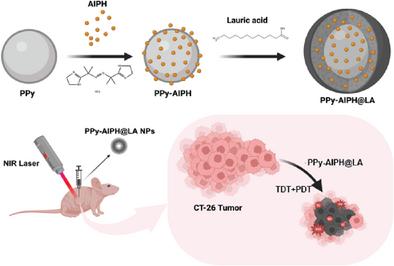
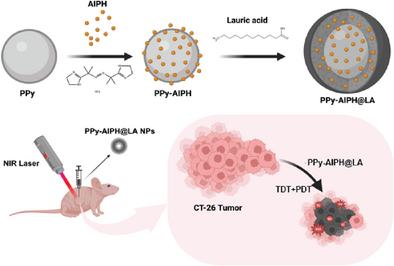
In this study, we introduce a novel nanoplatform, polypyrrole (PPy)-2,2′-Azobis[2-(2-imidazolin-2-yl)propane] dihydrochloride (AIPH)@lauric acid (LA) (PPy-AIPH@LA) nanoparticles (NPs), designed to overcome these limitations through synergistic photothermal therapy (PTT) and photodynamic therapy (PDT). This dual-responsive system incorporates PPy for efficient photothermal conversion, AIPH for thermos-responsive and oxygen-independent free radical generation, and LA as a thermally responsive encapsulation layer. The LA coating melts upon 808 nm near-infrared laser irradiation, releasing AIPH and free radicals to enable precise spatiotemporal activation of therapeutic effects. PPy-AIPH@LA demonstrates exceptional photothermal conversion efficiency (55.74%) and generates sufficient radicals to enhance PDT efficacy, even in hypoxic tumor microenvironments. In vitro studies revealed concentration-dependent tumor cell ablation and inhibition of migration, while in vivo experiments showed that the combined PTT-PDT treatment achieved an impressive 90.7% tumor growth inhibition rate in a mouse colon cancer cells CT-26 murine model, with no significant systemic toxicity. Molecular analyses further revealed modulations in pathways associated with tumor metabolism, apoptosis, and immune escape, highlighting the comprehensive therapeutic potential of this nanoplatform. These findings underscore the potential of PPy-AIPH@LA as a safe, effective, and minimally invasive nanotherapeutic platform for combating CRC and other solid tumors.
期刊介绍:
ChemistrySelect is the latest journal from ChemPubSoc Europe and Wiley-VCH. It offers researchers a quality society-owned journal in which to publish their work in all areas of chemistry. Manuscripts are evaluated by active researchers to ensure they add meaningfully to the scientific literature, and those accepted are processed quickly to ensure rapid online publication.





 京公网安备 11010802042870号
京ICP备2023020795号-1
京公网安备 11010802042870号
京ICP备2023020795号-1

 分享
分享
 求助内容:
求助内容: 应助结果提醒方式:
 扫码关注我们
