{"title":"Unveiling Correlations in Metal-Organic Interface Properties: A Computational Exploration of Alternant and Non-Alternant π-Electron Systems","authors":"Jakob Schramm, Prof. Dr. Ralf Tonner-Zech","doi":"10.1002/cplu.202400771","DOIUrl":null,"url":null,"abstract":"<p>Metal-organic interfaces are critical in organic electronic devices, influencing key performance properties. Understanding these relationships is essential for improving such devices. Polycyclic conjugated hydrocarbons (PCHs) with alternant and non-alternant topologies are promising candidates for exploring these interfaces since they show physisorption and chemisorption, respectively. Using density functional theory with periodic boundary conditions, we modeled the interfaces between a Cu(111) surface and 22 PCHs (11 alternant and 11 non-alternant). We identified quantitative correlations among interface properties, showing that these properties form a “fixed set” of properties for individual molecules. A clear distinction emerges between physisorption and chemisorption for most properties, except for work function changes, which are consistently governed by the Pauli pushback effect resulting from dispersion pull. Interestingly, molecules with larger π-electron systems exhibit stronger dispersion attraction yet higher adsorption heights. This study provides chemically intuitive explanations for these findings and highlights the interconnected nature of interface properties. The insights gained offer valuable guidance for understanding and optimizing Cu(111)-organic interfaces, contributing to advancements in organic electronics.</p>","PeriodicalId":148,"journal":{"name":"ChemPlusChem","volume":"90 6","pages":""},"PeriodicalIF":2.8000,"publicationDate":"2025-03-10","publicationTypes":"Journal Article","fieldsOfStudy":null,"isOpenAccess":false,"openAccessPdf":"https://onlinelibrary.wiley.com/doi/epdf/10.1002/cplu.202400771","citationCount":"0","resultStr":null,"platform":"Semanticscholar","paperid":null,"PeriodicalName":"ChemPlusChem","FirstCategoryId":"92","ListUrlMain":"https://chemistry-europe.onlinelibrary.wiley.com/doi/10.1002/cplu.202400771","RegionNum":4,"RegionCategory":"化学","ArticlePicture":[],"TitleCN":null,"AbstractTextCN":null,"PMCID":null,"EPubDate":"","PubModel":"","JCR":"Q2","JCRName":"CHEMISTRY, MULTIDISCIPLINARY","Score":null,"Total":0}
引用次数: 0
Abstract
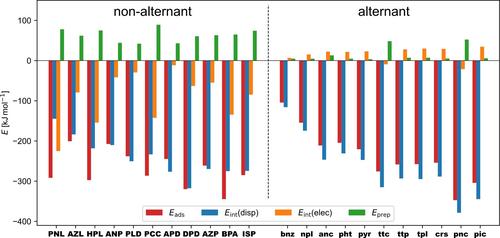
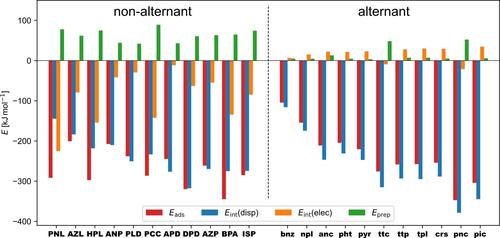
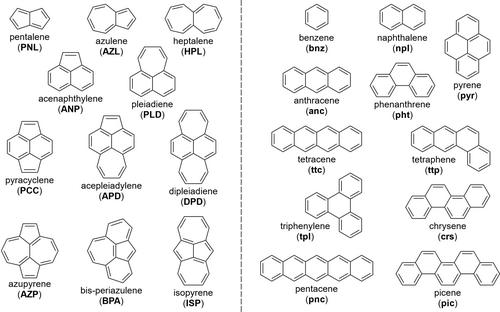
Metal-organic interfaces are critical in organic electronic devices, influencing key performance properties. Understanding these relationships is essential for improving such devices. Polycyclic conjugated hydrocarbons (PCHs) with alternant and non-alternant topologies are promising candidates for exploring these interfaces since they show physisorption and chemisorption, respectively. Using density functional theory with periodic boundary conditions, we modeled the interfaces between a Cu(111) surface and 22 PCHs (11 alternant and 11 non-alternant). We identified quantitative correlations among interface properties, showing that these properties form a “fixed set” of properties for individual molecules. A clear distinction emerges between physisorption and chemisorption for most properties, except for work function changes, which are consistently governed by the Pauli pushback effect resulting from dispersion pull. Interestingly, molecules with larger π-electron systems exhibit stronger dispersion attraction yet higher adsorption heights. This study provides chemically intuitive explanations for these findings and highlights the interconnected nature of interface properties. The insights gained offer valuable guidance for understanding and optimizing Cu(111)-organic interfaces, contributing to advancements in organic electronics.
期刊介绍:
ChemPlusChem is a peer-reviewed, general chemistry journal that brings readers the very best in multidisciplinary research centering on chemistry. It is published on behalf of Chemistry Europe, an association of 16 European chemical societies.
Fully comprehensive in its scope, ChemPlusChem publishes articles covering new results from at least two different aspects (subfields) of chemistry or one of chemistry and one of another scientific discipline (one chemistry topic plus another one, hence the title ChemPlusChem). All suitable submissions undergo balanced peer review by experts in the field to ensure the highest quality, originality, relevance, significance, and validity.




 京公网安备 11010802042870号
京ICP备2023020795号-1
京公网安备 11010802042870号
京ICP备2023020795号-1

 分享
分享
 求助内容:
求助内容: 应助结果提醒方式:
 扫码关注我们
